Verification
AI output keeps growing while the people who verify it don't: 700-plus math papers and a 50-agent civilization experiment

Spend 1% of your day keeping up with tech.
Quote of the Day#
“Perhaps engineers will begin to treat any new software project with suspicion.” — Kyle Kingsbury, author of Jepsen (Source)
“Everything has been claimed to be proved. I expected to see a few of them in the list. But not all of them. Not all at once.” — Hugo Duminil-Copin, mathematician (quoted in Frank Calegari’s post, Source)
Today’s Theme#
In his Jepsen report on ParticleDB, Kyle Kingsbury writes that LLMs make it harder to judge whether a project is reliable from its documentation and the look of maturity. The same day, a Databricks engineer went through the Scion numbers Anthropic published line by line and found several pre-migration figures unusually high. In the Minecraft experiment Tom’s Hardware reported on, 50 GPT-6.1 Sol agents failed to build a civilization in three hours, and four of them spent 11 minutes assigning a “fertilizer operator” to a single piece of bone meal. Mathematics is facing the same kind of problem: Frank Calegari says the 700-plus papers OpenAI released on October 6 are poorly written and some are wrong, and his advice is to put effort into what the math community itself can control. Output speed is no longer the bottleneck. Reading this material every day, the thing I spend the most time on is confirming the original really says what it is said to say.
Must Read#
- Introducing Kwi, a new KDE terminal emulator — Lobste.rs
Product - Show HN: HackerBooks – HackerTube, but for books mentioned on HN — Hacker News
Tools - An outsider’s perspective on Scion and Mononoke — Lobste.rs
Dev - Police chief unplugs cameras after Flock ignores contract cancellation — Hacker News
News - Quoting Kyle Kingsbury — Simon Willison
AI - How a 19-year-old intern built the growth engine behind this $2B AI company — Lenny’s Newsletter
Startup - andyhuo520/digital-human-koubo — GitHub
AI - AI agent swarms in Minecraft fail to build civilization, drown in bureaucracy — Hacker News
AI - OpenAI might rebrand its data centers as ‘AI compute campuses’ — TechCrunch
AI - The AI cost of JavaScript frameworks — Hacker News
Dev - Binance resumes withdrawals following $6.3 billion breach — TechCrunch
News - Mathematics has changed. Let’s act like it — Hacker News
AI
1. Introducing Kwi, a new KDE terminal emulator#
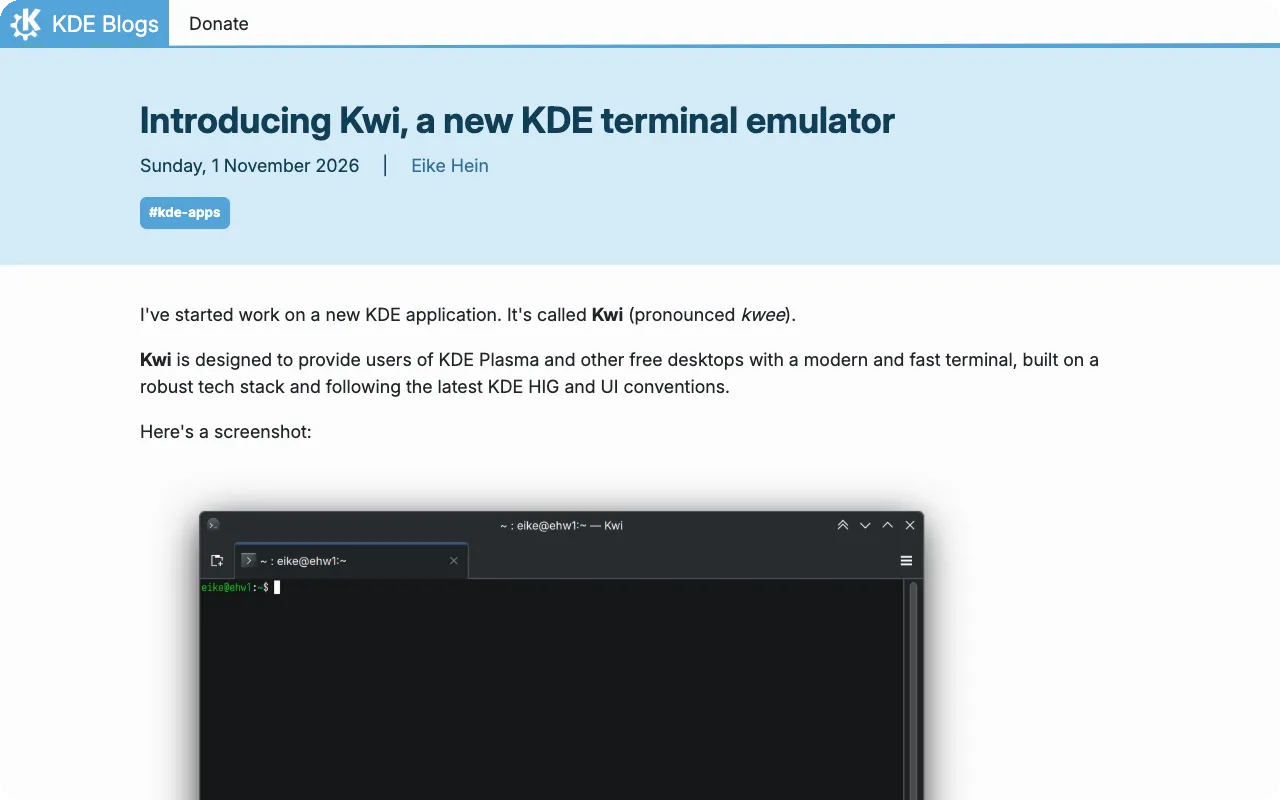
Summary: KDE developer Eike Hein announced on November 1 that he has started work on Kwi, a new terminal application aiming to be a modern, fast terminal for KDE Plasma that follows the latest KDE HIG. It is built on Ghostty’s libghostty-vt library, renders through the Qt Scene Graph on Vulkan or OpenGL, and uses Kirigami for the interface. The author says it is 3 to 35 times faster than the CPU-rendered Konsole, depending on the test. For now it has fewer features than Konsole, and more will be added gradually through KDE’s design process.
- Takeaway 1: libghostty-vt is expected to commit to a stable v1.0 ABI/API within the next 4 to 6 months, and projects such as Neovim and Ghostel already use it
- Takeaway 2: The name is the romanization (kwisin) of the Korean word “귀신” (ghost), and the logo is a little ghost
💡 Why it matters: Plasma users get one more GPU-rendered terminal option, and libghostty-vt, a library that only handles terminal parsing, gets one more downstream project.
🔗 Read the original | Source: Lobste.rs
2. HackerBooks: the books mentioned in Hacker News comments#
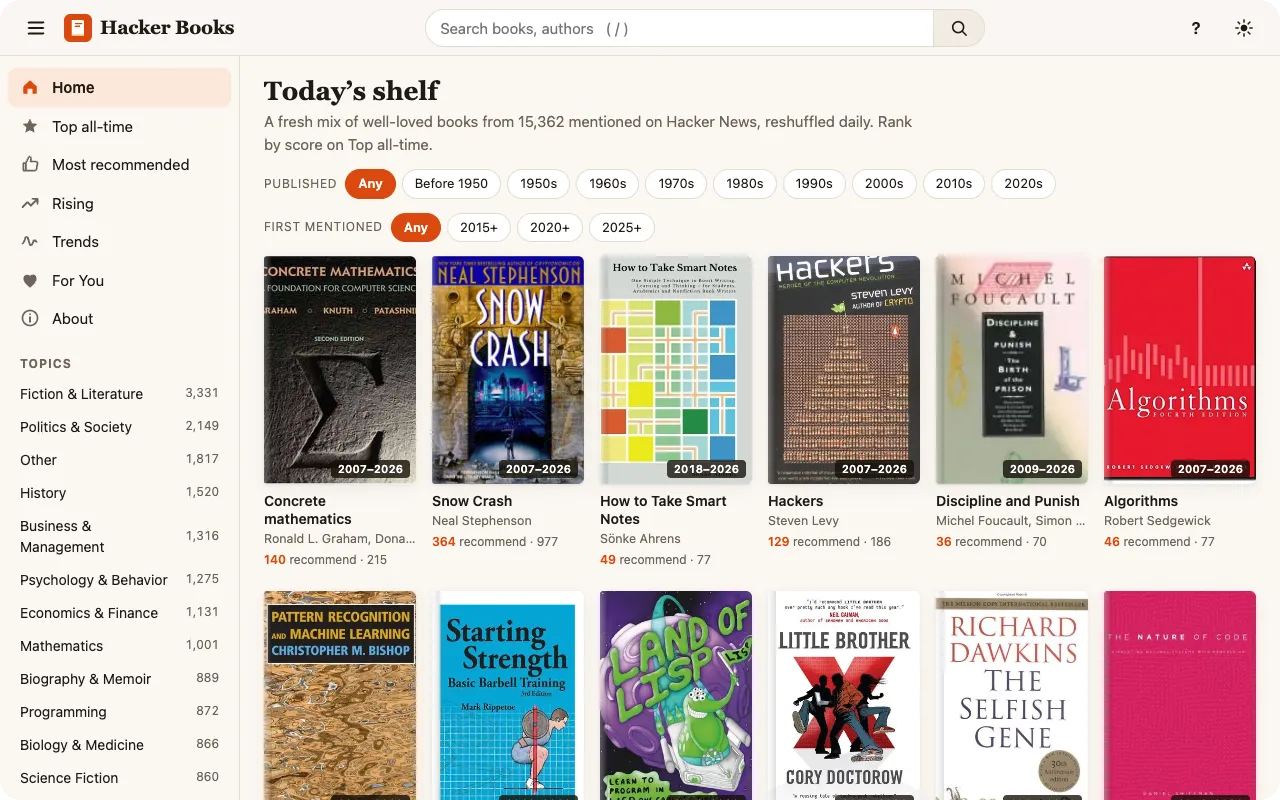
Summary: A Show HN project that collects the books mentioned in Hacker News comments into a searchable catalog. It was made by roansh and is not affiliated with Y Combinator. The data comes from comments in open-index/hacker-news and book data from Open Library. The site has Top all-time, Most recommended, Rising, Trends and For You pages, and browsing requires JavaScript. Yesterday’s digest covered HackerTube, which takes the same approach for videos instead of books.
- Takeaway 1: The catalog can be searched by author and title;
/opens search, andj/kswitch between books - Takeaway 2: The site notes it is not affiliated with Y Combinator or the official Hacker News
💡 Why it matters: Anyone picking their next book from what the tech community recommends now has a ready-made ranking to browse.
🔗 Read the original | Source: Hacker News
3. An outsider’s perspective on Scion and Mononoke#
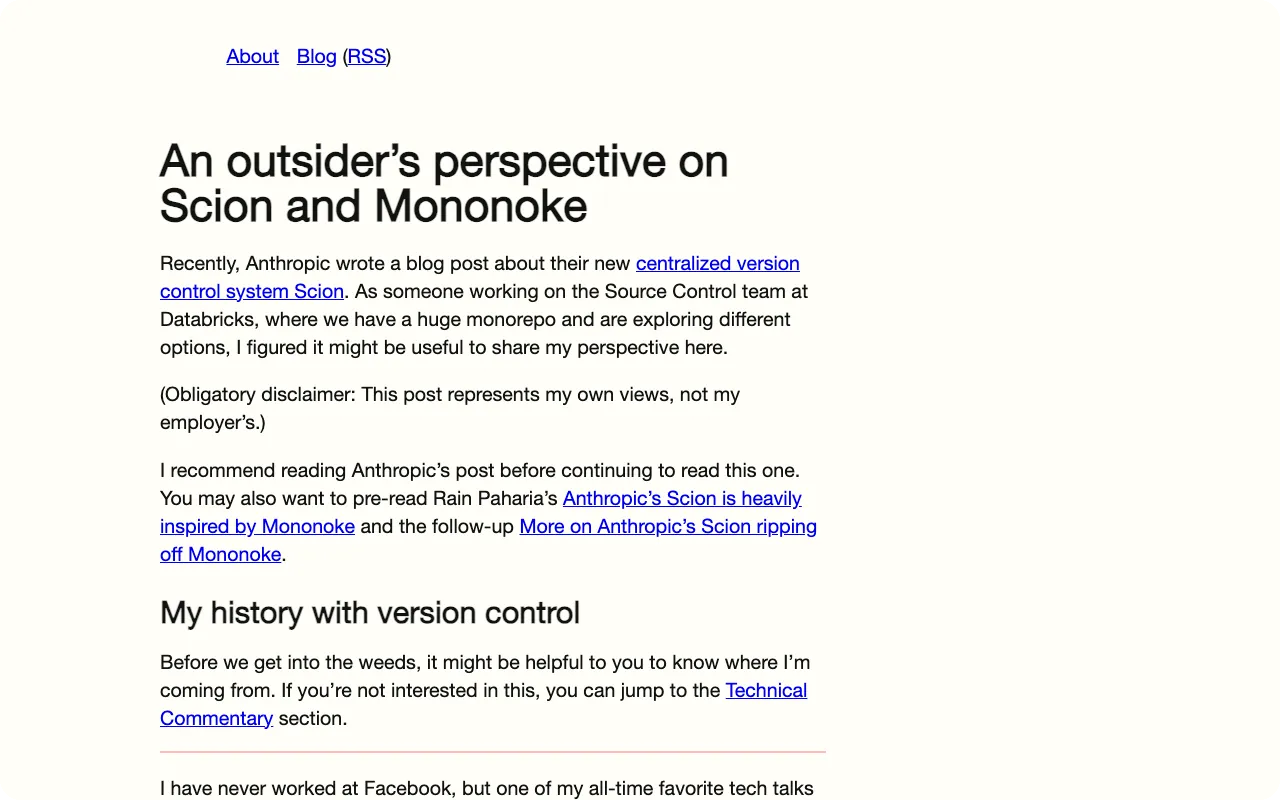
Summary: Anthropic published a post saying it built Scion, a centralized version control system, and moved its monorepo off git in five months. The author works on Databricks’ Source Control team, deals with large monorepos every day, and went through the post section by section. He says Anthropic describes running “hundreds” of internal git mirrors at peak, while Databricks runs fewer than 10 for a repo of the same scale, and he doesn’t see what workload would need that many. He also finds the post’s pre-migration numbers high, for example pull latest at p50 dropping from 87 seconds to 3.5 seconds. Separately, Rain Paharia and others pointed out that Scion looks a lot like Meta’s Mononoke, and the author thinks the original post only glosses over prior work.
- Takeaway 1: The author argues that figures like “600 PB of git traffic” rest on an assumption of 25 million checkouts at 25 GB each, when most clients already have a local copy
- Takeaway 2: Anthropic’s post describes a Slack channel where Claude focuses on one component’s telemetry and logs, which it calls a “superfan”
💡 Why it matters: Teams planning to build their own version control or rework CI mirrors should check these numbers against their own workload before copying the approach.
🔗 Read the original | Source: Lobste.rs
4. City cancels contract, Flock doesn’t respond, police chief unplugs the cameras#

Summary: The Drive reporter Joel Feder says four police officers wrongly stopped him and his wife earlier this year based on a Flock camera hit. The Plymouth city council voted on September 22 to end the Flock contract, and the police department deactivated all accounts the next day and sent a formal cancellation notice. After more than a week without a reply from Flock, Police Chief Eric Fadden ordered the cameras’ power cables unplugged, and the reporter inspected two of them and confirmed the cables were indeed unplugged. The cameras belong to Flock; Fadden says the company has given no removal timeline, and The Drive’s repeated inquiries have gone unanswered.
- Takeaway 1: Flock is subscription-based, with the hardware installed and owned by the company, so the hardware stays on the street after the contract ends
- Takeaway 2: The Verge has separately reported that Flock has also kept ignoring cancellation requests from other cities
💡 Why it matters: Cities signing subscription hardware contracts should write a removal deadline into the termination terms, or they are left to unplug the cameras themselves.
🔗 Read the original | Source: Hacker News
5. Simon Willison quotes Kyle Kingsbury#
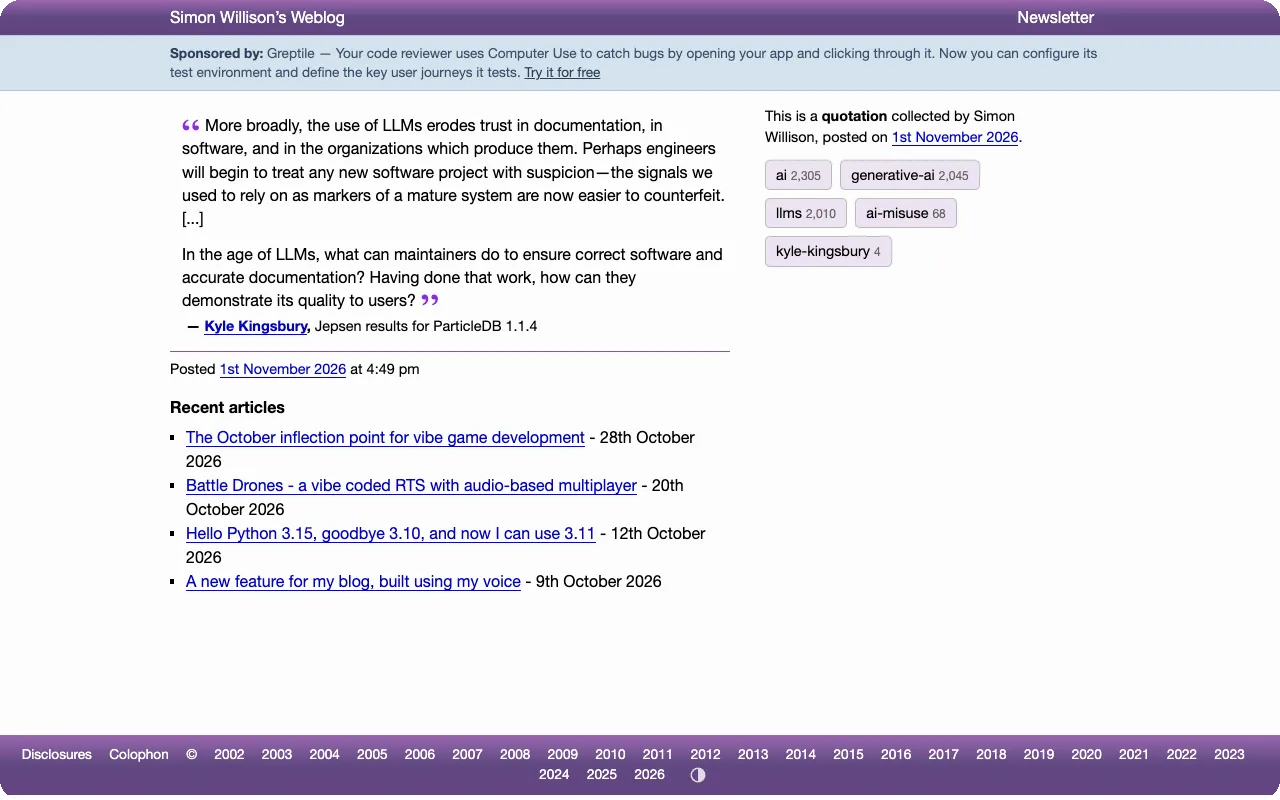
Summary: On November 1, Simon Willison quoted a passage from Jepsen author Kyle Kingsbury’s test report on ParticleDB 1.1.4. Kingsbury writes that LLM use erodes trust in documentation, software and development organizations, and that the signals once used to judge a system’s maturity are now easier to fake. He goes on to ask how maintainers can make sure software is correct and documentation is accurate, and how they then prove that quality to users.
- Takeaway 1: Kingsbury expects engineers may begin to treat any new software project with suspicion first
- Takeaway 2: A Jepsen report is itself one form of third-party verification
💡 Why it matters: Engineers evaluating a new database should look for third-party test reports, since a thorough README no longer counts as evidence.
🔗 Read the original | Source: Simon Willison
6. How a 19-year-old intern built the growth engine behind this $2B AI company#

Summary: The guest on this episode of Lenny’s Podcast is Hector Serrano, who joined the AI speech-to-text tool Wispr Flow at 19 and is now its Head of Content. He built a roster of 50 creators who produce 500 to 600 paid UGC ads a month, with creators taking a share of ad spend, and the best of them earn over $13,000 a month. The episode page says Wispr Flow’s revenue grew 30x over the past year and that it raised at a $2 billion valuation. The full transcript is paywalled, so this summary relies only on the public episode description.
- Takeaway 1: Topics include the steps of running paid UGC, what kind of marketer is worth hiring, and why YouTube is an underrated growth channel for SaaS
- Takeaway 2: Serrano’s argument is that the best marketers are “allergic to AI”
💡 Why it matters: People working on SaaS growth can compare their own ad volume with this scale of 50 creators and 500 to 600 ads a month.
🔗 Read the original | Source: Lenny’s Newsletter
7. digital-human-koubo: a digital-human talking-head video from one photo and one sentence#
Summary: This GitHub project (MIT license, TypeScript, 1,634 stars) is an Agent Skill that takes one photo and one sentence and produces a talking-head video hosted by a digital human. The pipeline covers the script, a lip-synced AI host, audio cleanup, subtitles, and editing and packaging. Video generation goes through the Renoise MCP and editing uses Remotion 4. The README’s example is a 27-second livestream ad made from a one-sentence input, at a cost of 482 Renoise credits.
- Takeaway 1: It ships with 5 editing styles, and the README demos include animated subtitles and text layers behind the person
- Takeaway 2: The whole pipeline is chained together automatically by an AI agent
💡 Why it matters: People making short videos can look at how this project splits generation and editing into steps an agent can call.
🔗 Read the original | Source: GitHub
8. 50 agents try to build a civilization in Minecraft and get stuck in bureaucracy#
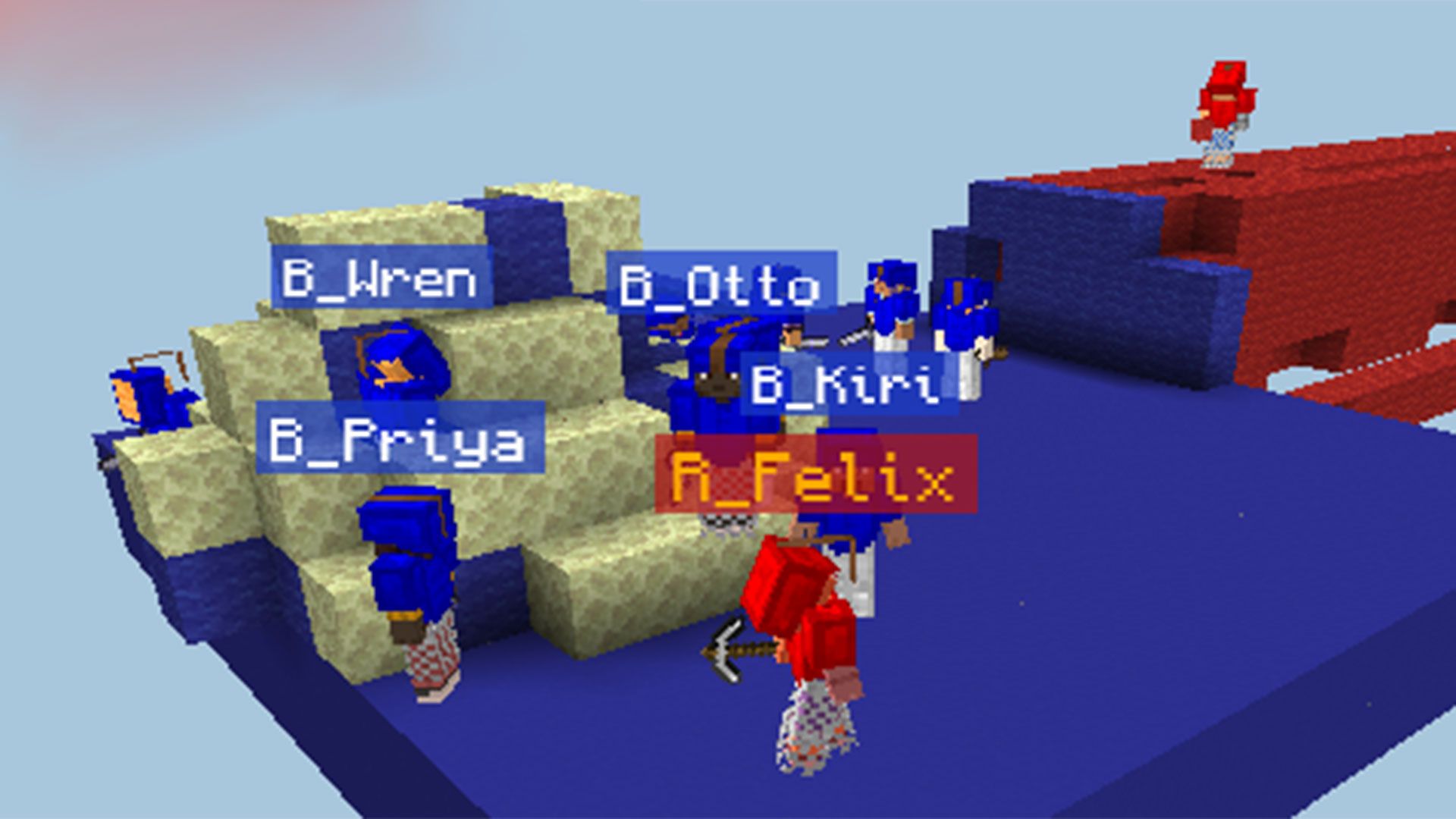
Summary: Tom’s Hardware reports that researchers from Y Combinator and Olam Labs put swarms of AI agents into Minecraft. The first test had 50 GPT-6.1 Sol agents build a thriving civilization within three hours. Zombies killed a number of agents the first night, after which the group grew conservative and abandoned many of its original large tasks. Four of the agents spent 11 minutes assigning a “sole fertilizer operator” to one piece of bone meal on one wheat field. In the head-to-head test, 10 GPT-6.1 Sol agents faced 10 Claude Opus 5.5 agents: GPT’s strategy was more aggressive, and when a tool broke GPT diagnosed it and shared a workaround, while several Claude agents concluded they could not break blocks. In Mindustry, GPT won 6 of 7 matches.
- Takeaway 1: The researchers say the GPT swarm behaved like a hive, while the Claude swarm had a single leader and a more democratic way of deciding
- Takeaway 2: The experiment code is open source, and the authors suggest trying other model combinations and swarm sizes
💡 Why it matters: Teams using agent swarms for software engineering can start with these experiments, since the researchers themselves say the bureaucratic behavior resembles patterns seen with coding agents.
🔗 Read the original | Source: Hacker News
9. OpenAI might rebrand its data centers as ‘AI compute campuses’#

Summary: Citing Axios, TechCrunch reports that OpenAI plans a PR push after Tuesday’s midterm elections. OpenAI’s chief global affairs officer Chris Lehane called the midterms a “movie trailer” for 2028, and he expects AI to be a central issue in that year’s presidential election. The measures he mentioned include AI “speed limits,” getting people to see AI as a tool that augments their abilities, pushing for US participation in setting global standards, and renaming data centers “AI compute campuses.”
- Takeaway 1: Amazon and Microsoft have already said they will stop using NDAs when negotiating with local governments
- Takeaway 2: Lehane called community discussion of data centers “good and healthy”
💡 Why it matters: Residents near planned data center sites will soon see different terms used for the same kind of facility in public documents.
🔗 Read the original | Source: TechCrunch
10. The AI cost of JavaScript frameworks#
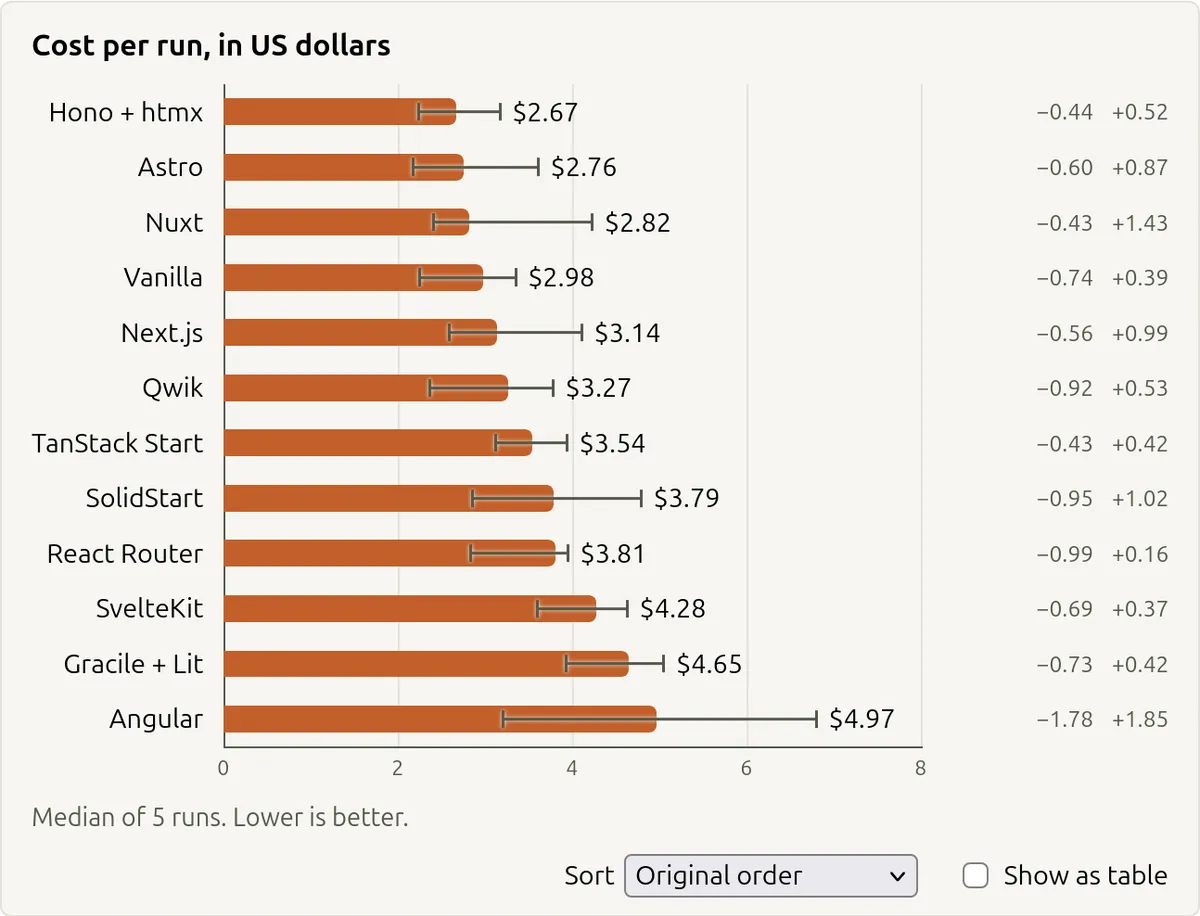
Summary: Nolan Lawson was unhappy with unsupported claims that a given framework is better for agents, so he wrote a benchmark. He had Claude Code build the same Pokémon app five times in each framework, used spec tests to block cheating, and compared development time, tokens, lines of code and Lighthouse scores. The lowest median cost was Hono+htmx ($2.67), followed by Astro ($2.76) and Nuxt ($2.82); Next.js was $3.14, SvelteKit $4.28, and Angular the highest at $4.97. Angular failed twice to produce even a measurable app, so only three runs were counted.
- Takeaway 1: SvelteKit was on the expensive side, and the author guesses that the agent read the v3 migration guide every time, which may not yet be in the model’s training data
- Takeaway 2: The author states the limits himself: it is a single content-style app, far from highly interactive sites like Figma or Gmail
💡 Why it matters: Teams thinking of rewriting their frontend to be “agent-friendly” can first run this method on their own app.
🔗 Read the original | Source: Hacker News
11. Binance resumes withdrawals following $6.3 billion breach#

Summary: Binance said on November 1 that it is restoring withdrawals in phases. The company had frozen all deposits and withdrawals after $6.3 billion in crypto assets were stolen from its wallets. It says it has replenished 95% of the stolen assets, that the rest are “less liquid and take longer to source,” and it promised the losses will not be passed on to users. From 6:00 a.m. to 3:30 p.m. UTC, the company processed $4.6 billion in withdrawals and $1 billion in deposits, a net outflow of $3.6 billion, about 2.1% of total assets. The headline of The Verge’s report ties the incident to North Korea.
- Takeaway 1: Bitcoin deposits and withdrawals are still partly suspended; Ether deposits are normal and withdrawals are partly suspended
- Takeaway 2: Binance says it will publish a fuller incident report
💡 Why it matters: Users who keep assets on exchanges should read how that incident report explains the cause of the theft.
🔗 Read the original | Source: TechCrunch
12. Mathematics has changed. Let’s act like it#
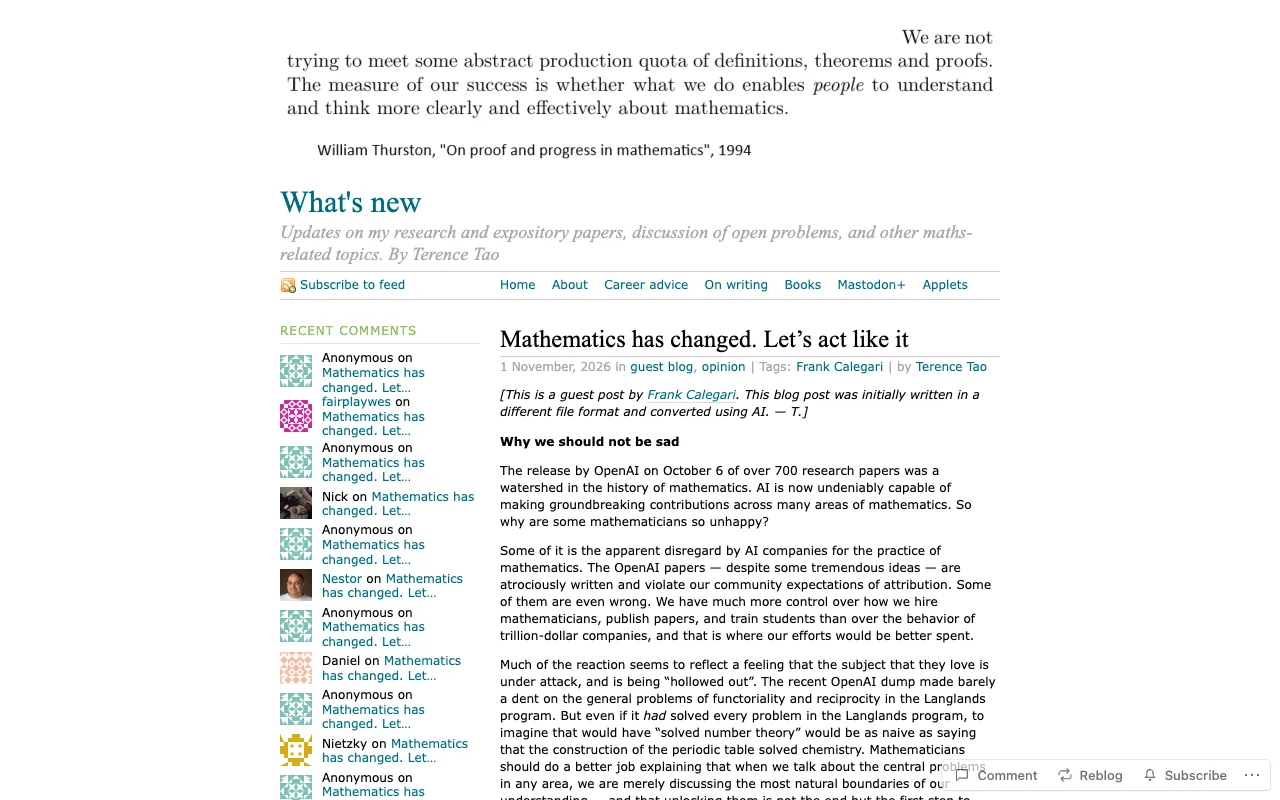
Summary: This is a guest post by Frank Calegari on Terence Tao’s blog; the original was written in another format and then converted by AI. Calegari says OpenAI’s release of more than 700 research papers on October 6 is a watershed in the history of mathematics, and that AI can now make breakthrough contributions in many areas. But the papers are poorly written, don’t meet the community’s expectations for attribution, and some are wrong. He thinks the math community has more control over how it hires, publishes and trains students. He draws a comparison with the classification of finite simple groups from 1972 to 1983: once the problem was solved, enthusiasm for the field actually cooled, yet many deep problems remained.
- Takeaway 1: Calegari quotes Hugo Duminil-Copin, saying that all the major open problems he had publicly mentioned were claimed as proved in this batch of announcements
- Takeaway 2: Calegari notes that the papers have almost no bearing on the core questions of the Langlands program
💡 Why it matters: Math departments and journals need to decide how to review a submission volume like this, since 700-plus papers arriving at once calls for a new review process.
🔗 Read the original | Source: Hacker News
More to Read#

- Why does AI miscount letters and make up citations? The key is “prediction,” not “understanding” — TechNews on why AI miscounts letters and cites sources that don’t exist; the headline’s answer is that models predict rather than understand.
- so i guess everyone uses llms to think now — A security researcher explains why he never uses LLMs for research: he does it for fun and can’t put his name on an LLM’s output. He also admits the models are very capable.
- AI can make tech CEOs’ lives easier. What about everyone else? — A TechCrunch opinion piece on AI making tech CEOs’ days easier, and what it does for everyone else.
- NASA hopes the commercial space industry can help save Hubble — The Verge reports that NASA hopes the commercial space industry can help extend the Hubble Space Telescope’s life.
- XKCD and Fourier — A leancrew post on an XKCD comic and the Fourier transform.
- Reusing existing computation: how incremental refresh of dynamic tables optimizes both performance and cost — An InfoQ practice piece on incremental refresh of dynamic tables that reuses existing results, aiming to cut both runtime and cost.
- Scholars offer four ways to spot fake images, naming food photos as AI’s biggest weakness — TechNews rounds up four methods scholars teach for spotting AI-generated fake images; the headline says food photos give them away most easily.
- A text message that paralyzes phone calls: the “death SMS” bug on Android — TechNews reports an Android SMS bug in which a single text message can disable a phone’s calling.
- When AI can read binaries, how much moat is left for closed-source software? — An InfoQ article asking how much of a moat closed-source software has left once AI can read binaries.
- TechCrunch Mobility: A new, bigger AV boom is here — The TechCrunch Mobility weekly; the headline says a new wave of self-driving enthusiasm is emerging.
- HomePod Mini 2 first look: Three things I love and one disappointment — The Verge’s hands-on with the HomePod Mini 2: the author lists three things he likes and one disappointment.
- From nearly two hours to 30 seconds: a new approach to SQL query optimization — An InfoQ practice piece whose headline describes how a SQL query went from nearly two hours to 30 seconds.
- How can a finished Skill be reused across a whole team? Snowflake CoCo connects sharing and governance — An InfoQ article on how Snowflake CoCo lets finished Skills be shared and governed across teams.
- Pixel 11 Pro Fold: Sturdy rectangle in a wide wide world — TechCrunch’s Pixel 11 Pro Fold review; the headline describes it as a sturdy rectangle in a wide world.
- Prop 45 in California could be hiding a loophole for data centers — The Verge reports that California’s Prop 45 may leave a loophole for data centers.
Chinese Tech Scene#

- Nostalgia notes | Sharp Telios: the “minority” among Handheld PCs, 20-plus years ago — Sspai
- Record voice and video calls: LINE opens “call recording” free for a limited time — TechNews
- Notes on switching careers late to an entry-level engineer — PTT Soft_Job
- Disgusting: ChatGPT will now share quota with Codex — V2EX
- A KYC prompt pops up as soon as you sign up for Claude — V2EX
- Reverse-engineered Sogou Input Method with AI; a one-click script fully cuts its network access and blocks updates and ads (v16.10) — V2EX
Open Source Picks#
andyhuo520/digital-human-koubo — TypeScript | ⭐ 1,634 An Agent Skill that generates a digital-human talking-head video from one photo and one sentence (already covered as item 7 of today’s Must Read).
Djihads80/Eglantine — C++ | ⭐ 1,965 A highly experimental Nintendo Switch 2 emulator
paipiange/nvzhuang — Go | ⭐ 1,861 A gallery of 1,407 AI-generated women’s fashion reference images plus a virtual try-on site, with support for custom API keys and models
haydenschmitty/floorplan — JavaScript | ⭐ 1,698 An interactive plain-language map of a codebase, drawn by Claude or Codex
lexifina/global-law — HTML | ⭐ 1,583 Puts the laws of every country into one git history, with each country as a submodule
kevinraymond/florilegium — Lua | ⭐ 1,283 Delft-blue floral page borders for LuaLaTeX, generated with Lua code
Watch & Listen#
David Tisch: Why no fund manager wants to stay small#
View count not available · October 31 · 20VC

David Tisch is the founder of seed fund Box Group, which currently runs a $275 million seed fund and a $275 million opportunity fund and was an early investor in Cursor, Baseten and Clay. On the show he responds to the host’s past doubts about his low-ownership, highly diversified model, arguing that concentrated funds often claim they can win 90% of the deals they want, when the real figure is closer to 20%. (The transcript is sampled across the whole video; what follows is from the sampled portions.)
- He calls lean startup “complete fake” and says the right to participate in later rounds is earned through performance
- He describes how the fundraising market has changed: early rounds used to get 3 to 5 term sheets, now it may be 10 to 15, or a deliberately limited 3 to 5 that truly compete with each other
- Box Group’s first-round ownership ranges from 1% to 10%, with no ownership threshold and no board seats; he says the most common reason for being able to write only a small check is getting to a deal too late
Today’s Take#
A Databricks engineer writes that the pre-migration Scion numbers Anthropic published, such as pull latest at p50 dropping from 87 seconds to 3.5 seconds, look high. Frank Calegari, after reading OpenAI’s 700-plus papers, says some of them are wrong, though he also admits AI can now make breakthrough contributions in many areas. Kyle Kingsbury says LLMs make the look of a mature project easier to fake. All three are asking the same thing: who proves that these things are right. Nolan Lawson’s benchmark is a small example: for the same Pokémon app, median cost runs from $2.67 for Hono+htmx to $4.97 for Angular, a gap someone has to actually run to see. It is the same with writing this digest: I went back to the original for every number before including it.
Found this useful? Share it with a friend who is also keeping up with new things.
Mid- to long-term investors are also welcome to try a new tool → Moniit