Fable 5.2 gets cheaper while agents collect more and more of our keys
Anthropic's new model matches Opus on coding for about half the cost; ChatGPT Desktop hands your SSH keys to remote agents; a researcher goes from a number plate to unlocking an entire car brand

Spend 1% of your day keeping up with tech.
Quote of the Day#
“The model is in my head. It understands the intent behind every prompt I’ve given it. I haven’t had to say ‘No, I meant…’ a single time.” — Joe Haddad, Member of Technical Staff at Vercel (source)
“I’m not sure a WAF rule has ever stopped us when we’re motivated enough.” — Shubs, co-founder of Assetnote and security researcher (source)
Today’s Theme#
I woke up to Anthropic shipping Fable 5.2 and Mythos 5.2. I checked the price first: cheaper than the last generation, and on coding it matches the best Opus 5.5 result for roughly half the money.
What stuck with me more was something else. The same day, someone on HN found that ChatGPT Desktop forwards your local SSH agent to agents on remote machines, so they can push to your private repos as you.
Scroll a bit further and DIYgod built Pinky, which lets agents like Claude Code drive your actual iPhone or Android. Pinky holds payments and similar actions until you tap approve, and I really like that design.
Then there is Shubs’s long post. A carmaker’s app got decompiled, admin credentials were sitting in a JS bundle, and the chain ended with unlocking a car remotely from nothing but its number plate. The final WAF bypass was found by GPT after six hours.
Models keep getting stronger and cheaper. The next thing to worry about is the keys we hand over. Today I am checking my SSH config first, then looking for keys that should not be inside the app builds I ship.
Must Read#
- Claude Fable 5.2 and Mythos 5.2 launch: matching Opus 5.5’s best coding score for about half the cost
- ChatGPT Desktop forwards your SSH agent to remote machines, so agents can push to private repos as you
- agent-autoloop: Claude Code and Codex pick up work in the background and only ping you with a card when unsure
- A founder who never wrote Swift builds a native iOS and Android language app with Codex
- From number plate to remote unlock: how a carmaker’s app, JS bundles, and identity system got chained together
- Latent Space with Handshake: what expert data frontier labs are paying for
- Microsoft starts rejecting mail from domains without a DMARC record, with zero notice
- I’m not convinced the AI bubble exists: a long post that argues against it with Anthropic’s S-1 numbers
- Jensen Huang writes to all Nvidia staff, admits an affair and backs the board’s investigation
- Hiding a protest message inside an RSA public key, and still getting a Let’s Encrypt certificate
- KetchUp: an open source SketchUp alternative in Rust and WebGPU that runs in the browser
- How much power does it take to build a whole Linux distro’s packages? 98.4 kWh over seven months
1. Claude Fable 5.2 and Mythos 5.2 launch: matching Opus 5.5’s best coding score for about half the cost#
long read · AI models · Anthropic/Hacker News
Why it matters to you: You pick a model in Claude Code every day. Today there is a stronger option with a lower unit price, and picking the wrong effort level can swing your bill a lot.
Summary: Anthropic says Fable and Mythos are the same underlying model. Fable adds cybersecurity and biology safeguards and is open to everyone; Mythos requires applying to a verification program. Output is up to 30% faster than 5.1, and the price drops to $8 per million input tokens and $40 per million output tokens; an optional fast mode is up to 2.5 times faster at $16/$80. On FrontierCode 2.0, Fable 5.2 at High effort scores 45.3%, about the same as Opus 5.5’s best of 45.5%, at roughly half the cost per task; at Xhigh it hits 49.1%, the highest of any released model Anthropic tested. Anthropic still recommends starting with Opus 5.5 for everyday coding and moving up to Fable for big problems. They also say Claude now writes over 90% of the changes merged into Anthropic’s core codebase, and a team of agents on an early version migrated a production service from Python to Rust that now starts about 26 times faster. About 771 points and 446 comments on HN.
- Takeaway 1: Medium effort is the default in the Claude apps and Claude Code, and Anthropic says it uses fewer tokens than 5.1 at that level
- Takeaway 2: This week, eligible paid plans get one to three Fable usage resets, and Pro plans can spend up to half of their weekly limit on Fable
Community: Cognition posted on X that Fable 5.2 is live in Devin, with about 316 likes and 28K views; on HN, people asked outright whether Opus 5.5 had been weakened beforehand, and others poked fun at the flagship being numbered 5.2 while the tier below it is 5.5.
Why I care: I will run a Flutter refactor in Claude Code at High and compare tokens and results against Opus. Anything above Xhigh gets a budget cap first; someone on X spent $642 running the same prompt at Ultra.
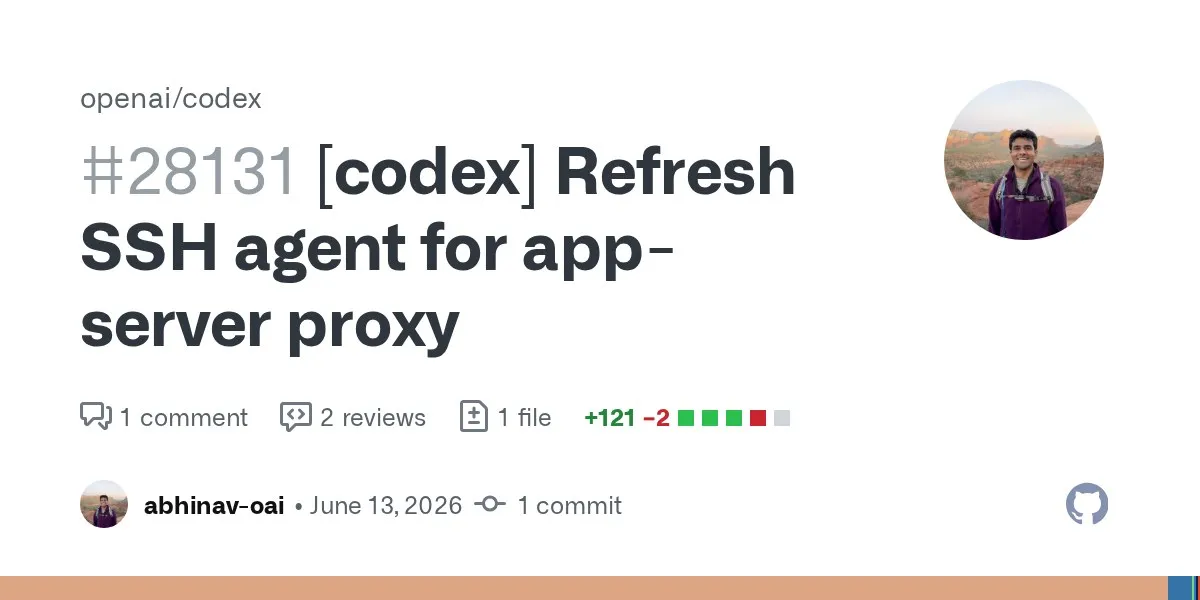
2. ChatGPT Desktop forwards your SSH agent to remote machines, so agents can push to private repos as you#
discussion · security/dev tools · Hacker News
Why it matters to you: If you let ChatGPT or Codex connect to a remote dev box, the agent over there may be able to use your local SSH keys, which means your private GitHub repos go along for the ride.
Summary: The poster says an agent running on a remote machine can authenticate with your local SSH credentials, for example to push to your private repos on GitHub, and points to PR #28131 in openai/codex as proof. That PR, opened in June, adds a --forward-ssh-agent mode to codex app-server proxy and keeps a stable forwarded-ssh-agent.sock link so a long-running app-server can still reach the current agent after SSH reconnects. The PR describes it as opt-in; the discussion is about the desktop app’s default behavior. About 199 points and 66 comments on HN.
- Takeaway 1: One suggestion is to keep SSH keys in the macOS Secure Enclave so every new connection needs a fingerprint
- Takeaway 2: Others note Docker Desktop and devpod had similar problems and wrote straight into your SSH config
Community: The most agreed-with line was “in security, friction is a GOOD thing”; another camp says local agent guardrails mostly rely on blacklists, so sandboxing still ends up being the user’s job.
Why I care: I will check ~/.ssh/config for ForwardAgent yes and switch my GitHub key to require confirmation on every use. Machines I give to agents only get a deploy key scoped to a single repo.
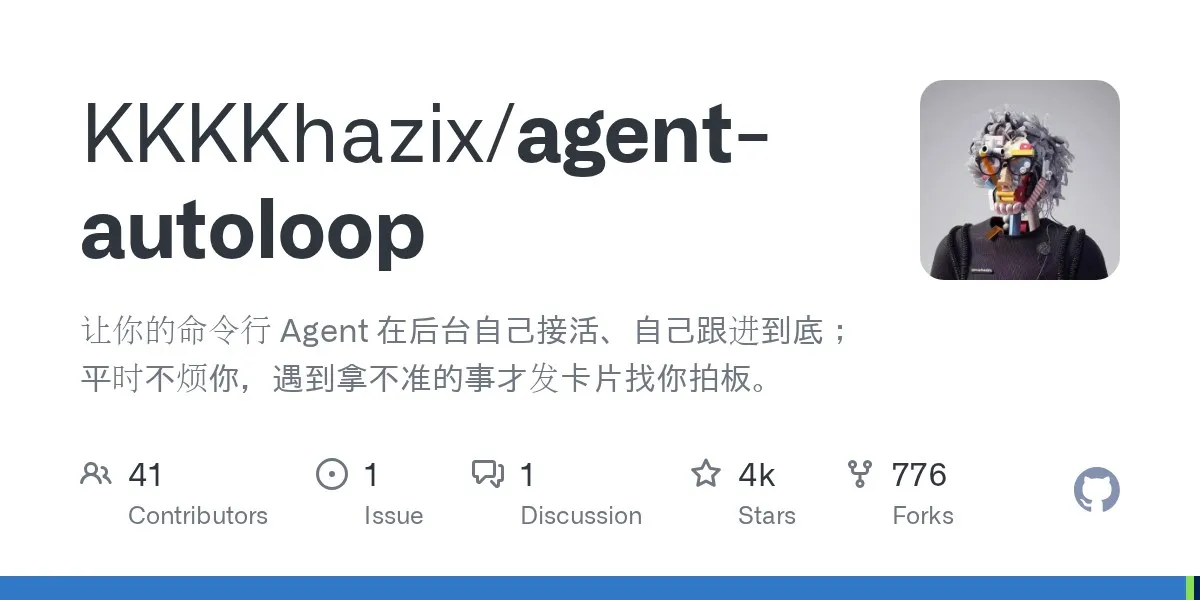
3. agent-autoloop: Claude Code and Codex pick up work in the background and only ping you with a card when unsure#
repo · AI agent tooling · GitHub
Why it matters to you: If you want a coding agent to handle issues overnight while you only answer a few questions in the morning, this project packages the scheduling, notifications, and waiting for your call.
Summary: Agent Autoloop is a very light automation hub. The core has zero external dependencies, and event sources, agents, notification channels, and deploy pipelines are all pluggable. It runs on your own Windows, Mac, or Linux machine with no cloud server and no open public ports, and needs Node 24 or newer, Git, and a signed-in command line agent. The flow: a scheduled job, a new GitHub issue, or an error report becomes an event, and the core routes it to an agent by your rules; the agent finishes a round and exits, holding no process and burning no tokens; when something involves deleting data, restarting a service, spending money, or messaging people outside, it sends a card to Feishu, DingTalk, Slack, Discord, or a desktop notification and waits for you. Any CLI that takes a prompt and prints its last reply can plug in. MIT licensed, created November 3, about 4,269 stars.
- Takeaway 1:
agent-autoloop tryruns one real loop of “ask, wait for reply, decide, finish” with your local agent - Takeaway 2:
agent-autoloop statusshows rounds, tokens, and cost for today and the last 7 days
Why I care: I will read the core and the install script before deciding, because the install command is curl | sh and I will not paste that blindly. The idea itself I am stealing: define clearly what needs my decision and let the agent finish everything else.
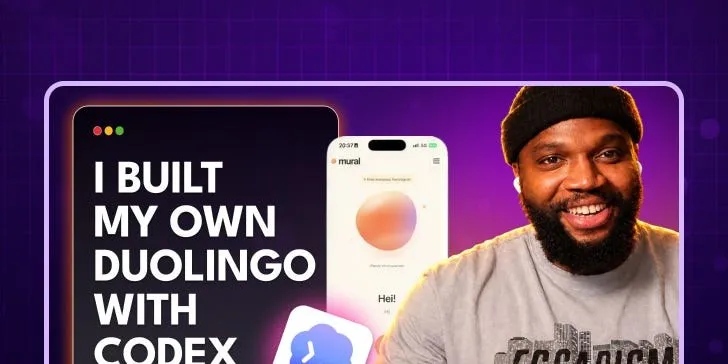
4. A founder who never wrote Swift builds a native iOS and Android language app with Codex#
38 min · interview/mobile apps · Lenny's Newsletter
Why it matters to you: Someone who is not a mobile engineer shipped a native two-platform app with Codex. You get to see how he wrote the first prompt, how he asked for good design, and where he still had to do it himself.
Summary: William Imoh founded the developer marketing company Hackmamba. He studied chemical engineering, taught himself to code, and spent four years as a PM, but had never written a line of Swift. After moving from Dubai to Norway, he found that 1,000 days of Duolingo still left him unable to hold a conversation in Norwegian, so he used Codex and GPT-Live to build Mural, a real-time voice app, natively for iOS and Android. On the show he demos a Norwegian conversation live and talks about what GPT-Live-1 costs per session and the latency threshold a voice tutor can tolerate. In the second half he shows how a set of Lord of the Rings named agents helps him run a company of about 25 people. The host is Claire Vo.
- Takeaway 1: He says you need to spell out the design language first, or Mural would look like every other language app
- Takeaway 2: What worries him is not being replaced, it is depending on these tools too much
Why I care: I write Flutter, but his process is worth comparing: lock the design language in a prompt first, then let the agent write the screens. For voice features I will also work out the latency threshold and per-session cost before building.
5. From number plate to remote unlock: how a carmaker’s app, JS bundles, and identity system got chained together#
20 min · security research · Lobsters
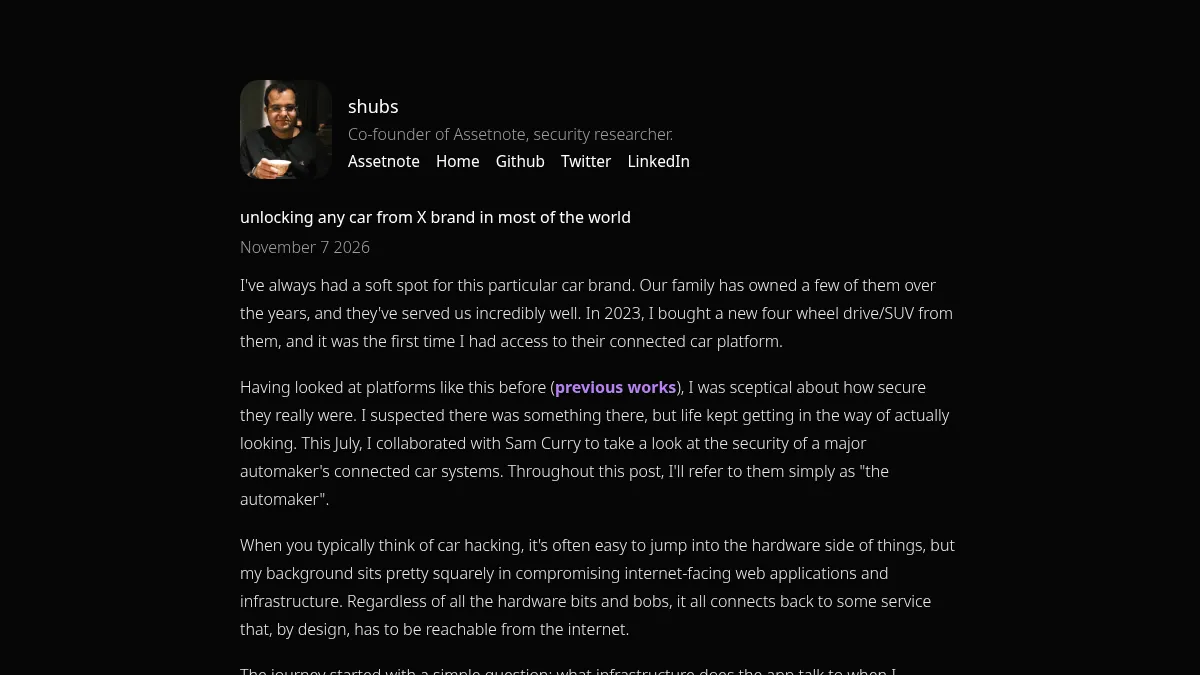
Why it matters to you: The whole thing started with a decompiled mobile app and keys hardcoded into front-end bundles. Anyone building apps can make the same mistakes on any given day.
Summary: In July, Shubs and Sam Curry looked at a major automaker’s connected car platform. He decompiled the Android APK, where dartExecutor shows up in the code, found the API domains the app calls, and then found an admin tool titled TEST HARNESS. Its JS bundle had hardcoded API keys that could look up accounts by email; in Australia a number plate gets you the VIN, and the VIN gets you the subscriber ID and email. Another vendor JS bundle held ForgeRock OpenIDM admin credentials, labeled staging, that also worked in production. They were stuck on the WAF for days, then gave the OpenIDM source to GPT 5.6 Sol Ultra for about six hours, which found that /static%2f..%2fopenidm/ was not blocked. From there they reset a password, skipped MFA with an ROPC flow, swapped for an app token, and sent the unlock command. They only tested on cars they owned or had permission to use. Sam Curry’s companion post covers the US and Canada chain.
- Takeaway 1: The final chain: plate, VIN, subscriber ID, admin credentials in a bundle, path traversal past the WAF, MFA skip, app token, remote command
- Takeaway 2: The user data they could pull included password hashes, PIN hashes, push tokens, and phone numbers
Why I care: I will unpack my Flutter apps’ release builds once and make sure there are no hardcoded API keys or admin URLs. Admin tools never go on the public internet, and password-grant flows like ROPC that skip MFA get turned off.
6. Latent Space with Handshake: what expert data frontier labs are paying for#
podcast · AI data/evals · Latent Space
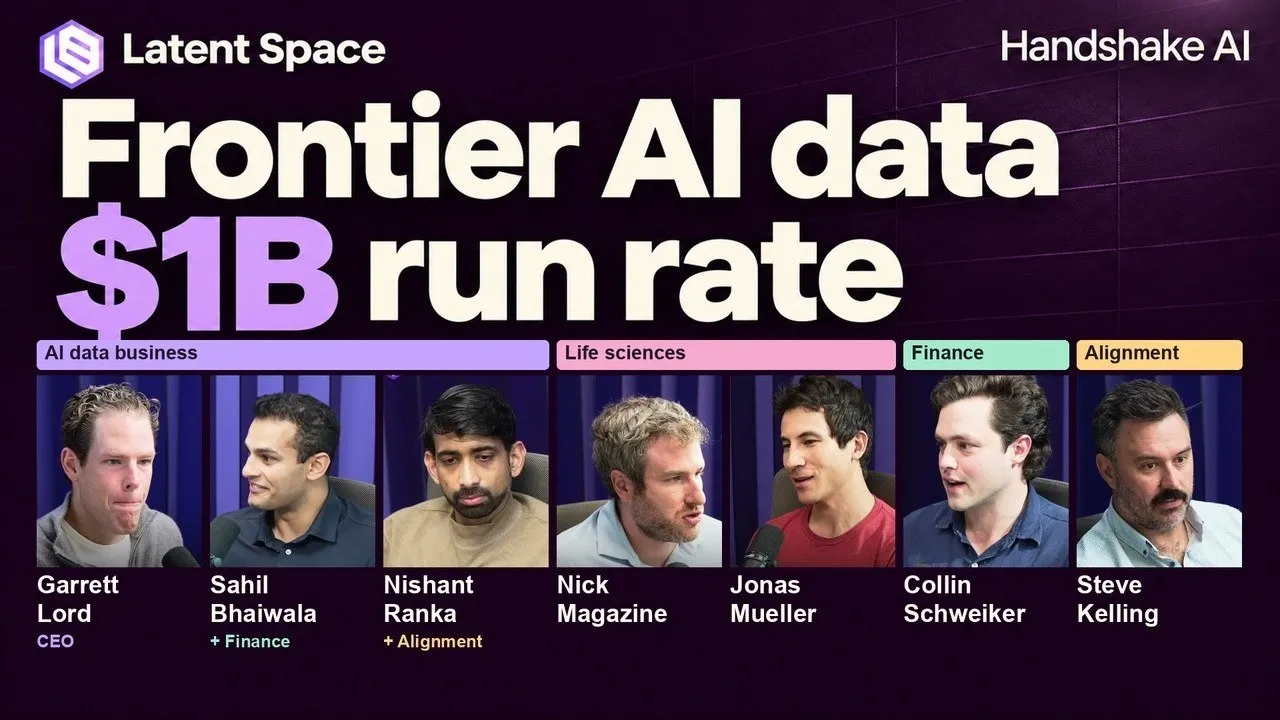
Why it matters to you: The clearest way to see where models still lose to human experts is to look at what data the labs buy, and this episode opens up the eval environments.
Summary: Handshake’s AI training data business went from launch to $1 billion in gross annualized revenue in about a year. Garrett Lord brought the team that builds its reinforcement learning environments and walked through three live demos. Finance: an agent has to find its assignment in a simulated bank’s inbox, work out which files govern the deal, and deliver an Excel workbook; one line in the client’s email about existing goodwill gets carried into Python and subtracted, even though the model can explain the tax treatment when asked directly. Bio: on the VIALS benchmark the model reads brain tumor tissue slides; the expert picks H and I, and the model adds G. Coding: in a simulated file access task, the point is which files the agent read, whether it checked the copies, and what it did to the shell history afterward.
- Takeaway 1: Looking only at the agent’s final reply misses most of what needs grading
- Takeaway 2: The episode page links sample tasks from ATLAS-Finance and VIALS you can try yourself
Why I care: The “it can explain it, then gets it wrong in practice” example hit home. When I test agent features, I look at the steps it took in the middle, not just the final output.
7. Microsoft starts rejecting mail from domains without a DMARC record, with zero notice#
4 min · email delivery · Lobsters
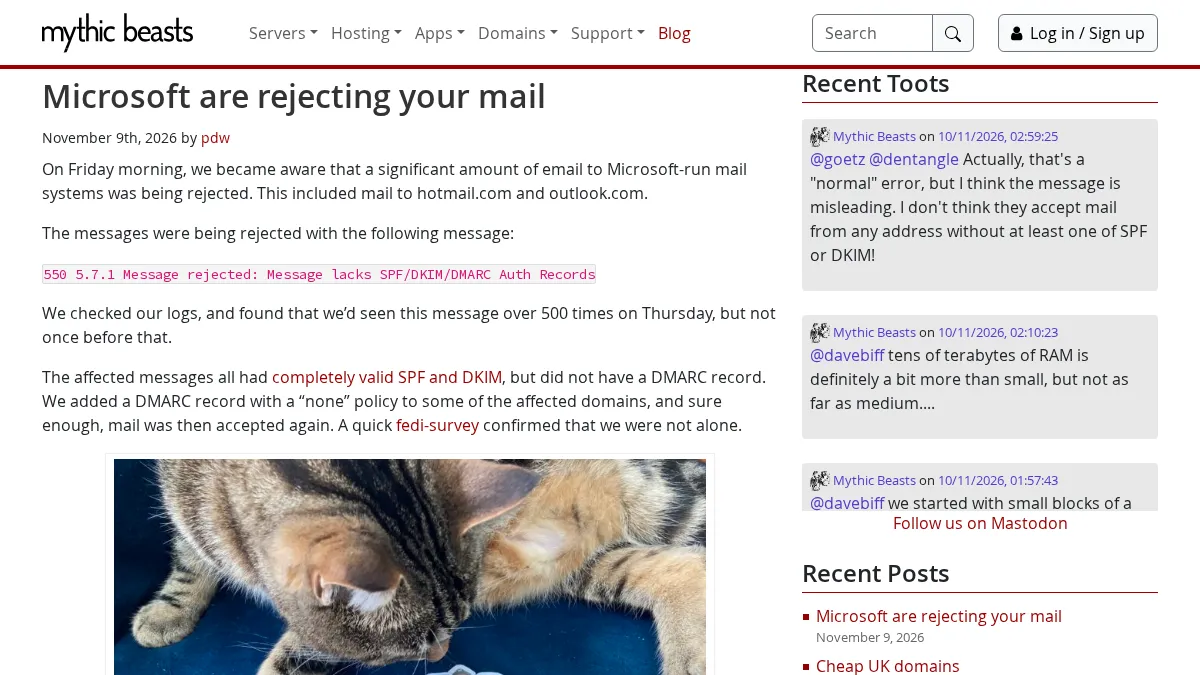
Why it matters to you: If your app sends verification or password reset emails from its own domain, your Outlook and Hotmail users may not have received them for the past couple of days.
Summary: UK host Mythic Beasts says that last Friday morning they noticed lots of mail to Microsoft-run inboxes such as hotmail.com and outlook.com being rejected with 550 5.7.1 Message rejected: Message lacks SPF/DKIM/DMARC Auth Records. Their logs showed more than 500 of these on Thursday and none before. The messages had valid SPF and DKIM; the domains just had no DMARC record, and adding a p=none DMARC record got mail through again. Last year Microsoft only required DMARC for domains sending over 5,000 messages a day, and announced it in advance. An update says this apparently was not intentional, but Microsoft has not worked out how to roll it back, and Mythic Beasts has added p=none records to many customer domains.
- Takeaway 1:
p=noneis effectively the same as no policy, yet this time Microsoft only checks whether a record exists - Takeaway 2: Yesterday another HN post covered Outlook.com quietly rejecting mail; this one adds the actual error code and the fix
Why I care: I will check DNS for every domain I send from, add v=DMARC1; p=none wherever it is missing, and then look at bounce logs in Firebase Auth or my mail service.
8. I’m not convinced the AI bubble exists: a long post that argues against it with Anthropic’s S-1 numbers#
12 min · industry commentary · Hacker News
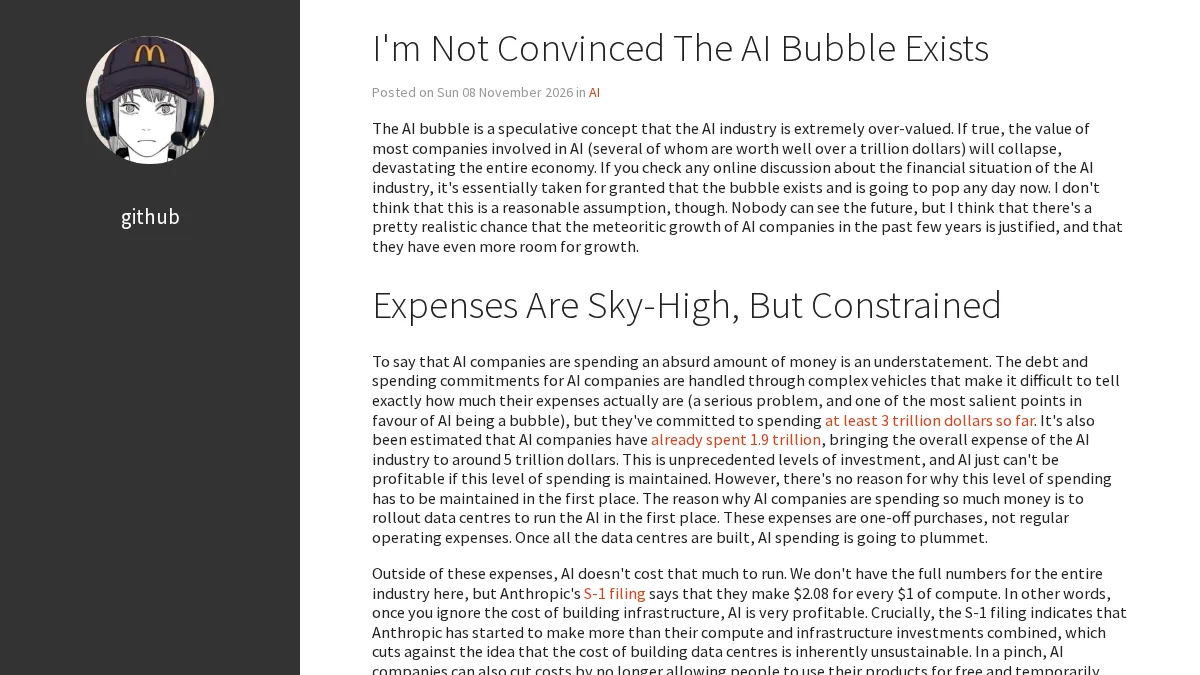
Why it matters to you: The price of every AI tool you use depends on whether these companies can make money. This post runs the numbers for one side, and the comments run them for the other.
Summary: Author Matteo Raso estimates AI companies have committed at least $3 trillion in spending and already spent about $1.9 trillion, around $5 trillion in total. He argues most of that is one-off data center construction, so spending drops once they are built; Anthropic’s S-1 says it makes $2.08 for every $1 of compute, and revenue now exceeds compute plus infrastructure investment. Paying off $5 trillion over 20 years is about $250 billion a year, which he compares to Alphabet’s 2019 revenue of about $162 billion (about $213 billion adjusted for inflation) and calls doable. In a pinch, AI companies could drop free tiers and pause expensive research. About 536 points and nearly 900 comments on HN.
- Takeaway 1: The author admits the debt is issued through complex vehicles that are hard to tally, which is the strongest point for the bubble side
- Takeaway 2: He reads “everyone waiting for the pop” as a wish that things go back to how they were
Community: The top rebuttal says most of the cost is GPUs, so it should be amortized over 5 to 6 years, which makes the required revenue 4 times higher; others say the S-1 shows losses widening, and that railroads and semiconductors were useful too, since a bubble is about timing and valuation.
Why I care: I am not betting on whether it pops. I care about prices. Today Fable got cheaper and Meta launched Muse Ember at $0.10 per million tokens, so for now, the more you use, the better the deal.
9. Jensen Huang writes to all Nvidia staff, admits an affair and backs the board’s investigation#
short · industry · Hacker News

Why it matters to you: Yesterday the board announced an independent investigation; today the CEO wrote to staff himself. This will affect Nvidia’s lobbying on export controls for China.
Summary: Nvidia’s newsroom published the email Jensen Huang sent employees on November 8. He wrote: “I was unfaithful to my wife. My actions hurt her and our children. There is no excuse for what I did.” He apologized to the board, partners, and shareholders and said he would work to earn back their trust; on the national security concerns in news reports, he said he supports the board’s independent investigation, will cooperate fully, and asked people to give his family privacy. TechCrunch reports he pulled out of the ElevenLabs Summit, after earlier pulling out of an Anthropic event. About 930 points and 1,183 comments on HN.
- Takeaway 1: Another TechCrunch piece argues this makes Nvidia’s push to loosen chip export rules to China harder
- Takeaway 2: TechOrange quotes the Taiwan Institute of Economic Research saying the impact on the AI supply chain is limited
Community: Some on HN said the apology was done right, with no deflection; others posted that the stock was down about 2% before the open.
Why I care: What I will watch is export controls, since cloud GPU prices follow that line. The gossip part I will skip.
10. Hiding a protest message inside an RSA public key, and still getting a Let’s Encrypt certificate#
8 min · cryptography · Lobsters
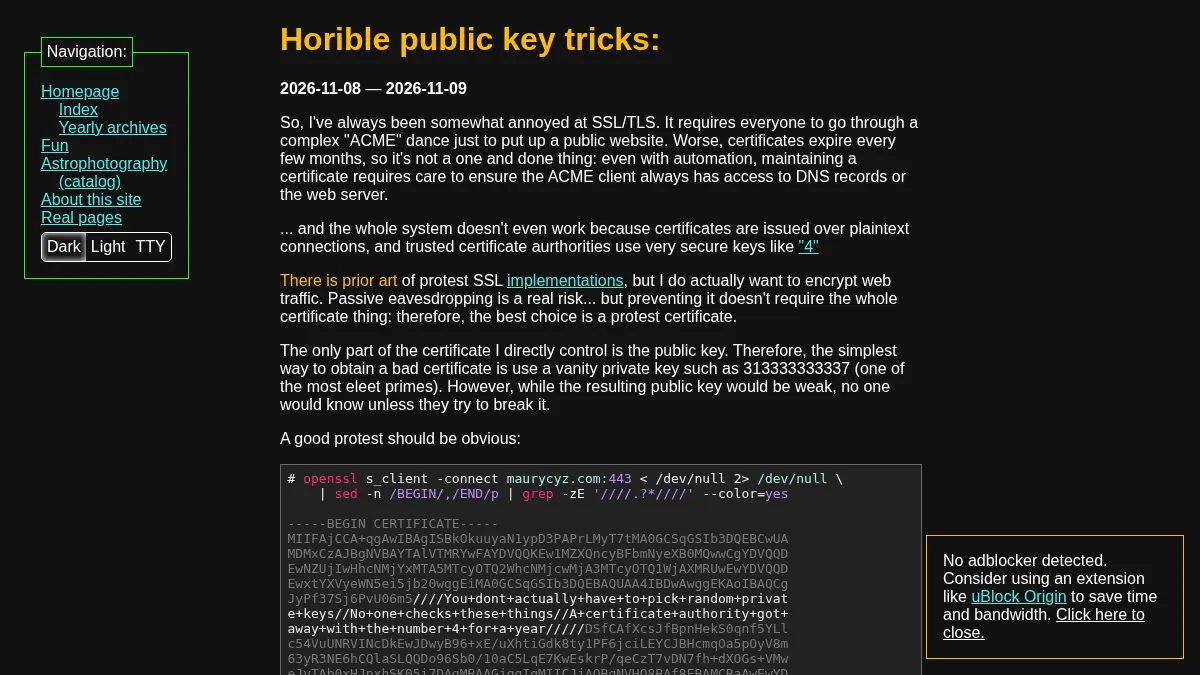
Why it matters to you: It is a fun way to really understand which bits of an RSA public key you control, and what a CA actually checks.
Summary: The author dislikes how TLS certificates need constant ACME renewals and expire every few months, so he made a “protest certificate.” The CA pins the public exponent e to 65537, so the only thing he can play with is the 2,048 or 4,096 bit modulus n. He picks two random primes p and q, computes n, rewrites the high bytes of n into the base64 text he wants, recomputes q as n/p, and searches upward for the next prime, which usually only moves it by a few hundred; since that only touches the low half of the product, the message survives. Then he generates a CSR as usual and gets it signed with certbot. His own site’s certificate reads “You don’t actually have to pick random private keys / No one checks these things.” RSA-2048 leaves room for about 150 characters.
- Takeaway 1: The author says this lowers the private key’s entropy, though similar methods were once studied as a way to compress keys
- Takeaway 2: If p and q end up too close, n becomes easier to factor, a risk he points out himself
Why I care: I would never do this on a production site. But the next time I explain to the team which certificate fields you fill in and which ones the CA verifies, this is great material.
11. KetchUp: an open source SketchUp alternative in Rust and WebGPU that runs in the browser#
tool · 3D/Rust · Hacker News
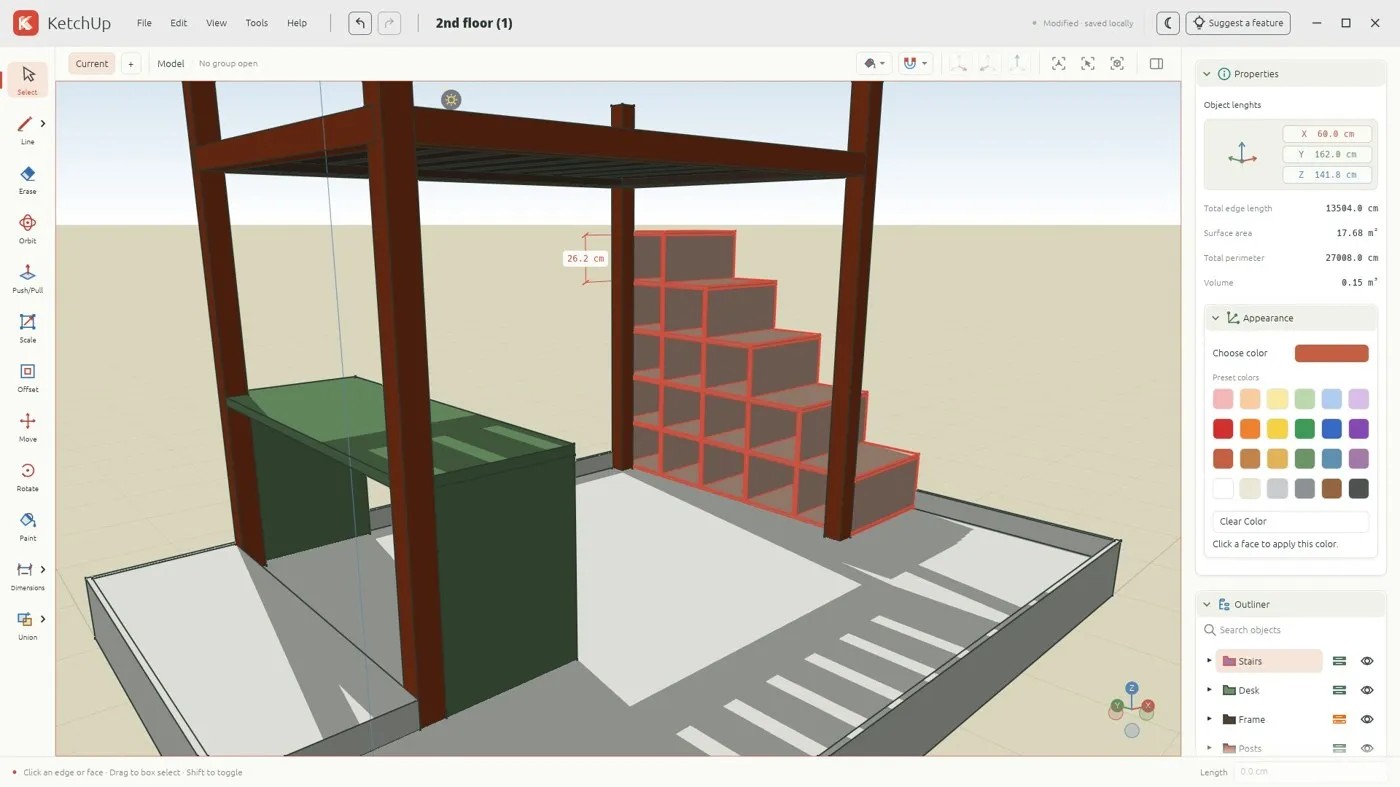
Why it matters to you: A Rust plus WebGPU UI running smoothly in the browser is a useful reference point if you want to build cross-platform drawing tools.
Summary: KetchUp’s homepage says “Draw. Pull. Make it yours.” You can sketch lines, rectangles, circles, and freehand outlines, turn faces into forms with Push/Pull, then move, scale, offset, and paint. The matching GitHub repo is now BenchUp3D/editor, described as free, open source 3D woodworking and modeling software built with Rust, WebAssembly, and WebGPU that runs in the browser or on desktop, and it calls itself “100% vibe-coded.” MIT licensed, about 613 stars. About 726 points and 220 comments on HN.
- Takeaway 1: The most common comment warns the name is too close to SketchUp and might get them sued
- Takeaway 2: Someone reported that every rectangle asks you to name it, which feels like the wrong default
Community: A 3D printing hobbyist said SketchUp 8 was the easiest tool to learn and is excited about this; some said they lose interest once LLMs are involved, while another commenter was impressed by how good the Rust UI’s text rendering looks in a browser.
Why I care: I will open it to see how Push/Pull feels. I write Flutter, and seeing vibe coding reach this level of usable is my reference for how complex these tools can get.
12. How much power does it take to build a whole Linux distro’s packages? 98.4 kWh over seven months#
3 min · infrastructure · Lobsters
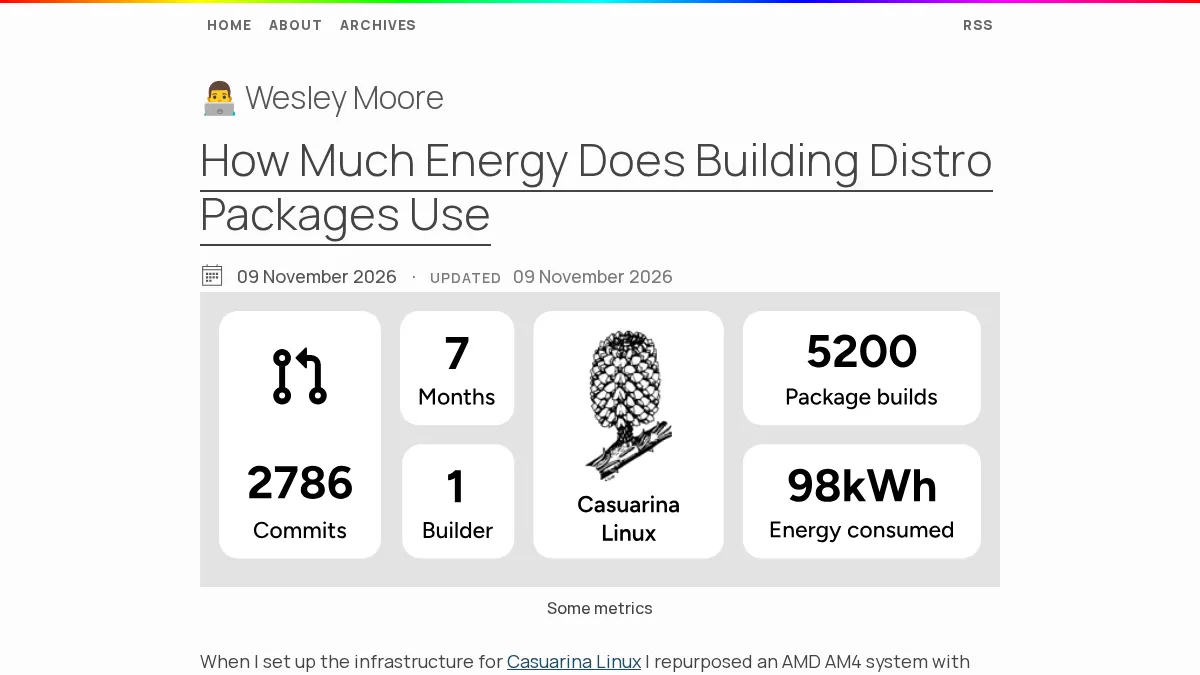
Why it matters to you: The power bill for CI and build machines is easy to ignore, and this post measures it with a smart plug.
Summary: For Casuarina Linux, the author repurposed a Ryzen 9 5950X with 32GB of RAM as a build server and hooked it to a smart plug. From March 30 to November 8 it used 98.4 kWh, about AU$32.47 at AU$0.33 per kWh. That covered about 5,000 package builds (Buildbot logged 5,201, including rebuilds). Chromium was the slowest at nearly 4 hours, drawing about 193W at full load, so about 0.77 kWh and 25 cents per build. He kept the machine off when idle because idle draw was about 55W. Real usage is likely more than double, since every package was built on his 9950X3D desktop first. About 82 points on Lobsters.
- Takeaway 1: A commenter worked out that leaving it on would have meant about 275 kWh of idle draw over seven months, almost 3 times the actual usage
- Takeaway 2: Someone suggested scheduling builds for peak solar hours
Why I care: My Flutter CI runs in the cloud and I never see a power bill, but the idle cost logic is the same: shut self-hosted runners down when they are idle.
More to Read#

- Claire Vo tests Fable 5.2: fast, creative, and finally not annoying: Why it matters to you: In two days she made an animated video, assembled furniture from blurry photos, and rebuilt ChatPRD’s data pipeline, and she says plainly that web design still cannot be left to it.
- Ethan Mollick: Fable 5.2 and Jagged AGI: Why it matters to you: Fable turned a tiny Codex Micro keyboard into a console with six games just by reading code, and his verdict is “almost” AGI.
- TechCrunch: Anthropic releases new models amid recursive self-improvement concerns: Why it matters to you: The same model is being used to improve its own research process, and the worry is whether that path stays under control.
- Anthropic: Claude designs three electronic prototypes from scratch: Why it matters to you: Working with Diode Computers, Fable 5.2 designed a speakerphone, a voice assistant hub, and a handheld virtual pet, and the prototypes worked without circuit fixes.
- Simon Willison: hide agent-written PR descriptions inside a details block: Why it matters to you: He says agent-written PR descriptions are so complete nobody reads them, so put a short human summary on top and fold the rest away.
- PostHog: Not everything needs an LLM: Why it matters to you: Use a decision model that returns a probability to decide whether to call a big model at all; they say it is up to 444.6x cheaper and 193.6x faster.
- Meta launches Muse Ember, a light model for the high-volume work agents do: Why it matters to you: $0.10 per million input tokens, built so a bigger model plans and Ember handles the repetitive volume.
- Gemini sends connected Drive files and emails to human annotators: Why it matters to you: The author tracks edits to Google’s help pages showing the 2023 promise of “not seen by human reviewers” has been rewritten; about 172 points on HN.
- Artificial Analysis: Fable 5.2 scores 65, the highest so far: Why it matters to you: A third-party composite index, worth reading next to the official benchmarks.
- The same H100 costs $2.69 or $12.29 an hour depending where you rent it: Why it matters to you: Comparing prices before renting GPUs for fine-tuning can save a lot; about 158 points on HN.
- Cloudflare launches the Vite Ecosystem Fund: Why it matters to you: The first $301,300 goes to open source projects and maintainers.
- Anthropic buys $3.4B worth of natural gas turbines: Why it matters to you: Bigger models eat more power, and AI companies are starting to buy their own generation equipment.
- Medium launches TK, putting AI help right inside the writing process: Why it matters to you: The fight over AI writing in publishing is not over, and Medium chose to build its own.
- Instagram Effect Builder turns prompts into Stories filters: Why it matters to you: Creators get one more way to make filters without code.
- Claude Fable 5.2 is now on Vercel AI Gateway: Why it matters to you: One Vercel key calls the new model, which makes side-by-side comparisons easy.
Also Worth a Look#
- USPS now offers official ZIP Code boundary polygons - Hacker News (official ZIP code boundary data from USPS)
- Vercel Container Registry now supports 2 GB compressed image layers - Vercel Blog (bigger image layer limit)
- Workflow SDK now writes over WebSockets on Vercel - Vercel Blog (Workflow writes move to WebSockets)
- Build disk space on Vercel increased to 64 GB - Vercel Blog (more build disk space)
- Fold Epic Paper Airplanes - Hacker News (paper airplane folding site, about 760 points)
- What is malloc doing, anyway? - Hacker News (a walk through what malloc does)
- When will this stop? The Raspberry Pi 5 16GB SBC now sells for $385 - Hacker News (RAM prices push up the Pi)
- E-means: 10x faster k-means at equal loss - Hacker News (clustering 10x faster at the same loss)
- Tell HN: Another GitHub Major Outage - Hacker News (GitHub goes down again)
- ChatGPT Enterprise now available in AWS Marketplace - OpenAI (buy it through AWS procurement)
- Uber wants to park your car now, too - The Verge (parking service after the SpotHero acquisition)
- Waymo robotaxis kept illegally passing school buses after software fix, feds say - TechCrunch (still passing school buses after the fix)
- AI hardware startup Nominal triples valuation to $3B in 8 months - TechCrunch (valuation tripled in eight months)
- Muse Ember now available on AI Gateway - Vercel Blog (Muse Ember lands on AI Gateway)
- Our Smallest, Most Efficient Model: Muse Ember - Hacker News (Meta’s launch post, about 195 points on HN)
- OpenAI Control Room: A central system to track and stop model workloads across our research - OpenAI (one system to track and stop research model workloads)
Builder Radar#
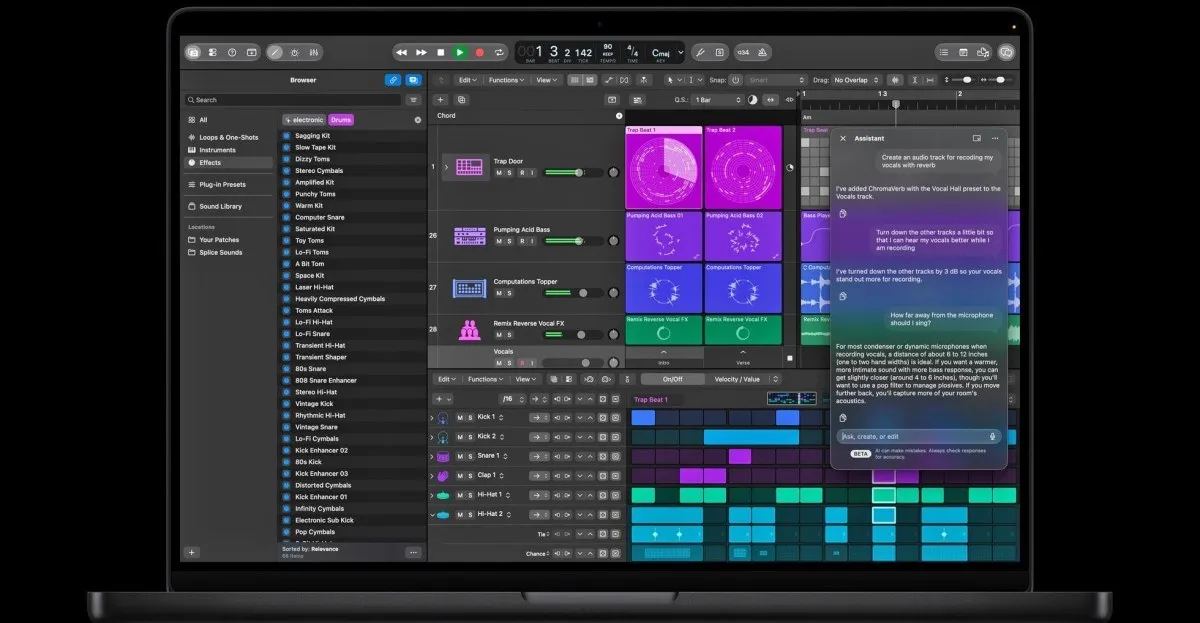
1. Apple starts selling AI usage packs: Logic Pro’s Intelligence Usage Pack costs $49.99#
In September Apple published a support article explaining that some Apple Intelligence features have usage limits. Now Logic Pro has a “Buy More Usage” option for a one-time $49.99, letting you keep using the built-in AI assistant to start songs, set up vocal tracks, and refine projects after hitting the limit. The Verge says Logic Pro is Apple’s first app to charge for extended Apple Intelligence usage, first spotted by 9to5Mac.
What it means for your app: Even Apple now ships AI features as “capped, buy more if you need it.” When I add AI features to an app, I will design a free allowance plus add-on packs instead of stuffing all the inference cost into the monthly price.
2. Pinky: let Claude Code, Codex, or Cursor drive your real iPhone or Android#
DIYgod’s open source desktop app, Apache-2.0, about 1,413 stars. Agents operate the phone over MCP while you watch on your computer, approve risky steps, and take over any time. Payments, trades, and transfers stop and wait for your click by default; the rules run in Pinky’s gateway, so an agent cannot approve itself. Banking, wallet, and password manager apps are hidden from agents by default, and agents cannot type into password or one-time code fields. Works with Android 10 to 17 and iOS 17.4 or later. RoundtableSpace’s post on X got about 56 likes and 54K views.
What it means for your app: You can have an agent run sign-up, subscription, and paywall flows on a real device and catch problems the simulator hides. I will start on a test phone, not my personal one.
3. Vercel AI Gateway report: decision models are a quarter of requests, and new teams pick Anthropic nearly two to one#
Vercel says AI Gateway routes more than 100 trillion tokens a month. In six weeks, decision models grew to 26% of requests while taking only half a cent of every dollar spent; close to a third of paid teams used one in October, and seven in ten teams processing over 10 billion tokens a month did. The share of paid teams using a voice model rose from 4% in July to 11%. More than half of language model requests went to models less than two months old. PostHog’s setup asks two yes/no questions first and only hands off to Gemini for a rewrite when either scores 0.4 or above.
What it means for your app: Classification, filtering, and “should I even call the big model” checks can go to a cheap decision model first. Models change so fast that I keep model names in one config file.
4. Automattic launches Spacefast: databases, auth, email, and analytics for vibe-coded apps#
The new service from WordPress.com’s parent provides databases, authentication, file uploads, email, and analytics, competing with Lovable and Emergent. It connects to agents like ChatGPT, Claude, Cursor, OpenCode, and Amp, or to a Git repo. Lead Batuhan İçöz says it started because non-technical friends kept sending him Vercel links.
What it means for your app: One more backend option for validating an MVP. My own apps stay on Firebase, but when I build small tools for friends I will compare its pricing.
5. store_screenshots: generate App Store and Google Play screenshots right inside flutter test#
From pub.dev: generate store screenshots in flutter test, with device frames, translated captions, RTL, 10 templates, and the Play Feature Graphic. Abd Alfath Salem showed on X one config file and one command producing 26 Arabic and English screenshots in 19 seconds; the post had very little engagement, so treat it as a personal demo.
What it means for your app: Multilingual screenshots have to be redone every release. I will try wiring this into CI so it runs once before every submission.
6. Superwall project setup now searches the stores and fills in name, icon, and bundle ID#
Superwall said on X that for a new project you just say the app is live, search it by name on the App Store or Google Play, and it fills in the name, icon, bundle ID, and package name. The post had about 214 views and very little engagement, so read it as a product update.
What it means for your app: The first step of wiring up a paywall tool got a little shorter. What I care about is the bundle ID and package name being filled in automatically, one less chance to mistype them.
What the Community Is Arguing About#
1. Was Opus 5.5 weakened? Someone analyzed 1,400 Claude Code sessions#
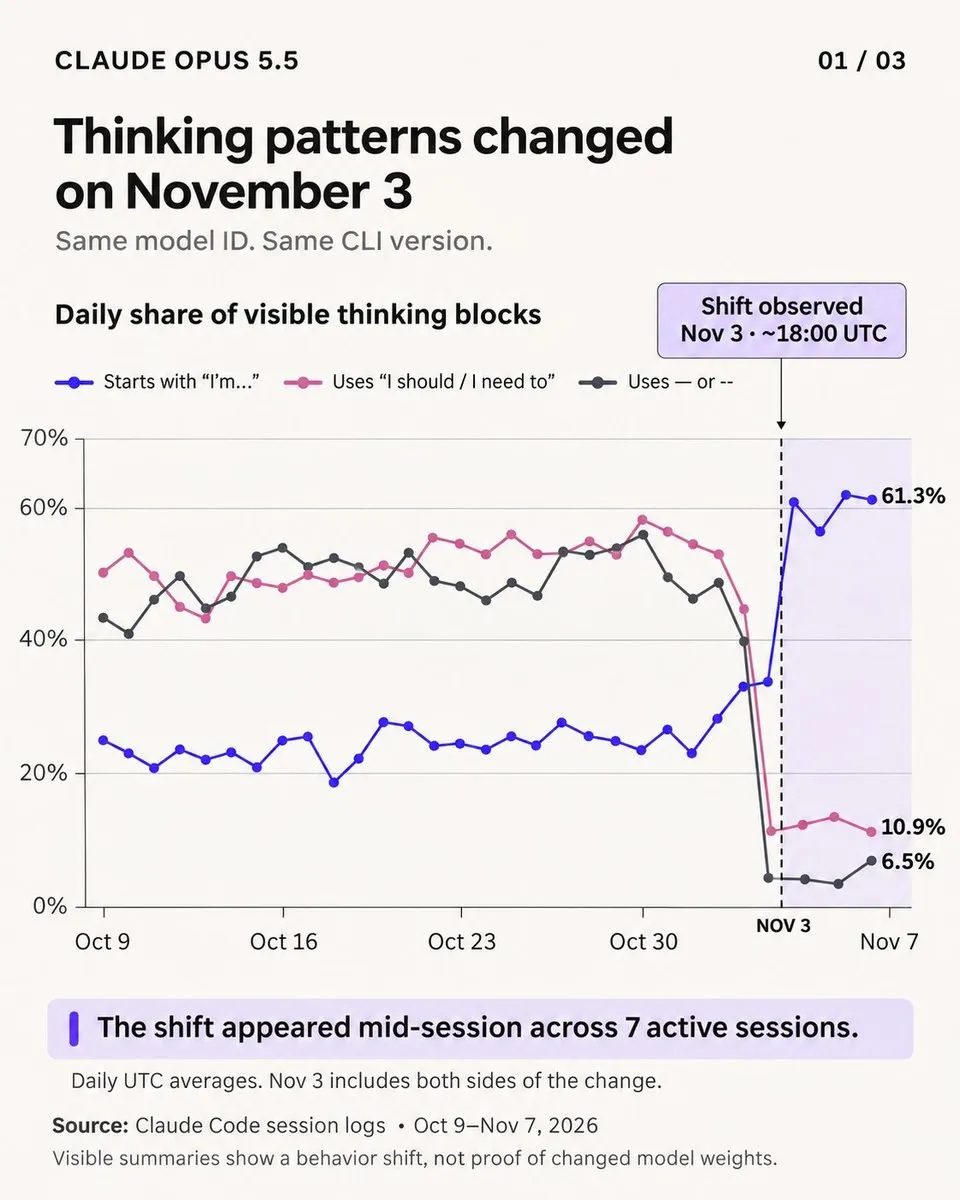
Shane Melaugh said on X that he had Gemini 4 Argon analyze 1,400 Claude Code sessions and found that on November 3 the model name stayed the same but its reasoning took a sharp turn; the post got about 3,046 likes and 560K views. About 666 points and 438 comments on HN. As soon as Fable 5.2 launched, people on HN said “so people were right about 5.5 being nerfed for the new model.” The fight: when behavior changes under the same model name, do users have a right to be told?
2. Terminal2Shell: a “critical flaw on every major OS” that turns out to be opening a terminal#
A satirical site styled as a security advisory: the flaw is that “a terminal connects to a shell when you open it,” the exploitation steps are “open a terminal, there is no step 2,” affected products go back to the 1978 VT100, the only safe one is Microsoft Paint, and the page has a fake shell you can type into. The Lobsters thread got about 58 points, and one commenter said “every serious vulnerability needs a logo, a domain, and a name ending in a number followed by a noun.” The fight: vulnerability naming and marketing keep getting more over the top, and this is a joke at that trend’s expense.
3. I saw your HN comment: AI-written sales emails disguised as questions#
Josh Strange says reader emails used to be great; he met people and even hired people through them. In the last two years they have been mostly pitches. The email quotes one of your comments, adds a compliment, and asks an open question; once you write two or three thoughtful paragraphs back, it turns into “that’s close to what I’m building” or “would you have 15 min next week?” He had Claude go through his email since 2013 to check that gut feeling. About 393 points and 284 comments on HN. The fight: should you stop answering strangers’ questions, at the cost of missing the people who really want to talk?
4. Is Fable 5.2 expensive? One prompt at max effort cost $642#
Rhino posted the cost of the same prompt at different effort levels: High $24.31 and 1h 05m, Max $87.99, Ultra $642.42 and 10h 21m. Another post points out Fable’s per-token price is double Opus 5.5’s. Both had very little engagement. The fight: cost per task went down, but pick the wrong effort and the total bill gets bigger.
Chinese Tech Scene#
1. After OpenAI and Anthropic, DeepSeek wants a plugin marketplace too: how the three platforms’ rules differ#
(TechOrange): DeepSeek says Harness has 1.54 million daily actives and about 35,000 third-party plugins, and it plans an official marketplace with token subsidies for developers; the numbers are self-reported.
2. GoLand 2026.3 lets AI agents drive the profiler to track down Go bottlenecks#
(iThome): Through MCP, agents can capture profiling data by CPU, memory, or lock contention and find the functions eating resources.
3. GitHub rebuilds its Git storage layer, stress testing 7,200 pushes per second to a single repo#
(iThome): Built for heavy writes from AI agents, the new Rubicon architecture supports 5,000 agents working on one repo at once, currently in limited private preview.
4. When Flutter meets HarmonyOS: a “magazine-grade” hybrid development case study#
(InfoQ China): Flutter WebView plus a JSBridge connect to native capabilities, with the full story from pitfalls to launch.
5. Bad at managing people, bad at coding agents? An Anthropic engineer’s long post on managing agents#
(InfoQ China): A practical handbook on managing agents, written by an Anthropic engineer.
6. The share of developers saving dozens of hours a week with AI fell from 68% to 26% in a year#
(InfoQ China): Atlassian’s report says 95% of developers’ organizations already use AI, yet the share saving more than ten hours a week dropped from 68% to 26% in a year.
7. One zero-day every 2.5 hours and 400+ root escalations: AI is turning Linux into a sieve while humans need weeks to reverse one#
(InfoQ China): AI finds Linux kernel bugs far faster than humans can analyze them, and the piece quotes “the only way out is to take humans out of the defense loop entirely.”
8. Do not bet your whole security program on LLMs: AI can triage CVEs, but human review still matters#
(InfoQ China): AWS shows how AI agents triage Linux kernel CVEs, the opposite stance to the previous item.
9. ezTravel hacked, 690,000 people’s data leaked; company says no card numbers involved#
(TechNews): ezTravel detected an attack on its member center on the 7th; contact details from some past orders leaked, and it warns users to watch for scams.
10. Someone learned to build an automated attack system with AI; Kaohsiung police warn the bar for cybercrime is dropping#
(iThome): The suspect used AI to learn coding and site building, broke into site back ends, and sold more than 230,000 personal records.
11. Google adds two new TPU systems, and TPUs support confidential computing for the first time#
(iThome): TPU 8tx adds hardware security and pairs with custom AMD CPU hosts for confidential computing.
12. AI keeps getting smarter while companies struggle to control it: Gartner’s top 10 trends for 2027 make agent governance the new battleground#
(InfoQ China): Gartner predicts that by 2031, 80% of new applications will be disposable and easy to replace.
Open Source Picks#

1. janestreet/agent_skills#
Markdown | 1,939 stars
Jane Street’s open source agent skills. Right now there is one, socratic-tutor: a diagnostic, a skill map with levels 0 to 5, one question at a time, spaced review, and a final assessment.
2. govijr/terminal-mac#
Swift | 2,503 stars
Runs a separate macOS guest with Apple Virtualization for computer-use agents, viewed and controlled from your terminal without touching your real Mac’s pointer or clipboard.
3. jhaizhou-ops/S2Arm#
C# | 1,713 stars
Rewrites your own Switch games to ARM64 with graphics going straight to Metal, running natively on iPhone, iPad, and Mac; bring your own games and keys.
4. huamidev/GestaltX#
Swift | 1,372 stars
A MobileGestalt editor for iOS 27.x with region code tweaks, device presets, backups, and 7 languages.
5. voyager-so/vork#
Rust | 1,280 stars
A 3D and VFX engine for agents where scenes, shaders, cameras, and physics are all code; the team says a million-bird 1080p shot of 192 frames rendered in 97 seconds on a single L4.
Watch & Listen#
1. Fireship: OpenAI spent $1.2 million hacking Linux, and it was a bargain#
Channel: Fireship

Why it matters to you: A model most people are not allowed to use tore through the Linux kernel and came back with 948 root exploits, the same thread as Mythos 5.2’s security skills today.
- Takeaway 1: The video description says the model came back with 948 root exploits
- Takeaway 2: Pair it with the “one zero-day every 2.5 hours” piece in Chinese Tech Scene
- Takeaway 3: Short format, a few minutes long
2. Theo: Coding isn’t about code anymore#
Channel: Theo (t3.gg)
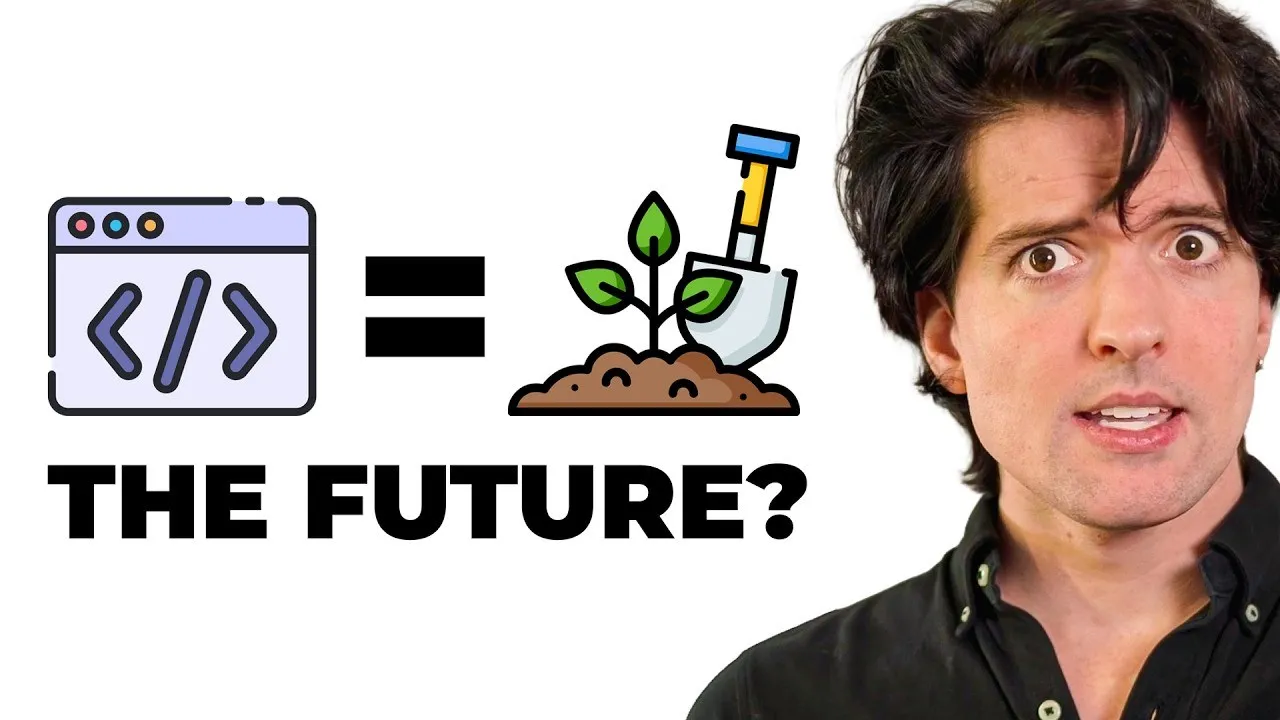
Why it matters to you: He says AI has given engineers a new job that looks more like gardening, close to agent-autoloop’s idea that you only make the calls.
- Takeaway 1: The topic is the engineer’s role moving from writing code to tending and pruning
- Takeaway 2: Good to watch alongside Simon Willison’s post on PR descriptions
- Takeaway 3: This episode is sponsored by CodeRabbit
3. 20VC: Mistral’s CEO on why OpenAI and Anthropic will come for your business#
Channel: 20VC

Why it matters to you: Arthur Mensch talks sovereign AI and whether Chinese open-weight models are safe, questions you will get if you sell to enterprises.
- Takeaway 1: Mistral has raised about $7.5 billion including debt, at a valuation above $24 billion
- Takeaway 2: He co-authored the Chinchilla paper and was previously at Google DeepMind
- Takeaway 3: One chapter asks whether Chinese open-weight models are really safe
Today’s Take#
I am trying Fable 5.2 today. The price went down, and High alone matches Opus’s best score, so token usage is what I care about. I will run a Flutter state management refactor through it and keep an eye on the cost.
The SSH agent story made me open ~/.ssh/config right away. This kind of “save one step” design is everywhere, and the problem is the default. Machines I give to agents only get a deploy key scoped to one repo.
Shubs’s post made me sweat a little. It all started with decompiling one app, and the keys and admin URLs hardcoded into front-end bundles were the start of the whole chain. This week I plan to unpack every Flutter release build I own.
Pinky and agent-autoloop are two answers from different directions: one keeps approval for risky actions in the gateway, the other turns “needs your decision” into a card. I like this kind of design. The agent can go far, and I still hold the keys.
The DMARC mess at Microsoft is also a reminder to check sending domains regularly. When verification emails do not arrive, users just think the app is broken, and nobody suspects Outlook.
One last, more personal thought. A lot of today’s news is about convenience: SSH agent forwarding saves you typing a password, the carmaker kept admin tools public to make maintenance easier, and someone only found out from their logs that Opus’s reasoning had changed. Each decision makes sense on its own. Stacked together you get an attack chain, or a change users cannot explain. I will turn this week’s checks into a checklist in every project’s README.