No One Checks the Sender
A shared link takes over ChatGPT accounts; a Linux TCP bug rated CVSS 9.8 is still unpatched in RHEL

Spend 1% of your day keeping up with tech.
Quote of the Day#
“I was looking at an enshittified wall of slop.” — Andrej Karpathy, former Tesla AI lead and former OpenAI researcher (HackerTube post)
“The underlying bug is not specific to MPTCP.” — Go Security Team, Go language security team (quoted by Atlas Security)
“A bit cheap for a vulnerability this serious.” — Simon Willison, creator of Datasette (on the $5,000 bounty)
Today’s Theme: No One Checks the Sender#
Parameter Labs used a public ChatGPT share link to run the attacker’s JavaScript inside the victim’s logged-in session as soon as the link was opened. It starts with MathLive’s keyboard message listener, whose origin policy is set to none, so the sandboxed HTML Preview can push HTML into the main page. The Linux TCP bug CVE-2026-98432 was patched upstream on October 11 and 15, yet Ubuntu’s tracker still said Vulnerable on October 31, and RHEL 8, 9 and 10 have no fixed version either. Jepsen found 96 problems in ParticleDB, whose homepage says “formally proven”, yet no TLA+ spec was available during testing. What the three share is a layer between the protection that is claimed and what anyone actually checks. My read is that nobody normally verifies that layer, which is why outside researchers got to it first.
Must Read#
- Jepsen tests ParticleDB: 96 issues, and the default mode still loses committed writes — Lobste.rs
Dev - Karpathy had Opus 5.5 build a YouTube of only the 6,454 videos Hacker News recommended — Hacker News
Tools - DeepSeek open-sources dsh-superagent: a GitHub coding agent that acts only when asked or when rules allow — GitHub
AI - matklad: public functions should not call other public functions — Lobste.rs
Dev - Linux TCP use-after-free CVE-2026-98432: CVSS 9.8, and Ubuntu and RHEL kernels are still unpatched — Hacker News
News - Parameter Labs takes over ChatGPT accounts with one share link; OpenAI pays a $5,000 bounty — Hacker News
AI - Arca’s head of AI on agents doing multi-day financial work: persistent memory and a custom harness — Latent Space
AI - The Kluever Maneuver: fix a bug in two commits, starting with a passing test of the wrong behavior — Lobste.rs
Dev - Pragmatic Engineer: one Anthropic team has dropped the coding interview — Pragmatic Engineer
AI - Google admits AI Mode hurts search revenue; stock falls 15% in a day, about $500B in market value gone — Latent Space
AI - Scribd data breach: last four card digits, expiry dates and payment history accessed — Hacker News
News - Jülich researchers trace the grid’s 60-second frequency dips to large battery storage systems checking their charge — Lobste.rs
News
1. Jepsen tests ParticleDB: 96 issues, and the default mode still loses committed writes#
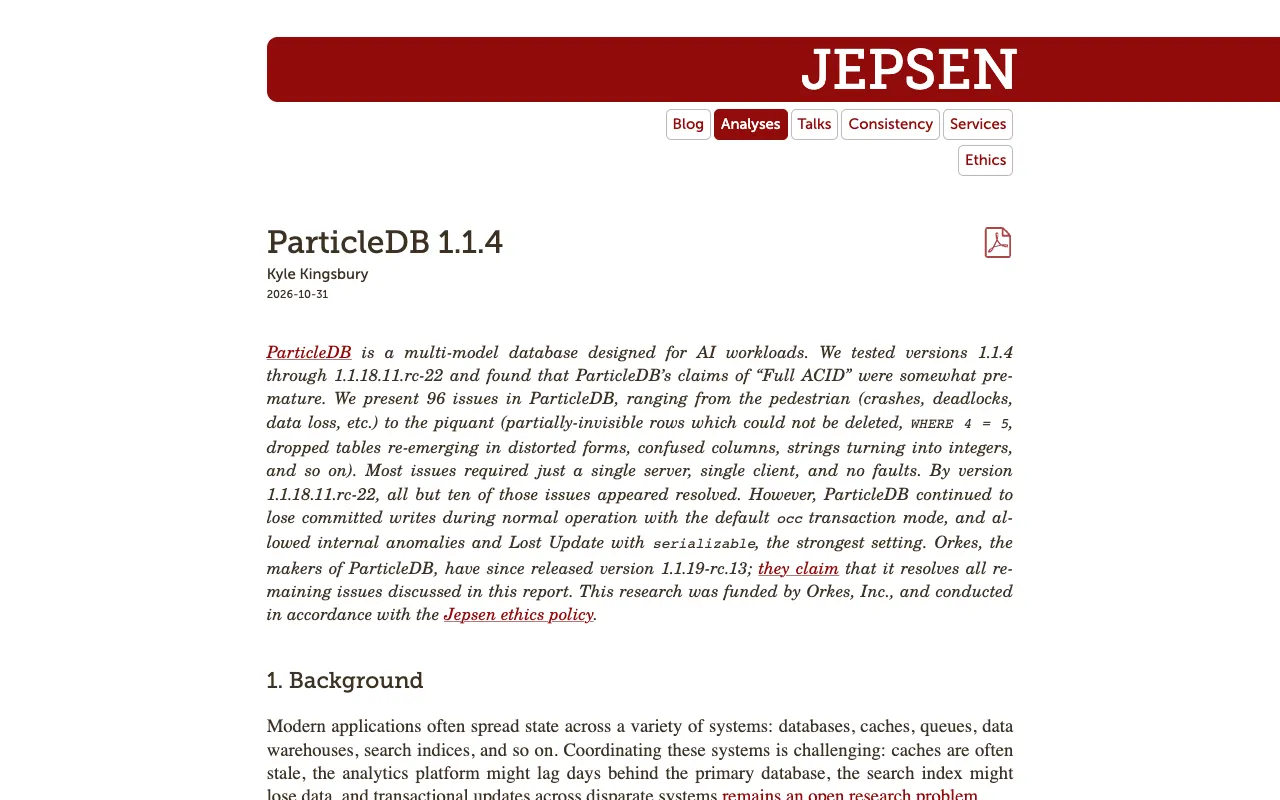
Kyle Kingsbury tested ParticleDB 1.1.4 through 1.1.18.11.rc-22 and found 96 issues, from crashes, deadlocks and data loss to “WHERE 4 = 5” returning rows and half-invisible rows that cannot be deleted. Most of them reproduce with a single server and a single client, with no faults injected. By rc-22 only 10 remained unresolved, but the default occ transaction mode still loses committed writes, and even the strongest serializable setting shows Lost Update. Orkes funded the study, and says 1.1.19-rc.13 fixes the rest.
- ParticleDB’s homepage claims “formally proven” with a TLA+ proof, but Jepsen could not get any TLA+ spec during the collaboration
- Testing covered a single node only; Raft replication exists only in the enterprise cloud edition, which the version Orkes provided does not support
💡 Why it matters: Teams using ParticleDB as an AI agent state store should know the default occ mode still drops writes in rc-22, so run your own consistency tests before upgrading.
🔗 Read the original | Source: Lobste.rs
2. Karpathy had Opus 5.5 build a YouTube of only the 6,454 videos Hacker News recommended#

At 11 p.m. on Friday Karpathy opened YouTube and saw a wall of garish thumbnails and repetitive recommendations, so on Saturday morning he handed Opus 5.5 the job of building his own version. Opus downloaded the entire Hacker News comment archive and used Sonnet to run a workflow that filtered out junk, leaving 40,000 comments recommending YouTube videos. These were organized into 6,454 videos across 150 topics from 2007 to 2026, wrapped in a YouTube-style interface and put online at hackertube.org. He says the whole thing took about two hours.
- Thumbnails use the frame at 50% of each video instead of the uploader’s chosen thumbnail
- ForYou recommendations need no account, and state lives only in the browser session
- The site offers a data export that you can hand to your own agent to build another version
💡 Why it matters: Anyone who wants to build their own content recommendation site gets the full pipeline here: comment data, LLM filtering, front end, VPS, one round in two hours.
🔗 Read the original | Source: Hacker News
3. DeepSeek open-sources dsh-superagent: a GitHub coding agent that acts only when asked or when rules allow#
dsh-superagent is a proactive coding agent for a single GitHub repo, packaged as a DeepSeek Harness bundle. It listens to GitHub and can optionally connect to Feishu. When an allowed person asks, it opens a work item, works in its own session and directory, then returns to the original conversation, for example to submit a pull request. The web panel shows only what needs a human. The project has 2.9k stars and 250 forks, is MIT licensed, and has a single commit.
- The README opens by saying this is a research prototype, not an official DeepSeek product, and that a coding agent did much of the engineering
- The design principle is written as “the most value for the least human attention”: act only when asked or when a rule written by the team allows it
💡 Why it matters: If you want to bring an agent into your team’s GitHub workflow, read its docs to see how it sets the rules for “when to bother a human”.
🔗 Read the original | Source: GitHub
4. matklad: public functions should not call other public functions#
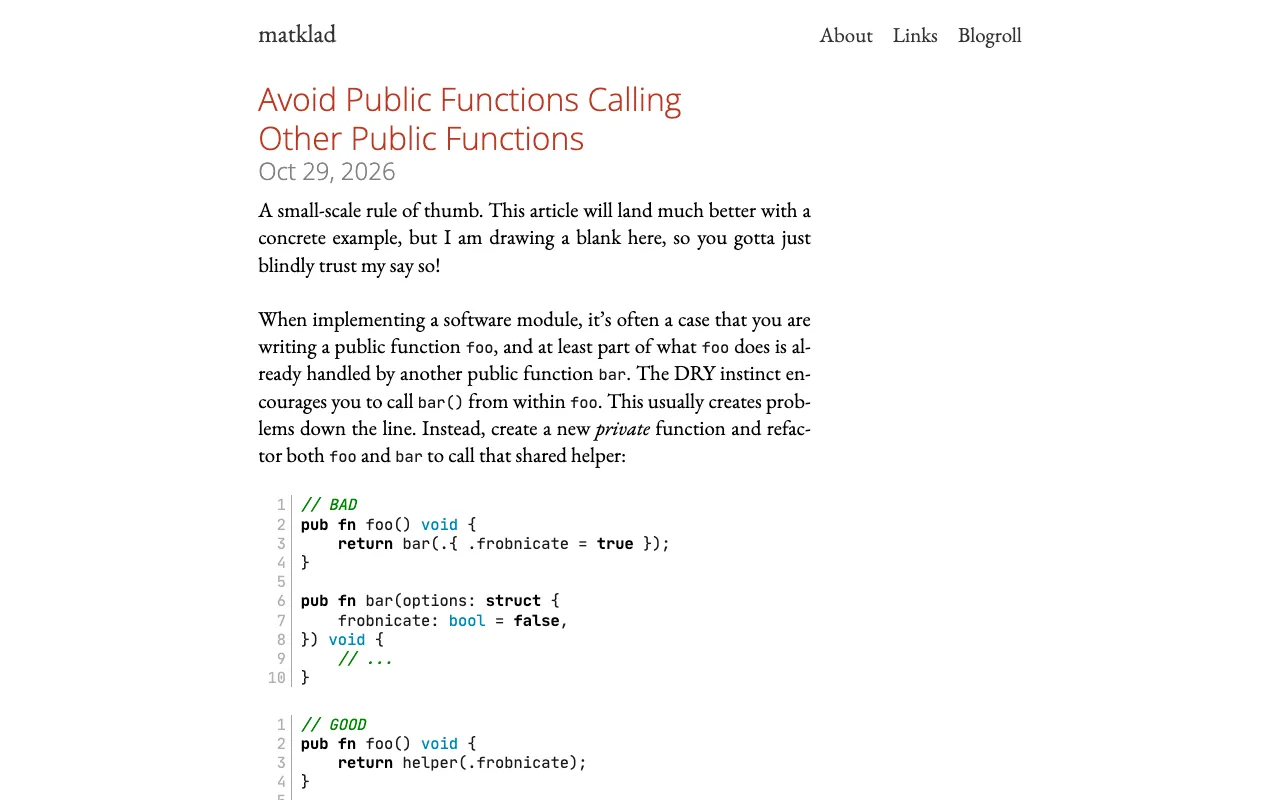
matklad offers a small-scale rule of thumb: when writing a module, if public function foo does part of its work through another public function bar, the DRY instinct says to call bar() from foo, but this usually causes trouble later. His advice is to extract a private function that both foo and bar call. He admits he cannot think of a good concrete example and asks readers to take the claim on trust for now.
- The example is in Zig syntax and changes foo() calling bar(.{ .frobnicate = true }) into both sharing a private helper
💡 Why it matters: For anyone maintaining a library’s public API, this rule decides whether a later change to bar’s parameters also changes foo’s behavior.
🔗 Read the original | Source: Lobste.rs
5. Linux TCP use-after-free CVE-2026-98432: CVSS 9.8, and Ubuntu and RHEL kernels are still unpatched#
Atlas Security wrote up a remote use-after-free in the Linux IPv4 TCP handshake. Upstream stable kernels fixed it on October 11 and 15, in versions 5.10.272, 5.15.223, 6.1.190, 6.6.159, 6.12.113, 6.18.56, 7.2.10 and 7.3, and the bug traces back to 4.4. As of 5:15 p.m. on October 31, Ubuntu’s tracker still marked every version Vulnerable, Red Hat raised it to Critical on October 30, and RHEL 8, 9 and 10 are listed as affected with no fix. Amazon Linux is fully patched, and AlmaLinux’s patched kernel is in testing.
- The reporter is Anthropic’s Xinyang Ge; Anthropic says Claude wrote a remote root exploit against servers with a multipath TCP listener, not yet public
- Since Go 1.24, MPTCP is on by default for listen sockets; the Go Security Team says the bug is not limited to MPTCP
- Check with
ss -Mlnpandsysctl net.mptcp.enabled
💡 Why it matters: Ops staff running Go services on Ubuntu or RHEL kernels should check their MPTCP listeners now and apply the nftables mitigation Red Hat provides.
🔗 Read the original | Source: Hacker News
6. Parameter Labs takes over ChatGPT accounts with one share link; OpenAI pays a $5,000 bounty#
Parameter Labs found an attack chain between ChatGPT’s HTML Preview and its charts feature. MathLive, loaded by the charts, installs a listener on the main page that receives keyboard configuration messages. Its origin policy is none, so any URL can send it messages, and the keyboard layout allows HTML. The sandboxed Preview can therefore push HTML into the main page and insert an iframe with no sandbox restrictions. The CSP blocks only inline scripts, but YouTube is on the allowlist and its oEmbed endpoint can reflect JavaScript back to be executed. A victim only has to open a conversation the attacker shared publicly, and their private conversations can be read and the data sent out.
- OpenAI patched it on October 26 and rated it P1
- Simon Willison’s comment: a $5,000 bounty is “a bit cheap” for this severity
- The victim does not need to install an app, paste code or open developer tools
💡 Why it matters: If you build a “paste HTML to preview” feature, the postMessage receivers outside the sandbox are the next thing to audit.
🔗 Read the original | Source: Hacker News
7. Arca’s head of AI on agents doing multi-day financial work: persistent memory and a custom harness#

Latent Space interviewed Arca’s head of AI at AI Engineer New York, in a 26-minute podcast about persistent memory, the benefits of a custom harness, and agent workflows that span several days. The episode title means the agent prompts the human proactively instead of waiting for commands.
- Topics include persistent memory, a custom harness, and multi-day agentic workflows
💡 Why it matters: If you are building long-running agents, this is a chance to hear how a financial firm actually keeps agent state across days.
🔗 Read the original | Source: Latent Space
8. The Kluever Maneuver: fix a bug in two commits, starting with a passing test of the wrong behavior#
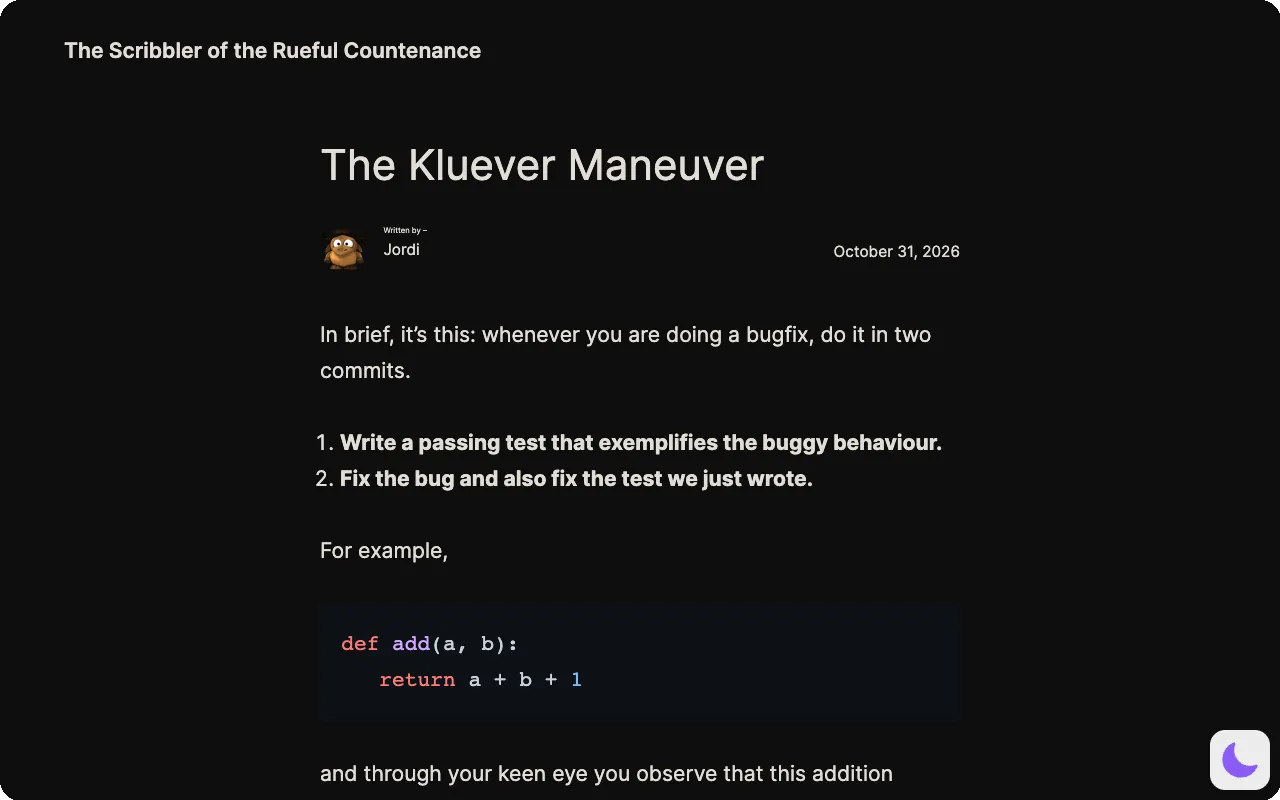
The author proposes a way to fix bugs: the first commit adds a “passing” test that records the current wrong behavior, and the second commit fixes the bug and changes the test to the correct expectation. There are two reasons: it proves the fix actually changed the behavior, and CI is green at every commit. In the traditional approach the test and fix share one commit, and if the test already passed before the fix, the fix did nothing and the test gives false confidence.
- Example: add(2, 2) first asserts it equals 5, then after the fix asserts 4
- A second example is an age-check off-by-one:
18 <= age_in_yearsbecomes18 <
💡 Why it matters: For people who review bug fixes in PRs, two commits let the reviewer see on its own that the test really was red before the fix.
🔗 Read the original | Source: Lobste.rs
9. Pragmatic Engineer: one Anthropic team has dropped the coding interview#
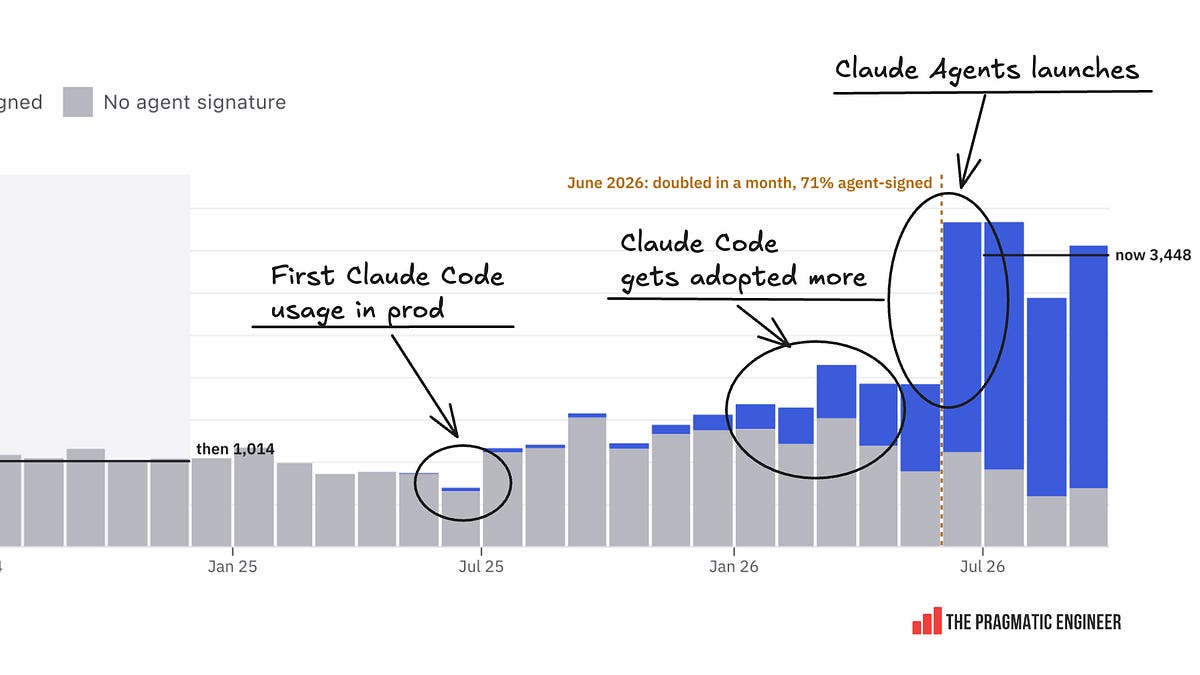
Felix Rieseberg, the Anthropic hiring manager who led Claude Cowork and Claude Desktop, revealed that his team no longer gives coding tests for software engineering roles. Gergely Orosz notes that the team got no signal from DSA interviews and so removed them from hiring, and that other teams at the company and other AI-native startups may follow. The same issue also covers incident.io’s per-developer monthly AI spend falling from $4,500 in August to $1,600, Amazon adding AI use to its SDE and SDM expectations, and Microsoft offering buyouts to 60,000 employees. The full text is paywalled, so this summary is based only on the public intro.
- Amazon found a correlation between AI use and productivity before writing it into engineer-level expectations
- Microsoft’s buyout terms are not very attractive, and Gergely expects thousands to accept, not tens of thousands
💡 Why it matters: For managers hiring engineers, this issue is the most concrete reference so far on what to replace the interview with.
🔗 Read the original | Source: Pragmatic Engineer
10. Google admits AI Mode hurts search revenue; stock falls 15% in a day, about $500B in market value gone#
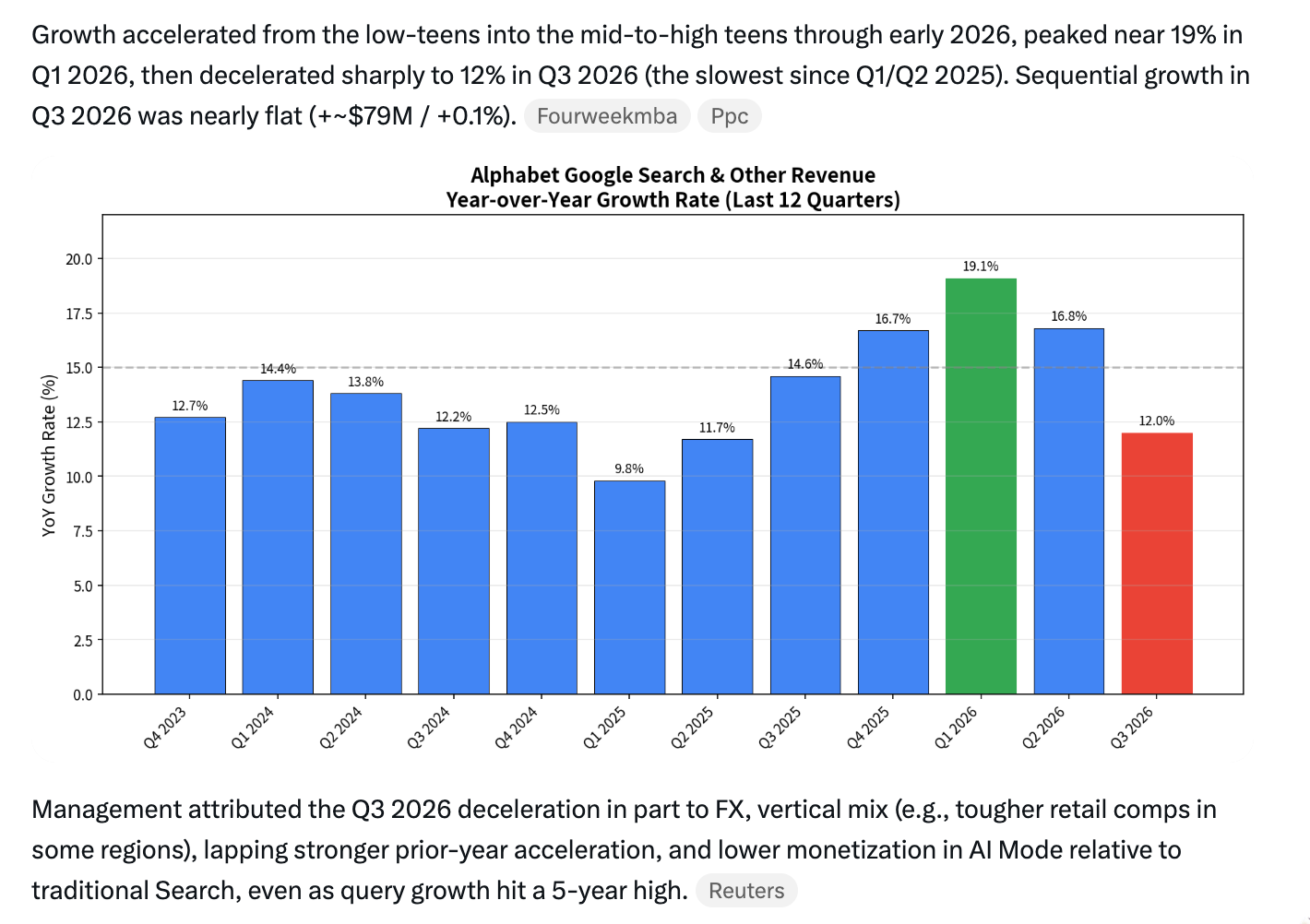
This AINews issue’s headline says Google admitted AI Mode hurts search revenue, and notes the 15% drop, about $500B in market value, the largest one-day fall since its 2004 IPO. The quoted explanation is that strong growth in AI Mode queries had an impact because AI Mode monetizes less. Google does not break out AI Mode, so the size of the effect cannot be calculated directly from the earnings report.
- Quote from the original: “strong growth in AI Mode queries had an impact because of the lower monetization we were seeing in AI Mode”
💡 Why it matters: For sites that live on search traffic, Google itself says AI Mode monetizes less, so both traffic and ad prices need to be re-estimated.
🔗 Read the original | Source: Latent Space
11. Scribd data breach: last four card digits, expiry dates and payment history accessed#
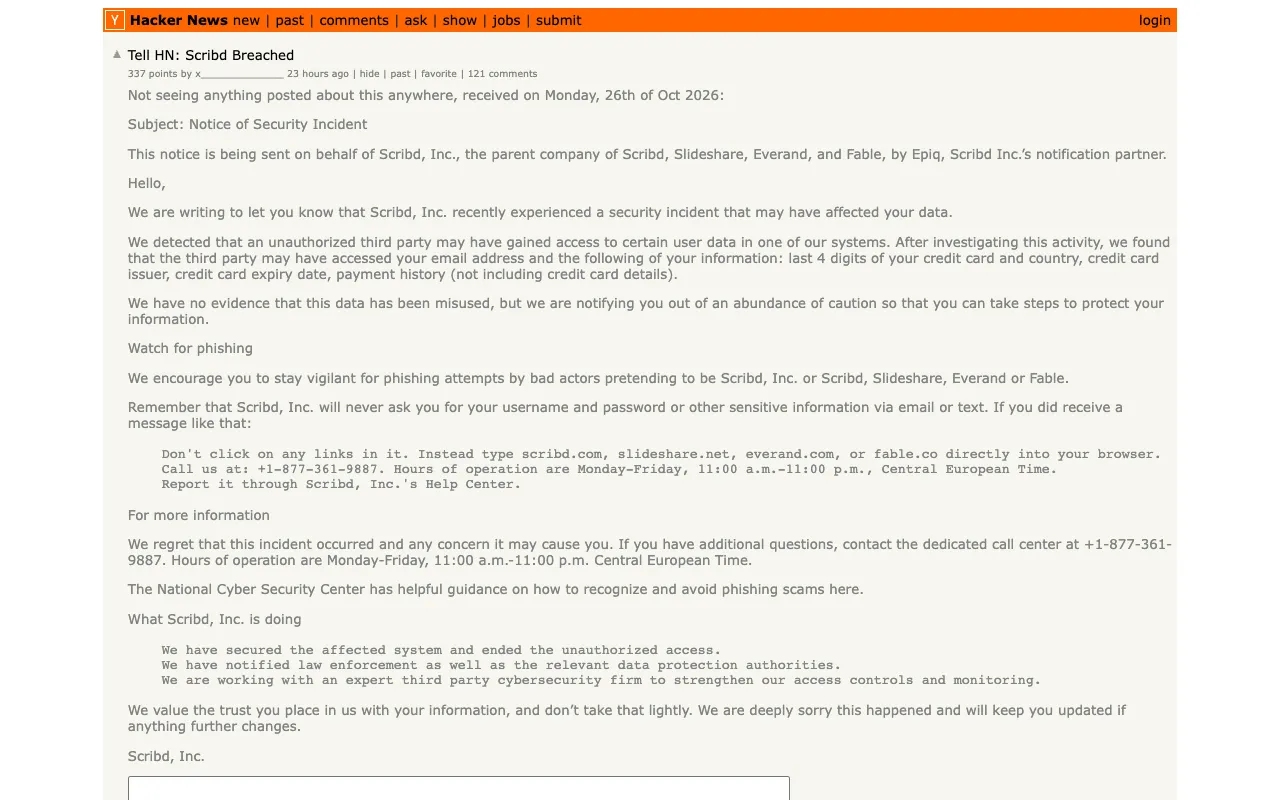
A Hacker News user posted a notice received on October 26: Scribd, Inc. (which owns Scribd, Slideshare, Everand and Fable) says an unauthorized third party may have accessed user data in one of its systems. What may have been seen includes email, the last four card digits and country, the card issuer, the expiry date, and payment history (not full card details). Scribd says it has no evidence the data was misused. The post has 337 points and 121 comments, and the poster says nothing else had reported it at the time.
- The notice was sent by Epiq on Scribd’s behalf and warns about phishing emails impersonating Scribd
💡 Why it matters: Scribd and Everand subscribers should expect phishing emails posing as the company, now that card expiry dates are out in the open.
🔗 Read the original | Source: Hacker News
12. Jülich researchers trace the grid’s 60-second frequency dips to large battery storage systems checking their charge#

For years, Tennet, Germany’s largest transmission operator, has seen the European grid frequency dip briefly every 60 seconds. A Jülich team led by Dirk Witthaut, working with the University of Cologne and KIT, published the result in Nature Energy: many large battery storage systems check their charge once a minute, causing a measurable swing in power draw. They placed measuring points at 80 locations on the Jülich campus and saw the same cycle wherever large battery storage systems are located. The effect is not limited to Europe and appears worldwide.
- There is no common standard for these charge checks, and Witthaut guesses most battery vendors consider 60 seconds a reasonable interval
- The researchers note the fluctuations may speed up turbine wear
💡 Why it matters: Designers of grids and storage systems can avoid the simultaneous draw spike by staggering the check times across batteries.
🔗 Read the original | Source: Lobste.rs
More to Read#

- Simon Willison: datasette-llm 0.1a9 now follows LLM’s default model — datasette-llm now picks up the default model used by LLM, so using Datasette Agent no longer requires setting a default model by hand first.
- Lenny: Community Wisdom 304, the biggest sources of PM interruptions and how to interview junior PMs with case studies — A community roundup on what interrupts PMs most, and how to interview junior PMs with case studies.
- OpenAI: helping websites express AI training preferences with robots.txt — OpenAI will honor a shared robots.txt signal so site operators can express AI training preferences to participating providers.
- NVIDIA on Hugging Face: nemotron-halloween — NVIDIA’s nemotron-halloween post on the Hugging Face blog. The source gave no summary, so read the original for the content.
- TechCrunch: data centers are now a midterm issue, even in Brooklyn — Five days before the election, at a midterm party in Brooklyn, talk from a city council member’s fireside chat to a debate about the Democrats kept coming back to AI and data centers.
- Cloudflare: tracking exploitation and patching of eMudhra weak keys — Cloudflare tracks how the eMudhra weak keys have been exploited and how far patching has come, following the certificate authority incident mentioned in the October 29 digest.
- OpenAI reportedly lowers funding target for new round — TechCrunch reports OpenAI has lowered the target amount for its new funding round; the source summary gave no further detail.
- Apple CEO says the company doesn’t want to ship AI for AI’s sake — Apple’s CEO says the company doesn’t want to ship AI “for AI’s sake”.
- The Verge: Binance CEO says 90 percent of stolen crypto has been replenished — Binance’s CEO says 90% of the stolen assets have been “replenished”.
- Stratechery Sharp Tech: Anthropic’s S-1 and what it means for Meta and Muse — A Sharp Tech video episode discussing Anthropic’s S-1 filing. The original is paywalled, so this is listed from the title only.
- Vitalik: digital minimalism — A post by Vitalik Buterin, published October 31, on digital minimalism.
- Talos: malware uses an LLM to rank victims by their “net worth” — A Cisco Talos post whose title says a piece of malware uses an LLM to assess the value of victims and prioritize them.
- ByteByteGo: how Uber built a gateway for AI agents — ByteByteGo walks through the design of Uber’s gateway that lets AI agents reach internal tools.
- Latent Space: why agents love Supabase — Latent Space’s feature on Supabase.
- Pragmatic Engineer: Titus Winters on software engineering at Google and CS education — Pragmatic Engineer talks with Titus Winters about software engineering at Google and CS education.
Chinese Tech Scene#

- InfoQ China: created tens of millions of times a day, why has the Agent Sandbox become a new form of compute? — A video program on the demand for Agent Sandboxes being created tens of millions of times a day.
- InfoQ China: if AI hallucinations had a budget, what happens after you overspend? — An article on what to do after overspending, from the angle of a “hallucination budget”.
- InfoQ China: an AI coding tutor takes on low-end Android phones, running Python and SQL right in the browser — An article on an AI coding tutor that runs Python and SQL in the browser of a low-end Android phone without a server.
- TechNews: Oxford study argues for making “happiness” the third core of AI policy — Oxford University researchers urge the EU to count public happiness as a yardstick in AI policy, alongside economic growth and risk reduction.
- TechNews: semi-adversarial training makes AI mental health support more realistic — The research notes that traditional training has two AI personas play therapist and client in a highly cooperative exchange; the new work uses semi-adversarial training instead.
- TechNews: Macronix earns more than a full share capital in the first three quarters, Q3 gross margin tops 70% — Macronix’s profit for the first three quarters exceeded its share capital, and Q3 gross margin broke through 70%, a record high.
- Ruan Yifeng’s Weekly for Tech Enthusiasts, issue 417: don’t let AI represent you — Issue 417 of the weekly, titled “Don’t let AI represent you”.
Open Source Picks#
patch-gg/pixelfx — JavaScript | ⭐ 1.5K 244 pixel-art effects, each a small piece of code, plus a Claude Code skill for making your own.
Watch & Listen#
My last video about ai harnesses#
2026-10-30 · Theo (t3.gg)
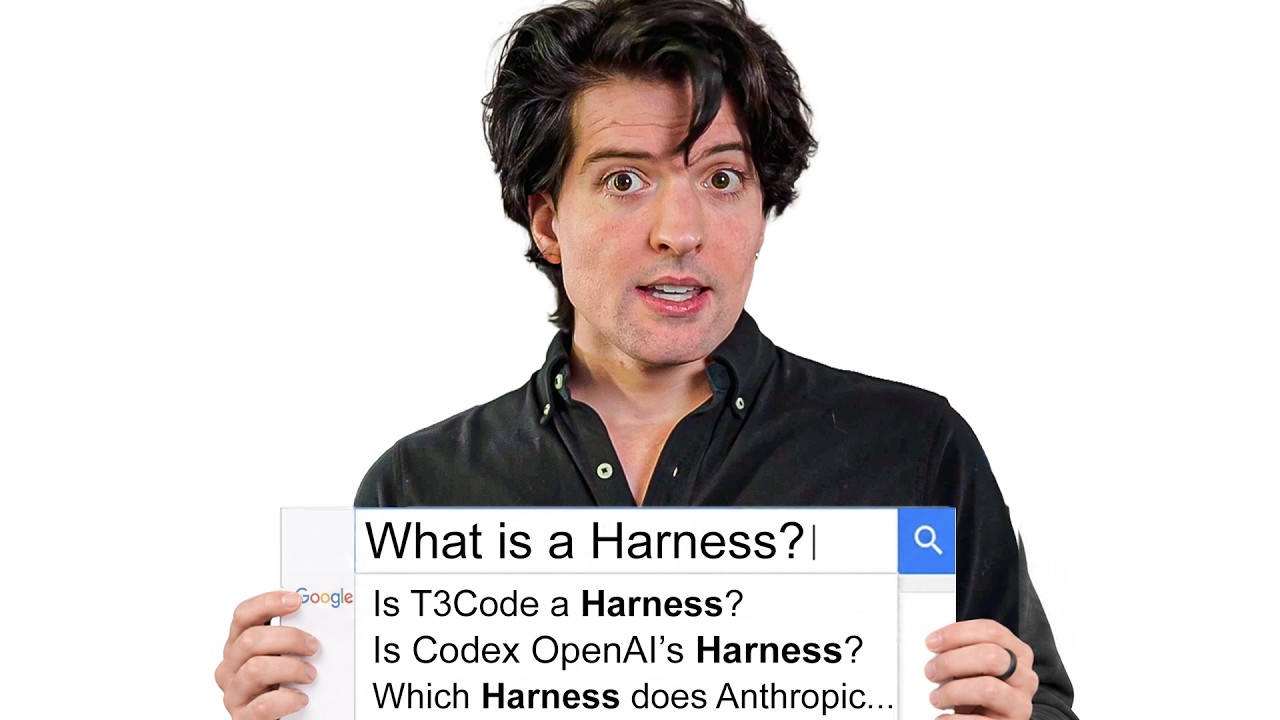
Theo says he could not find anything online that clearly explains what a harness is, so he made this video, prompted by an earlier tweet saying “harnesses don’t matter” that people mocked. The video is sponsored by Vercel.
- A harness gives the LLM a special syntax; the LLM responds in that syntax, and the harness reads files, edits files, pushes to GitHub, runs commands or accesses memory
- Shipping a tool means shipping code, whether TypeScript, JavaScript, Python, or even three lines of bash calling an external API
- His take: MCP is bindings, not code
David Tisch: Why No Manager Wants to Stay Small & Why Competing with Mega Platforms is a Losing Game#
2026-10-31 · 20VC
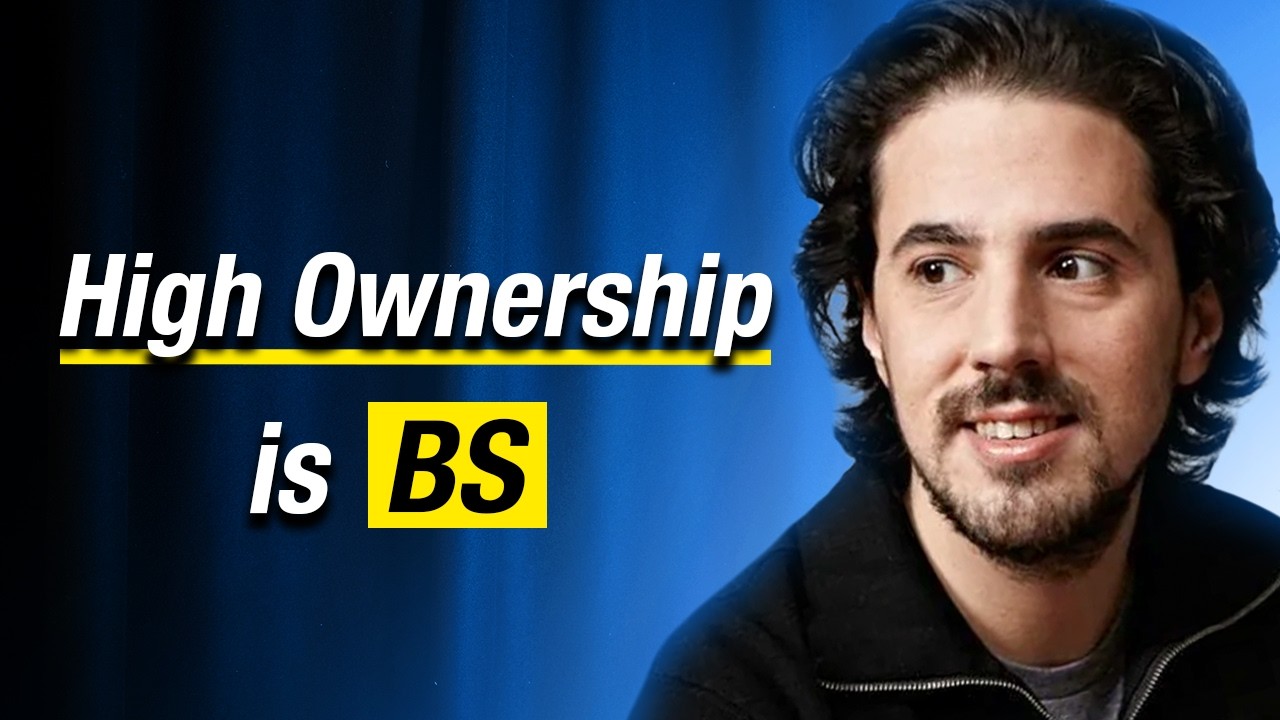
Box Group founder David Tisch on early-stage investing. Box Group has been one of the best seed funds of the past decade, with early bets on Cursor, Baseten and Clay, and currently runs a $275M seed fund and a $275M opportunity fund. It is a long video, summarized here from a transcript sampled across the whole episode.
- He says the seed market has become more efficient since the pandemic: competitive deals used to draw 3 to 5 term sheets and may now draw 10 to 15
- He thinks the lean startup is fake, and says the right to invest in later rounds is earned through performance
- The host says he has always questioned Tisch’s low-ownership, high-diversification model, and admits in this episode that he was wrong
OpenAI at $1.25 Trillion Is a Bargain?#
2026-10-30 · 20VC
Jason Lemkin thinks OpenAI is one of the most misunderstood investments in AI: at a $1.25 trillion valuation he would put 20% of a fund into it, and argues that this one position could return the whole fund.
- His argument is that the market is in a brief panic and OpenAI’s models have closed the competitive gap
- He contrasts it with the mispricing of Anthropic’s round at about a $183B valuation
Today’s Take#
In the Parameter Labs ChatGPT attack chain, no single feature is wrong on its own: the HTML Preview is sandboxed, MathLive’s keyboard receiver is just a side feature of a charting library, and having YouTube on the CSP allowlist is reasonable too. Three designs that each make sense, chained together, produce a path from the sandbox to the main page, and OpenAI’s bounty was $5,000. The Kluever Maneuver post does the opposite: it splits “the test was red before the fix” into its own commit so the reviewer can see it. My read is that what separates today’s stories is whether anyone pulled the seam out and checked it on its own.
Found this useful? Share it with a friend who also keeps up with new tech.
Long-term investors are also welcome to try a new tool → Moniit