Claude Code lets agents write code to call tools, and hardware starts opening up to agents
Claude Code ships an experimental Code Mode where Claude writes one JavaScript block that chains several tool calls; owners of a $70 synth wrote piles of custom firmware with AI, and the maker open sourced its own; old Bitly links were redirected, turning a 2011 Burger King tweet into a list of Nazi camps; a class action accusing the three DRAM makers of cutting supply survives dismissal

Contents59
Spend 1% of your day keeping up with tech.
Quote of the Day#
“When software is cheap to write, the firmware a device ships with is just the first version.” — Geoff Stearns, “Your Agent Will Pick the Hackable One” (source)
“Turning this collective knowledge into proprietary, closed-source code feels like license laundering.” — Jakub T. Jankiewicz, “All AI-generated code should be Open Source” (source)
“Having an affair with a subordinate is a fireable offense.” — An ally of Jensen Huang, as quoted by the Financial Times (source)
Today’s Theme#
The thing I want to start with is Claude Code’s Code Mode. Until now an agent went back to the model after every tool call. Now it can write a short JavaScript block that reads files, searches and runs commands in one go. To me this is a turning point in how agents work: they start acting by writing code, and what we review shifts from individual calls to a block of code.
The same day, a post about hardware landed. Owners of a small synth used AI to write a virtual analog synth, a groovebox, even Doom, and the maker responded by open sourcing its firmware. The author’s bet is that more buying decisions will run through agents, and the devices you can modify will get picked. On YouTube, someone had Codex help fix the engine computer of a 1994 Jeep, reading ECU data with an Arduino that costs a few dollars.
The flip side is old stuff coming back to bite. A batch of Bitly links from more than a decade ago got new destinations, so old Burger King and McDonald’s tweets now point to hate content. A big Microsoft 365 outage meant chlorine alarm emails at a German hotel pool never arrived, and people ended up in the hospital.
On the industry side, the Nvidia leadership saga keeps spreading, pulling Congress and Commerce Secretary Lutnick into the chip export control fight. A class action accusing the three DRAM makers of cutting supply together survived a motion to dismiss. Expensive memory is now something a court will look at.
If you build apps, two things to do today: look at how Code Mode hooks review code, and check your product for links and third-party services that have sat untouched for years.
Must Read#
- Claude Code adds Code Mode: Claude writes one JavaScript block that makes several tool calls in one step
- Your agent will pick the hackable one: owners rewrote a $70 synth’s firmware with AI, and the maker open sourced it
- Should all AI-generated code be open source? A short post climbs to nearly 1,000 points on Hacker News
- Old Bitly links hijacked: a 2011 Burger King tweet link now points to a list of Nazi camps
- A Microsoft 365 outage stopped alarm emails, and too much chlorine in a German theme park hotel pool sent 4 to hospital
- Samsung, SK Hynix and Micron accused of cutting DRAM supply together, and the class action survives dismissal
- NYT: Commerce Secretary Lutnick pushed to weaken chip rules that overlap with his family business’s clients
- After resigning, Jensen Huang is said to be weighing a return, and a petition passes 150,000 signatures padded with fake names
- ULA’s Vulcan rocket fails and destroys 40 Amazon Leo satellites, ULA’s first failure since 2006
- The OLED MacBook Pro’s PWM problem: a better screen that’s worse to use for some people
- Apple’s N50 smart glasses take shape: announced at next year’s WWDC, no AR, driven by the new Siri controlling apps
- Epoch AI breaks down Huawei’s Horinger data center: about 113,000 Ascend chips, roughly 81,000 H100 equivalents
1. Claude Code adds Code Mode: Claude writes one JavaScript block that makes several tool calls in one step#
6 min read · official docs · AI tools
Why it matters to you: If you run long tasks in Claude Code every day, most of the waiting and tokens go to back-and-forth tool calls. This mode changes exactly that.
Summary: Code Mode is an experimental Claude Code feature. It needs v2.1.323 or later and is turned on with CLAUDE_CODE_EXPERIMENTAL_CODE_MODE=1. Once on, Claude stops calling one tool at a time. It writes a JavaScript block that calls several tools inside a REPL, handles the intermediate results, and hands back a cleaned-up output. The docs say waits inside the code stop at 10 minutes and background runs can go up to 2 hours. On permissions, the auto mode classifier reviews the whole block of code instead of each call; if you use PreToolUse hooks, the matcher becomes REPL and the code Claude wrote shows up in tool_input.code. Supported models include Opus 5.5, Sonnet 5.5, Haiku 5.5 and Fable 5.2. The limits are spelled out too: it doesn’t work yet in -p non-interactive mode, the Agent SDK, VS Code, Desktop or the cloud version, and models reached through Bedrock or a gateway aren’t supported.
- Takeaway 1: Turn it on with
CLAUDE_CODE_EXPERIMENTAL_CODE_MODE=1on v2.1.323 or later; for now it only works in the interactive terminal. - Takeaway 2: The unit of review moves from a single tool call to a block of code; existing PreToolUse hooks need the
REPLmatcher and should readtool_input.code.
Community: On X, @dani_avila7’s intro post got 1,884 likes and over 240,000 views. @RhysSullivan (711 likes) laid out how each tool does it: Claude Code uses node:vm inside Bun, Codex uses V8, OpenCode wrote its own interpreter, and Pi uses quickjs. @pggalaviz (325 likes) compared it to the N+1 query problem in databases.
Why I care: Agents act more and more by writing code, so I need to rethink my own hooks and permission rules: what I review is the code it wrote, not which button it pressed.
2. Your agent will pick the hackable one: owners rewrote a $70 synth’s firmware with AI, and the maker open sourced it#
9 min read · opinion · hardware
Why it matters to you: If your product has firmware or on-device software, the one picking products for buyers may soon be an agent, and whether it can be modified becomes a selling point.
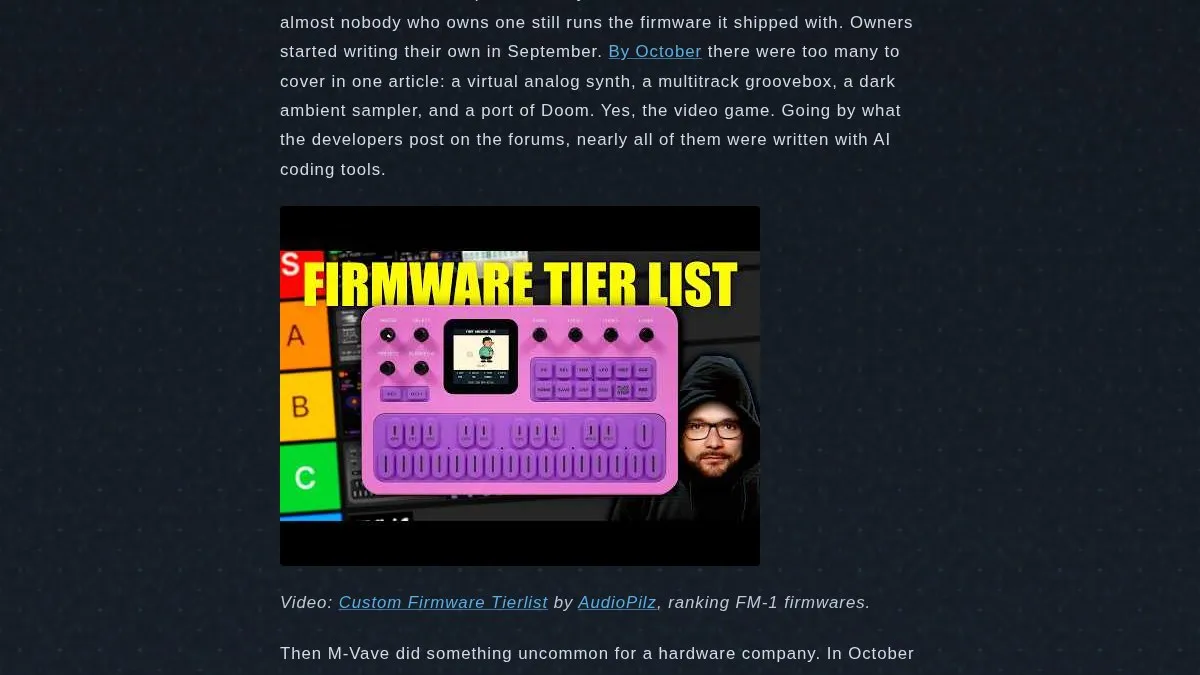
Summary: The M-VAVE FM-1 is a pocket FM synth that sells for about $70, and Geoff Stearns says almost nobody still runs the stock firmware. Owners started writing their own in September, and by October there were too many to cover in one post: a virtual analog synth, a multitrack groovebox, a dark ambient sampler, and Doom. Going by developers’ forum posts, nearly all of them were written with AI coding tools. The FM-1 runs on a JieLi chip with little public documentation, and owners still had working firmware within weeks. In October M-Vave open sourced its own firmware under GPLv3, with a dev kit and a browser emulator. The author also cites moves in the other direction: Chamberlain cutting Home Assistant off from its MyQ garage door openers in 2023, Bambu Lab adding server authorization to printer firmware as a security update, and Google requiring app developers to verify their identity before apps can be installed on certified Android devices, in effect in 4 countries since September 30 and planned worldwide for 2027.
Your Agent Will Pick the Hackable OneWhen firmware is cheap to write, the firmware a device ships with is just the first version. AI agents will favor devices they can change, and that will push hardware makers to open up.geoffstearns.com- Takeaway 1: M-Vave added a tool that restores the stock firmware in about ten seconds; the author argues a bad install must be recoverable, since an agent can’t open the case and fix a bricked board.
- Takeaway 2: The author’s bet: most buyers don’t care whether a device can be modified, but their agents will, and more buying decisions will run through agents.
Community: Hacker News was skeptical: the most-replied comment says the headline claim isn’t backed up and that its author hasn’t seen agents prefer hackable devices; another expects agents to recommend whichever brand pays AI companies for ads. What more people agreed with is a different point: LLMs make reverse engineering easier, so owners have a better shot at owning their devices.
Why I care: I rarely touch firmware, but agents choosing tools for users will happen to software too. Having an API and being operable by an agent will look more and more like a basic spec.
3. Should all AI-generated code be open source? A short post climbs to nearly 1,000 points on Hacker News#
3 min read · opinion · licensing
Why it matters to you: More and more of your code is written by AI. Whether that code can be copyrighted affects how you license it and how you sell it.
Summary: Jakub T. Jankiewicz’s claim is blunt: all AI-generated code should be open source. He gives two reasons. Models were trained on decades of open source code and on Stack Overflow content, which is under Creative Commons licenses that require attribution, so turning that into closed code feels to him like license laundering. Legally, the US monkey selfie case established that non-humans can’t hold copyright, a precedent the US Copyright Office later cited on AI, and Wikimedia Commons requires purely AI-generated images to be tagged public domain. Laws differ by country, and the UK gives computer-generated works limited protection, so he suggests developers release such code under open source licenses or CC0 themselves. He admits code is often a mix of human and AI work, but code where a person only wrote prompts and barely edited the output should, in his view, be open source all the more.
All AI-generated code should be Open SourceAll code generated with help from AI should be Open Source or on Creative Commons Zero (CC0) license.jakub.jankiewicz.org- Takeaway 1: The argument rests on where training data came from, plus the US precedent that non-humans can’t hold copyright.
- Takeaway 2: His proposal is to release AI-generated code under open source licenses or CC0 so it’s consistent across jurisdictions.
Community: 1,006 points and 170+ comment threads on Hacker News. An author of AGPL projects says early models would spit out his code almost verbatim; one commenter pointed to US Copyright Office guidance saying existing law can handle this; critics said human time spent testing and giving feedback in agentic work far exceeds generation time, and one asked whether code built on open source frameworks should be open source too.
Why I care: I won’t open source my products because of this post, but it’s a reminder that ownership of AI-generated code isn’t settled, so freelance contracts should spell it out up front.
4. Old Bitly links hijacked: a 2011 Burger King tweet link now points to a list of Nazi camps#
5 min read · security news · Ransom News
Why it matters to you: The short links you’ve put in docs, tweets and apps are controlled by someone else. If they get changed, it’s your brand that looks bad.
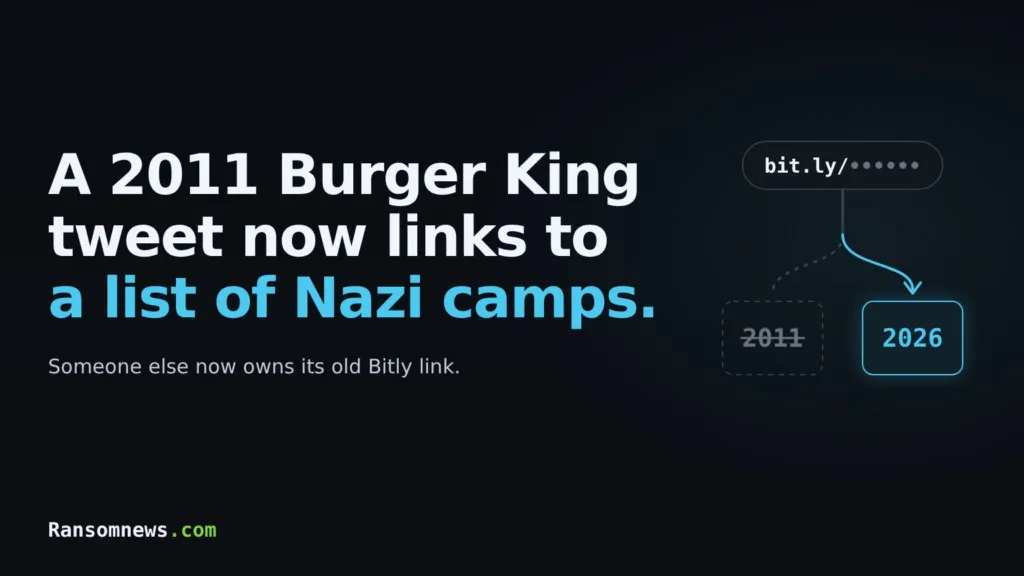
Summary: Ransom News reports that a Bitly link in a Burger King tweet from July 24, 2011 was changed to point to a list of Nazi concentration camps; the post that spotted it has over 2 million views. A McDonald’s tweet link from June 7, 2011 was redirected to 9/11-related content. Ransom News also checked 97 Bitly links in Trump’s tweets from 2009 to 2013. Bitly’s own pages show 56 were created again after the tweets were posted, 7 now lead somewhere unrelated, and 4 were registered on November 15. Bitly confirmed on X that an issue let bad actors repurpose certain old, inactive links, and said it suspended the accounts and is disabling the affected links. The report says an old bug let people claim a short code once the original link or account was deleted or deactivated, and links created on November 15 show the same thing is possible now.
- Takeaway 1: The hijacked links sit in brand tweets from over a decade ago; once the original link or account was inactive, the short code could be claimed again.
- Takeaway 2: The post that spread the Burger King case went up 79 minutes after the link was created and passed 2 million views within hours.
Why I care: I’m going to replace short links in my product docs and apps with redirects on my own domain, so at least I control them.
5. A Microsoft 365 outage stopped alarm emails, and too much chlorine in a German theme park hotel pool sent 4 to hospital#
3 min read · news · WDR

Why it matters to you: If your monitoring and alerts depend only on email, one cloud outage can cut them off. This is a very concrete example.
Summary: German broadcaster WDR reports that the automatic dosing system for the pool at Phantasialand’s Ling Bao hotel failed and pumped far too much chlorine into the water. The sauna area’s maintenance safety system had already raised the alarm by email, but Microsoft 365 was down that day, the emails never arrived, and nobody noticed. 13 guests first reported respiratory irritation, and the count rose to 15; the number taken to hospital was first given as 5, later corrected to 4, with 1 kept for observation due to a moderate injury. Firefighters’ tests confirmed the dosing defect, the water was replaced, and the pool has reopened.
- Takeaway 1: Email was the only alarm channel, so when the cloud service went down, the alerts went with it.
- Takeaway 2: 15 affected and 4 hospitalized, during the same Microsoft outage that stalled many companies.
Community: 265 points on Hacker News. The most-replied comment puts the blame on the hotel for relying only on email for something this dangerous, with no backup or double check; another asked why nobody simply locked the pool door.
Why I care: My own service alerts go out by email and push, and after reading this I’ll add one more channel that doesn’t depend on the same cloud.
6. Samsung, SK Hynix and Micron accused of cutting DRAM supply together, and the class action survives dismissal#
6 min read · legal news · industry
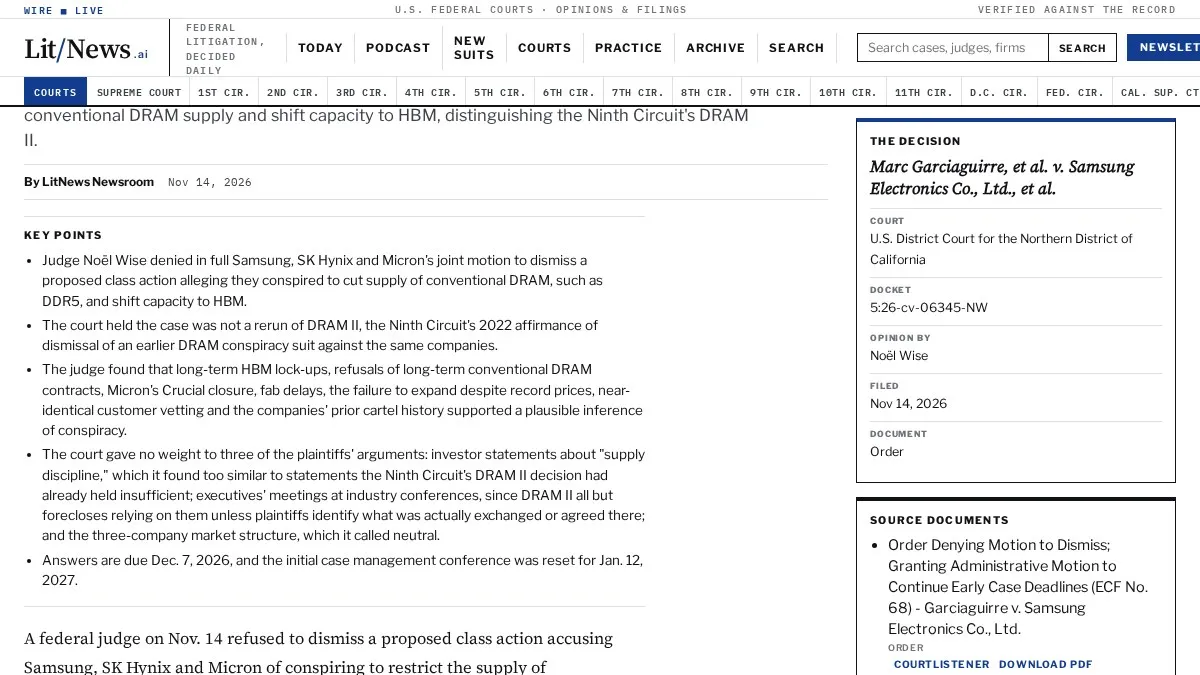
Why it matters to you: Memory prices more than doubled in a year, and your cloud bill and phone costs are paying for it. Whether this case changes anything is worth following.
Summary: On November 14, Judge Noël Wise of the Northern District of California denied a joint motion by Samsung, SK Hynix and Micron, letting a class action proceed that accuses the three of cutting conventional DRAM supply together and shifting capacity to HBM. Plaintiffs say the three held over 91% of the market in Q3 2025, DRAM prices rose 171.8% in a year, and allegedly 697% over 18 months; each HBM chip takes 3 to 4 times the wafer area of regular DRAM. The judge found this different from DRAM II, which the Ninth Circuit dismissed in 2022, citing long-term HBM lock-ups, refusals of long-term conventional DRAM contracts, Micron closing its Crucial brand on December 3, 2025, and the companies’ cartel history: in the 1998 to 2002 price-fixing case Samsung was fined $300 million and Hynix $185 million. Answers are due December 7, 2026, and the case management conference moved to January 12, 2027.
- Takeaway 1: The judge gave no weight to investor talk about supply discipline, but accepted concrete actions like HBM lock-ups and the Crucial closure as supporting an inference of conspiracy.
- Takeaway 2: The companies quoted the late Judge Posner that competitors in concentrated markets watch each other like hawks; Judge Wise replied that the allegations are more akin to hawks flying in formation, which hawks ordinarily do not do.
Community: 481 points on Hacker News. The most-replied comment came from a researcher who just got a grant and says a workstation with 256 GB of RAM now costs four to five thousand dollars; another suggested governments require a share of DRAM output to go to consumer electronics.
Why I care: Memory won’t get cheaper soon because of a lawsuit, but in cloud budgeting I’ll assume pricey memory for the next year.
7. NYT: Commerce Secretary Lutnick pushed to weaken chip rules that overlap with his family business’s clients#
8 min read · investigative · policy

Why it matters to you: Whether Southeast Asian data centers can keep running AI for Chinese companies affects Nvidia’s business and the price and supply of the cloud GPUs you use.
Summary: The New York Times reports that a data center code-named A201 in southern Malaysia is set to open next year, packed with hundreds of millions of dollars of Nvidia’s top AI servers, selling its compute to a Chinese tech giant. That’s legal today and sidesteps the US ban on selling the most advanced chips directly to Chinese firms. The operator is a client of Cantor Fitzgerald, the firm Commerce Secretary Lutnick used to lead before handing it to his sons. The Times says Lutnick has been seen as a force slowing the rules and recently pushed a less stringent version. The Verge reported the same day that both parties in Congress want tighter export rules: Senate Banking Chairman Tim Scott sent letters asking Lutnick and Jensen Huang to testify publicly, Schumer wants them to answer to Congress, and the Remote Access Security Act, introduced in the House in April 2025, is getting renewed interest.
- Takeaway 1: The fight is over how tightly to regulate offshore data centers that run AI for Chinese companies.
- Takeaway 2: House Speaker Mike Johnson says there is growing consensus in Congress on limiting chip exports to China.
Community: 437 points on Hacker News, mostly anger about the conflict of interest; one commenter noted the Times says further down, in smaller type, that these dealings are a tiny portion of Cantor’s business.
Why I care: If the rules tighten, cloud GPU supply and pricing will move with them, so I’ll watch the next version of the export controls.
8. After resigning, Jensen Huang is said to be weighing a return, and a petition passes 150,000 signatures padded with fake names#
5 min read · news roundup · industry

Why it matters to you: The whole AI industry sits on Nvidia. Where its leadership goes affects GPU supply, pricing, and the long list of AI companies it has invested in.
Summary: Jensen Huang resigned as Nvidia CEO last Thursday after his affair with a former executive at Megaspeed, an Nvidia customer alleged to have ties to Chinese intelligence, came out, followed by reports of another relationship with an Nvidia executive. CFO Colette Kress is interim CEO. The Verge reports a public letter demanding Nvidia bring Jensen back has over 150,000 signatures and backing from Elon Musk and Epic Games CEO Tim Sweeney, but Business Insider found entries like Tim Cruise and a misspelled Xi Jingping. The Financial Times says Huang has discussed returning with close allies. Megaspeed said Alice Huang left the company effective August 30, 2025. On TechCrunch’s Equity, the hosts noted Nvidia holds about 80% of the AI GPU market, has about $99 billion in investments, plus $25 billion in investment commitments and $36 billion in cloud commitments.
- Takeaway 1: Nvidia had no succession plan, and the interim CEO is the CFO, widely read as a caretaker arrangement.
- Takeaway 2: 23andMe founder Anne Wojcicki told Bloomberg that power makes people think they’re invincible, and we’re all complicit in treating them like gods.
Community: On TechCrunch’s Equity, host Rebecca Bellan said she thought Jensen was Nvidia and would never step down; Tim De Chant said he saw it coming, just not this fast.
Why I care: I don’t care much about the gossip, but Nvidia’s investments and cloud commitments touch a lot of AI companies, and the next few weeks of decisions will ripple through the supply chain.
9. ULA’s Vulcan rocket fails and destroys 40 Amazon Leo satellites, ULA’s first failure since 2006#
6 min read · news · space

Why it matters to you: Amazon’s satellite network is meant to compete with Starlink, and this failure pushes its rollout back.
Summary: Spaceflight Now reports that ULA’s Vulcan failed on its fifth flight: about 10 minutes after liftoff, an anomaly occurred during the Centaur upper stage burn, and all 40 Amazon Leo satellites were lost. It’s ULA’s first total mission failure since 2006 and the first of 38 Vulcan launches Amazon booked. Success would have brought Amazon Leo to 436 satellites launched, while the full constellation needs more than 3,300. Amazon has also booked 24 New Glenn, 24 Ariane 6 and 13 Falcon 9 launches.
- Takeaway 1: The problem came during the Centaur upper stage burn; the cause is under investigation.
- Takeaway 2: Amazon still needs to deploy nearly 3,000 more satellites, and launch reliability is its biggest variable.
Why I care: The later satellite internet spreads, the fewer connectivity choices remote areas and boats have, and the longer Starlink stays dominant.
10. The OLED MacBook Pro’s PWM problem: a better screen that’s worse to use for some people#
7 min read · review and opinion · hardware

Why it matters to you: If you stare at a screen all day writing code and you’re sensitive to flicker, you should know this before upgrading.
Summary: Mac Anorak notes that the new OLED MacBook Pro uses PWM dimming, which Notebookcheck measured at 240Hz versus 14,880Hz on the previous Mini-LED model, roughly 62 times lower. PWM dims by switching the backlight on and off rapidly; the lower the frequency, the more likely flicker-sensitive people get headaches and eye strain. The author says Apple delivered better contrast and blacks on paper, but for this group the new screen is harder to use. AppleInsider reported the same issue on November 10.
- Takeaway 1: 240Hz versus 14,880Hz, about 62 times lower, is the number at the heart of this.
- Takeaway 2: Not everyone notices, but people sensitive to PWM have no setting that turns it off.
Community: 373 points on Hacker News. One commenter asked how common this really is, since at Apple’s scale it could hit millions; others were surprised Apple slipped on this kind of detail and said the frequency needs to be in the kHz range.
Why I care: I look at screens for over ten hours a day, so before upgrading I’ll spend real time with one in a store before deciding on OLED.
11. Apple’s N50 smart glasses take shape: announced at next year’s WWDC, no AR, driven by the new Siri controlling apps#
4 min read · news · hardware

Why it matters to you: If the glasses rely on Siri to operate apps, whether Siri can drive your app decides whether it shows up on the new device at all.
Summary: The Verge, citing Bloomberg’s Mark Gurman, says Apple’s first smart glasses will be announced at WWDC next June without augmented reality, with shipments starting before year end. Prototypes, code-named N50, run a pared-down visionOS on a processor based on older Apple Watch chips, with a MagSafe-like charger roughly the size of a Tic Tac that works while you wear them. The glasses have Wi-Fi so some functions keep working when the iPhone isn’t nearby. The key is the revamped Siri’s fine-grained control of apps, which Apple wants developers to support on iPhone first so the glasses can hit the ground running.
- Takeaway 1: No AR, announced at next year’s WWDC, shipping before year end.
- Takeaway 2: Developers wire up the new Siri on iPhone first, so the glasses have apps to work with.
Why I care: I’ll start looking at App Intents so my apps can be operated by Siri, which pays off on glasses or any other device later.
12. Epoch AI breaks down Huawei’s Horinger data center: about 113,000 Ascend chips, roughly 81,000 H100 equivalents#
8 min read · research · AI industry

Why it matters to you: Whether China can build large-scale compute under export controls affects open model competition and the cheap models you can use.
Summary: Using satellite imagery and public data, Epoch AI estimates Huawei’s data center in Horinger, Inner Mongolia, draws about 286 MW and holds roughly 105,000 Ascend 910C and 8,000 910B chips. That’s about 81,000 H100 equivalents (90% confidence interval 36,000 to 141,000), with one 910C at about 0.76 H100. The world’s largest AI data center, SpaceX’s Colossus 2 in Tennessee, has about 14 times as much compute, putting Horinger at 7%. Epoch also notes that just 10% of Horinger’s compute, about 8,100 H100 equivalents, is enough to train a DeepSeek-V4-Pro scale model in one month.
- Takeaway 1: One 910C is about 0.76 H100, and the site totals about 81,000 H100 equivalents, with wide error bars.
- Takeaway 2: It’s only about 7% of Colossus 2, but plenty to train a frontier open model.
Why I care: I often use Chinese open models for cheap tasks, and this tells me the compute behind them keeps growing, so pricing should stay competitive.
More to Read#
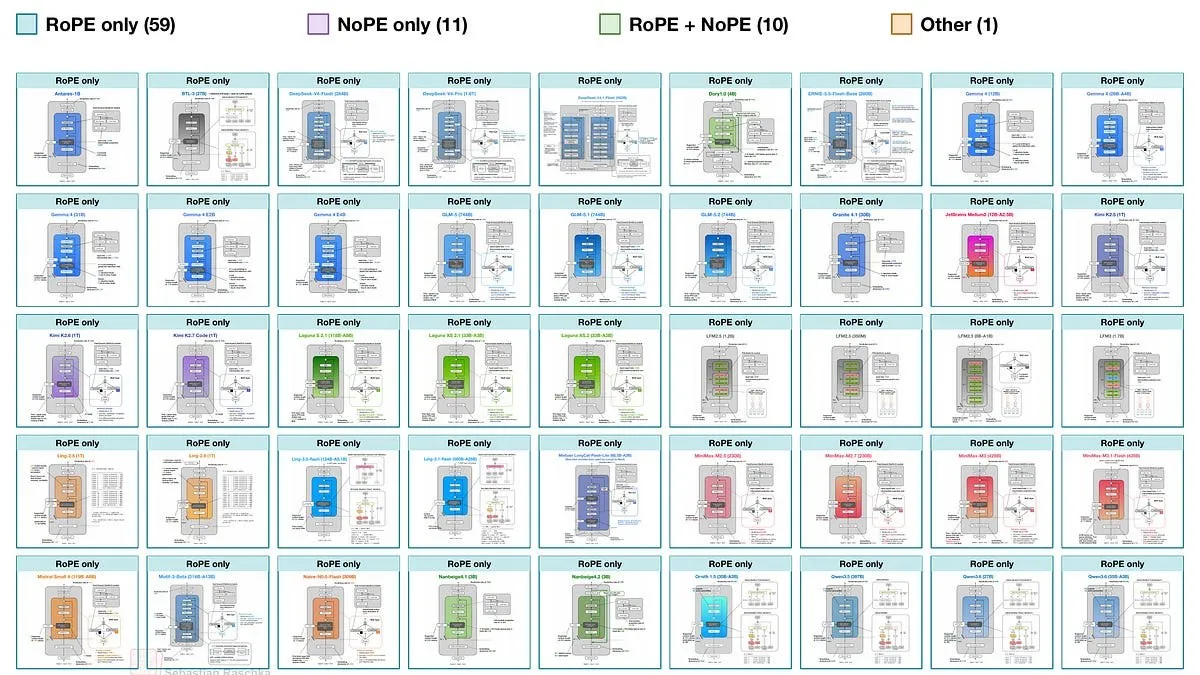
- Sebastian Raschka explains positional embeddings in LLMs, from absolute positions to RoPE: Why it matters to you: A long post with diagrams, a little math and a small PyTorch implementation, going from GPT’s learned absolute positions to RoPE, then mapping how 2026 open-weight models handle position; he says it’s groundwork for an upcoming piece on LLM architecture trends.
- How Meta’s Muse became the #1 app: its product lead’s first podcast interview: Why it matters to you: Mona Sarantakos, VP of Product at Meta Superintelligence Labs, has led Muse since day one; she covers how it started from a weekend running OpenClaw on a Raspberry Pi, why it waited seven months to launch despite starting early, and how the team uses agent swarms to surface user insights.
- How 40 major C projects manage memory: only 8 use malloc/free alone: Why it matters to you: Of 40 projects, 8 allocate only with malloc/free, 15 use regions somewhere, 7 primarily use regions, 5 primarily use garbage collection and 3 primarily use reference counting; SQLite, famous for correctness, allocates 100% manually, and cURL and Redis are mostly manual.
- The CSS Working Group resolves that base-appearance buttons get cursor: pointer: Why it matters to you: After years of arguing over pointer cursors on buttons, the CSSWG resolved that pointer means click this, the text cursor means prepare to type, and the grabbing hand means drag this; the rule only applies to
appearance: baseelements, has no!important, and is easy to override. - EFF and ACLU ask an appeals court to require a warrant for license plate reader searches: Why it matters to you: In United States v. Sturdivant, Cleveland police didn’t know the plate, so they ran an open-ended search of the Flock and ELSAG ALPR databases and found the defendant’s car; EFF argues the nationwide ALPR network amounts to constant tracking and counts as a Fourth Amendment search.
- Protomaps makes self-hosted map tiles cheap: one PMTiles file on a CDN: Why it matters to you: Once Mapbox’s free tier runs out it charges $5 per 1,000 map loads, which hurts if you go viral; PMTiles reads a single file over HTTP Range requests and can sit on any CDN that caches Range requests. The author deploys on Bunny.net; on Cloudflare you need an edge function to translate paths.
- Air traffic controllers reject Duffy’s ground stop explanation, says a reporter who spoke to 60 of them: Why it matters to you: Washington Examiner reporter Anna Giaritelli told CNN she spoke to 60 air traffic controllers and none believed Transportation Secretary Duffy’s account of the nationwide ground stop, which affected an estimated 1.5 million travelers and was only the third ever.
- Browsing the web inside Emacs: EWW handles 85 to 90% of cases: Why it matters to you: The author wants Emacs as his only computing environment and finds EWW usable for 85 to 90% of the web after a few days; what he values more is losing the suggestions and infinite scroll that pull him off track.
- datasette-llm adds OpenAI-compatible endpoints, so local models can power Datasette Agent: Why it matters to you: The new release works with any model that speaks the OpenAI protocol, including LM Studio, Ollama or llama.cpp, which just hit v1.0.0; Simon includes a one-line
uvxcommand that runs Datasette Agent on a local Qwen model. - Anthropomorphic software: when Git asks you to tell it who you are: Why it matters to you: The author collects program messages that talk in the first person, from Git’s Please tell me who you are to bisect’s We cannot bisect more! and changelog lines like git fsck learned to; useful tone reference if you write error messages.
- The Verge looks back at Sony’s Aibo: a robot dog that became family but never a huge hit: Why it matters to you: The season six opener of Version History, themed around pets; David Pierce and two colleagues discuss Sony’s 1990s belief in a coming robot era, why Aibo moved its owners so much, and what Sony got right and wrong.
- FreeBSD bhyve live migration reaches a first working state, published as an RFC: Why it matters to you: On FreeBSD 15.1, a running amd64 guest can move to another host over TCP, pausing only for the final stop-and-copy phase; it adds dirty-page tracking in the vmm kernel module plus a migration protocol in bhyve and bhyvectl.
- All of Turbo Pascal 3, compiler and IDE, was 39,731 bytes: Why it matters to you: A 2011 post resurfaced: Turbo Pascal 3.02 from 1986 was smaller than minified jQuery 1.6 (90,518 bytes) and smaller than the
touchcommand on OS X Lion; it hits differently next to today’s app sizes. - Periodic-Oriented Programming: a mentor of 17 years on FIRST Robotics argues for less abstraction: Why it matters to you: The author has written FRC robot code since 2010 and argues WPILib conventions push students to overengineer, so he puts as much as possible in the periodic function; useful for anyone writing game loops or real-time systems.
- C++ language server clice hits 1,000 commits and heads for its first stable release: Why it matters to you: clice has shipped nightly builds since July 19, 2026 and went through about four months of alpha testing, with a test system run against real open source projects; the author says core features are stable and it’s time for a stable release.
Also Worth a Look#
- Jensen Ousted as Nvidia CEO: Spy Scandal, Export Restrictions, Market Impact - All-In Podcast (the All-In hosts on Jensen Huang’s exit)
- [AINews] Jensen Huang resigns after 33 years leading NVIDIA - Latent Space (Latent Space’s roundup)
- Where was Nvidia’s security team? - TechCrunch (asking where Nvidia’s security team was)
- An overview of Jensen Huang’s messy days - The Verge (a timeline of Jensen Huang’s week)
- A step toward defining the Standard Model on a lattice - OpenAI (OpenAI on lattice physics research)
- Your Agent Doesn’t Need an LLM for Every Decision - AI Engineer (not every agent decision needs a model)
Show all sources (15 more)Show fewer
- Your Sub-Agents Are a Distributed System. Treat Them Like One. - AI Engineer (treating sub-agents as a distributed system)
- 225,000 Lines of Tests, Written and Merged by Agents - AI Engineer (Duolingo’s agent-written tests)
- Your SKILL.md Is 70% Stuff the Model Already Knows - AI Engineer (trimming skill files)
- I love you so jevving much - AI Engineer (on unreliable LLM automation)
- NoisyTCP: Linux Kernel TCP Pre-auth Remote Corruption - X (an 11-year-old Linux TCP bug)
- Your Spec Has Bugs. Catch Them Before Your Agent Codes. - AI Engineer (catching spec bugs before agents code)
- datasette-vega 0.7 - Simon Willison (Datasette charting plugin update)
- I made a NES emulator in Odin - lucypero (a NES emulator written in Odin)
- 25 of my favourite modern NES games - Lobste.rs (modern homebrew NES games)
- Disk encryption on NetBSD - NetBSD (threat models for NetBSD disk encryption)
- Reintroducing Spaces - Lobste.rs (Spaces on the AT Protocol)
- Flaming Hydra’s new Kickstarter campaign rethinks e-book ownership - TechCrunch (a new take on e-book ownership)
- Book list for streetfighting computer scientists - Hacker News (a reading list for engineers)
- Repurposing Thin Clients - Hacker News (giving thin clients a second life)
- Handwriting, as a Font - Hacker News (turning handwriting into a font)
Builder Radar#
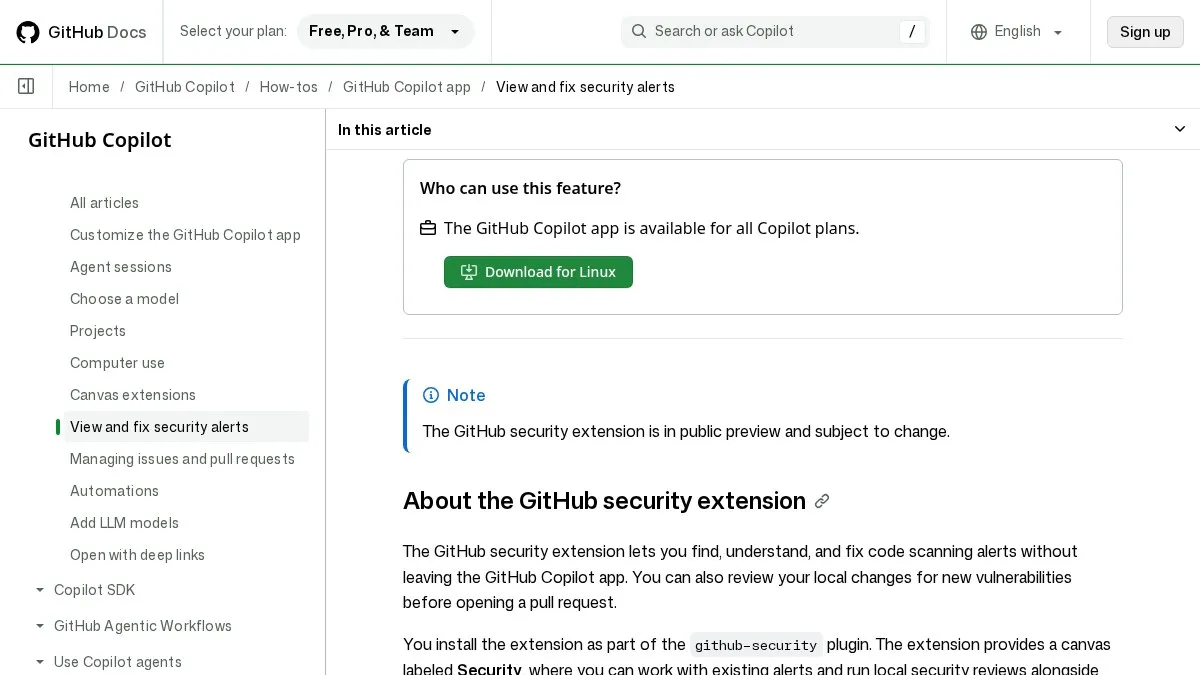
1. The GitHub Copilot app gets a security extension that reviews local changes before you open a PR#
The GitHub security extension, in public preview, adds a Security canvas to the Copilot app that lists code scanning alerts by severity, with Explain and Fix buttons that hand them to the Copilot agent; it can also run a local security review on your changes before a PR, which needs neither code scanning nor a Code Security license. Install with copilot plugin install github-security@awesome-copilot. It only shows code scanning alerts, not Dependabot or secret scanning, and GitHub Enterprise Server isn’t supported.
What it means for your app: As agents write more of your code, a local security pass before the PR is cheaper than reading alerts after merge.
2. Stripe closed an account after one $1,500 invoice, and HN commenters explain why#
A small per-appointment business had a client save his card through a $1 payment link, then charged that card $1,500 weeks later; Stripe blocked it and two days later closed the account because the payments didn’t appear authorized, and the appeal was rejected. Commenters noted that a tiny charge followed by a large one is exactly how criminals test stolen cards, and suggested Stripe SetupIntents configured for off-session use, with written authorization.
What it means for your app: If your app saves a card to charge later, use SetupIntents properly instead of working around it with a $1 payment link.
3. Apache HTTP Server 2.4.71 patches a CVSS 9.8 HTTP/2 flaw#
iThome reports that the ASF released 2.4.71 on November 11 with 3 fixes, the worst being CVE-2026-119618 in mod_http2: a race condition when handling HTTP/2 requests across threads can corrupt memory and let unauthenticated remote attackers run arbitrary code. It affects 2.4.55 through 2.4.70 and mod_h2 2.0.8 through 2.0.42; Red Hat scores it 9.8, and Wiz estimates 64% of cloud environments may be exposed.
What it means for your app: If Apache with HTTP/2 sits in front of your backend or VM, check the version today.
4. Nicolas Bustamante: most SaaS should become an MCP server#
He argues many AI startups build their own chat UIs and agents, effectively reselling big-lab tokens at low or negative gross margins; SaaS companies could do the opposite, exposing proprietary data, integrations, business logic and permissions as MCP tools while ChatGPT, Claude or Copilot handle the conversation, and the customer pays for tokens. His HR example: skip the AI assistant and expose tools for salary benchmarking, raise modeling, policy-based promotion recommendations, HRIS updates and approvals with audit trails, keeping the subscription without paying for every answer’s tokens. The post has 1,893 likes and 324 replies.
What it means for your app: Worth asking of my own app backends: which capabilities could become MCP tools that users’ agents call directly.
5. db-branch: instant MySQL and PostgreSQL branches for agents or every PR#
It uses ZFS clones for copy-on-write, so a large database branch takes seconds with nothing copied; use it to test migrations, let an AI agent loose, or give every PR its own database. Self-hosted, Apache-2.0, in beta, and it needs Linux and ZFS; on a Mac you can try it in an Ubuntu VM via Multipass.
What it means for your app: Branching the database before an agent touches it is the most direct way to protect production data.
6. turbo-browser-mcp batches browser actions to save lots of tokens#
A Playwright-based MCP server that folds 25 to 33 fine-grained browser primitives into 10 batched tools, with delta DOM snapshots, single-turn React/Shadow DOM form filling, and a default human confirmation before submit. The author’s benchmark shows a 140-button page snapshot using 93.9% fewer tokens than raw HTML. MIT licensed, created November 14.
What it means for your app: The numbers come from the author’s own benchmark, but the delta snapshot idea is worth borrowing so your E2E agent burns far fewer tokens.
What the Community Is Arguing About#
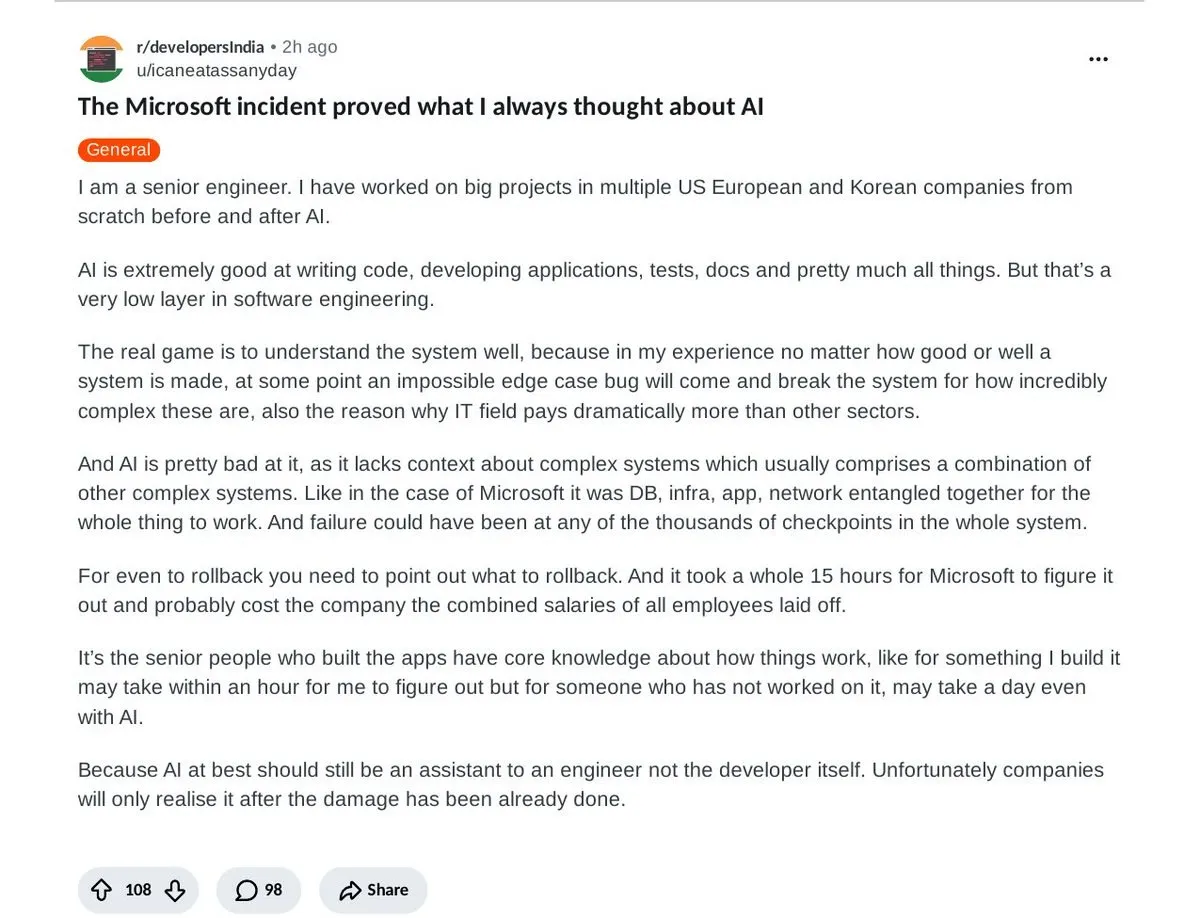
1. Microsoft was down 15 hours, and a senior engineer says that’s why AI won’t replace programmers soon#
@SahilExec relayed a senior engineer’s explanation of why the Microsoft outage lasted 15 hours and why AI won’t replace programmers anytime soon; the post has 11,446 likes, over 1.17 million views, 1,280 reposts and 3,684 bookmarks. The German hotel pool’s alarm emails were lost in this same outage; the longer an outage runs, the more every process that relies on a single cloud service stops with it.
2. ThePrimeagen: my work is so trivial I can’t tell Fable 5.2 from Opus 5.5#
A one-line self-own drew 2,024 likes, 148 replies and over 58,000 views: he says his work is so trivial he can’t tell Fable 5.2 from Opus 5.5 high. It hints at something real: for most everyday development, the gap between models may be smaller than benchmarks suggest.
3. Should Pangram’s 100% AI label be used to judge people?#
NYU professor Panos Ipeirotis (278 likes, 59 replies) says Pangram can’t tell AI-generated from AI-edited text and has no clue where ideas come from, yet people weaponize its 100% label to shame writers and wreck careers; the post he quoted (358 likes) argues the opposite, that Pangram has been shown to have a very low false positive rate, relies on a different statistical signature, and held up in the poster’s own experiments. Whether detector output should be used to judge a person has no consensus yet among academics or writers.
4. AI interfaces are still turn-based; what about interacting mid-turn?#
Bruce Liu shares an idea from his PhD thesis: today’s AI interfaces are almost all turn-based, and his example is intra-turn interaction, interacting within a single turn, shown in a 58-second demo video. The post has 7,771 likes and 7,060 bookmarks, nearly as many saves as likes.
5. Gergely Orosz: some of aviation’s most important systems can’t handle 200 QPS#
FAA acting CTO Rebecca Guy said, in a clip with 4,644 likes and 1.19 million views, that when the network became unstable, two sources were hitting it with 1,000 connections every 4 to 5 seconds; Gergely put that at about 200 QPS and called it trivial for any modern system (633 likes, 97 replies). He grants aviation isn’t modern by tech industry standards, but still finds it hard to excuse.
Chinese Tech Scene#

1. Yelp’s AI assistant blends native UI with server-driven UI#
(InfoQ China): Yelp’s assistant renders conversation content server-side through its CHAOS framework while keeping the nav bar and message input native; the backend defines the UI, so interface changes ship without a new app release, across Web, iOS and Android. A useful hybrid pattern for Flutter or native app teams.
2. GitLab 19.5 makes its MCP server generally available and adds governance for external agents#
(InfoQ China): MCP tools like Claude Code and Cursor get more GitLab tools and can call Duo Agent Platform agents, while security teams can see which agents are used, by whom and on which projects. GitLab.com also added MCP rate limits: 60 requests a minute on Free, 600 on Premium and Ultimate, with retries counted.
3. Closed-loop AI self-evolution: from skills and harnesses to training and evaluation (AICon Beijing)#
(InfoQ China): AICon Beijing runs December 18 to 19 with 13 tracks; Yang Yifan of Microsoft Research Asia will talk about recursive self-improvement in the Self-Evolving Agents track, from skills and harnesses to model training and evaluation.
4. PTT debate: should dozens of AI PRs a day count as productivity?#
(PTT Soft_Job): Continuing the Python backend job hunt thread, one side argues code generation speed and engineering productivity are separate, with token and maintenance costs to count; the reply says anything quantifiable, like the impact of bugs fixed by merged PRs, can be a metric, and agents are still cheap next to a senior engineer’s salary.
5. PTT: Linus says AI is a good tool, so focus on what it can’t do#
(PTT Soft_Job): The poster agrees with Linus that competing with AI on memory, syntax and speed is futile, and calls talking to models a new language layer in software engineering, where teammates are now AI; one reply predicts that in a few years the view will be that humans shouldn’t touch code at all.
6. AI rebounding: nearly 1 in 5 US workers replaced by AI were later rehired#
(TechNews): An SHL survey found 19.1% of US respondents were replaced by AI and later rehired by the same employer, 16% across the US and UK combined; a Robert Half survey found 32% of US hiring managers who cut staff for AI later had to restore the same or similar roles.
7. TSMC Arizona earned NT$53.99 billion in the first three quarters, and subsidies hit a record#
(TechOrange): TSMC Arizona earned NT$53.986 billion in the first three quarters, up more than tenfold from NT$4.769 billion a year earlier; JASM in Kumamoto turned profitable and ESMC in Germany lost about NT$1.079 billion. Subsidiaries in the US, Japan, Germany and China received about NT$167.586 billion in government subsidies, about NT$166.996 billion of it in Q3.
8. OpenAI launches Daybreak Defense Factory and Red Team to find, patch and simulate attacks#
(INSIDE): At its November 12 Cyber at the Frontier event, OpenAI launched two Daybreak security products: Red Team, in early access, uses models and source code context to probe web app attack paths and verify findings from scanners and bug bounties; Defense Factory handles automated patching.
9. V2EX: one developer’s path from Cursor, Codex and Claude Code to deepseek-harness#
(V2EX): The author has two and a half years of AI coding and treated deepseek-harness as a backup, until Codex got worse and Claude Code demanded KYC; after two weeks of heavy use, he says it handled UI, frontend, backend, GitHub commits, server deployment and production debugging end to end.
10. Zyxel firewalls natively integrate Bitdefender GravityZone, expanding in 2027#
(iThome): Zyxel announced a Bitdefender partnership in late October, letting USG FLEX H firewalls natively integrate GravityZone, with EPP, EDR, XDR and risk management in one console; endpoint risk scores and predefined actions come next, and whether it can auto-block on detected compromise hasn’t been announced.
11. PTT engineers dissect the SinoPac transfer incident: limits bypassed, no anomaly alerts#
(PTT Soft_Job): The poster argues the transfers bypassed the bank’s own limit controls and went straight to the interbank system, and that sudden NT$100,000 transfers from accounts that never do that raised no alerts; in another thread, people traded stories of test code reaching production, and one noted many banks fully outsource core systems.
12. Memories.ai pays gig workers to film hands-on tasks as robot training data#
(TechNews): Memories Upload launched October 28; participants wear the company’s LUCI Pin camera, under 45 grams, to record first-person footage of tasks like meal prep, shelving and bike repair, earning $6 to $18 per task, with labeled footage sold to robotics and AI developers.
13. A snorer taught himself to code: the story behind SnoreLab#
(TechNews): In 2011 Jules Goldberg’s wife complained about his snoring; he couldn’t find a good recording app and couldn’t spend house savings on a developer, so he taught himself Objective-C and built SnoreLab in about ten months, only then admitting he snored. A relatable story for solo developers starting from their own pain point.
14. Sequoia shuts down Scouts: why the inventor called it quits first#
(TechNews): Sequoia announced on November 4, in a post signed by 7 partners, a new fund of about $10 billion while closing its London office, merging early and growth teams, and ending the Arc accelerator and Scouts; Scouts, started around 2009, had founders source deals from their networks and found Uber and Stripe.
15. MicroIP’s chairman: the memory shortage is structural, and AI was only the trigger#
(TechNews): He says that over 10 to 20 years memory capacity and density kept improving while prices didn’t rise with them, stretching payback on R&D and equipment and dampening expansion; read alongside today’s DRAM lawsuit, it clarifies why memory is expensive.
16. Meta tests an internal prediction market app, Takes, where employees bet cred points#
(INSIDE): The Wall Street Journal reports Meta employees are testing Takes internally, betting on event outcomes with cred points that stand for credibility, with no real money involved, unlike Kalshi and Polymarket; no public launch date is known.
17. sspai: a small tool that switches macOS aerial wallpapers with the time of day#
(sspai): Apple shot several times of day for each location but the system treats them as separate wallpapers; the author built Aerial Switcher, a menu bar tool that downloads missing videos, switches on a default schedule, and lets you drag switch times along a 24-hour timeline in 15-minute steps.
Open Source Picks#

Today’s repos nearly all revolve around agents: Alibaba’s open source code review tool, a review surface for agent plans and diffs, agent skills for Google Stitch, and an Office SDK agents can operate. Star counts are checked against the GitHub API today; iOS system tweaking repos are excluded.
1. alibaba/open-code-review#
Go | 52,007 stars
Alibaba’s internal AI code review CLI of two years: it reads Git diffs and an agent that can read files and search the codebase writes line-level comments; the team says it beats Claude Code on precision and F1 with the same model while using about 1/9 of the tokens, at the cost of lower recall. Ships with AACR-Bench: 50 open source repos, 200 real PRs, 1,505 annotated issues. Apache-2.0.
2. backnotprop/plannotator#
TypeScript | 11,793 stars
A local, browser-based review surface that opens when an agent proposes a plan or finishes work, so you can annotate and comment and send feedback straight back; works with Claude Code, Codex, Copilot CLI, Gemini CLI, OpenCode and more, and reviews local changes and remote PRs. Apache-2.0.
3. google-labs-code/stitch-skills#
TypeScript | 9,258 stars
Agent skills and plugins for Google Stitch following the Agent Skills open standard, split into design, build and utilities, installable in Codex, Claude Code, Cursor, Gemini CLI and more. Worth a try if you design in Stitch and hand off to agents. Apache-2.0.
4. dream-num/univer#
TypeScript | 25,557 stars
An SDK for building Office features into your own product, covering sheets, docs, slides, tables and PDFs; the Web SDK is open source, a Server SDK handles collaboration and import/export, and an AI SDK connects editing to existing agents. Apache-2.0.
5. Tthanh2k6/turbo-browser-mcp#
JavaScript | 106 stars
A Playwright MCP server created November 14 that batches browser actions and returns delta DOM snapshots; the author’s benchmark claims 93.9% fewer tokens than HTML on a dense page. Few stars yet, but the idea is worth a look. MIT.
Watch & Listen#
1. Lydia Hallie: Rethinking Claude Code best practices#
Channel: AI Engineer
Why it matters to you: Watch it alongside today’s Code Mode: once models get stronger, which old rules can go and which must live in the harness, in the Claude Code team’s own words.
- Takeaway 1: She says Anthropic went from about 2,500 code changes a day in May to more than 30,000 in September, turning engineers into managers of dozens of sessions
- Takeaway 2: She cites an August study: only about 14% of people in the loop caught a clearly dangerous command while auto mode blocked 89%, yet about one in ten still got through, so guarantees need deny rules and a sandbox, and deny rules are checked before the classifier
- Takeaway 3: With stronger models, most CLAUDE.md content about your stack or where to look can go, and she recommends the
/doctorprompt audit to tune setup for the current model
2. Lauren Tan: All code is slop (except mine)#
Channel: AI Engineer

Why it matters to you: Her team merged 11,000 PRs in a month without chaos, and she explains how rules and verification keep agent output in check.
- Takeaway 1: She shipped 3,000 PRs to production herself last month, about 11,000 across the team, and the revert rate actually fell, holding steady around 0.5%
- Takeaway 2: Their desktop app framework encodes past lessons as constraints and lint rules, so agent mistakes get blocked outright
- Takeaway 3: She mentions a colleague who distrusted agents six months ago over subtle bugs and now spends 70% of daily tokens on verification, which matches her own usage
3. Claude Code and Codex reverse engineered a 1994 Jeep’s ECU over a $3 Arduino#
Channel: Muhammad Zulali

Why it matters to you: A concrete case of agents touching physical hardware, and the best footnote to today’s theme of hardware opening up to agents.
- Takeaway 1: His Jeep was failing the California smog test, so he had Claude Code read the ECU over the old SCI protocol and found the common scanner tool misread fuel trim; the 22% extra fuel was actually fuel being removed
- Takeaway 2: The ECU was built in December 1993, about 4 months before programmable versions, so it couldn’t enter programming mode; Codex found it would run a tiny program sent over the same three wires, about 90 times a second, and eventually wrote it to EEPROM
- Takeaway 3: He says Claude did most of the diagnosis and Codex handled the memory work while he did the wiring and driving, and the car finally passed; it reached 272 points on Hacker News
Today’s Take#
Code Mode has Claude write one block of code to make all its tool calls; in the Jeep video, Codex sends a tiny program into a 1994 engine computer and runs it; FM-1 owners rewrote entire firmwares with AI. The unit of agent work is shifting from a single call to a block of code.
That makes review more important and harder. Lydia says people caught only 14% of dangerous commands, and Lauren’s team spends 70% of tokens on verification. Both land in the same place: trusting agents means writing rules into the harness and running verification on everything they do.
Meanwhile, Bitly and Microsoft 365 remind me that the riskiest parts of a system are often links nobody has touched in a decade and single alert channels. This week I’ll update my hooks to review Code Mode code, then replace the short links and single alert channels in my products.