Coding agents can now test mobile apps on cloud simulators, and Jensen Huang steps down at Nvidia
Expo launches cloud iOS and Android simulators built for coding agents, and Flutter apps work too; Google ships the faster, cheaper Gemini 4 Hydrogen, available in Cursor the same day; Google releases A2UI 1.0 with a Flutter renderer and a Dart SDK; Jensen Huang resigns and CFO Colette Kress becomes interim CEO

Contents55
Spend 1% of your day keeping up with tech.
Quote of the Day#
“The agent was the fast part. Expo Simulators gives every agent a simulator, so a fix arrives for review already tested on several simulators, and the only decision left is whether it’s the right code.” — James Ide, co-founder and CTO of Expo (source)
“User interactions with agents today are where computers were in the terminal era: capable, and answering almost everything in text.” — The Google A2UI team, A2UI 1.0 launch post (source)
Today’s Theme#
The story that hit closest to home today is Expo’s. Agents already write mobile code faster than people, but verification is the bottleneck: after the agent changes the code, I still open a simulator and tap through it myself. Now Expo lets agents start iOS and Android simulators in the cloud, then post a recording and screenshots on the PR. Flutter apps work too.
I care about this because it’s exactly where I get stuck every day. A cloud agent running on Linux can’t open an iOS simulator at all, and running several on my laptop eats all the memory. I’ll try it with a debug build of a small project first and see whether what comes back is enough for me to decide on the merge.
Google shipped two things on the same day. One is Hydrogen, a new fast model meant to be the daily driver for coding and agents, and Cursor had it the same day. The other is the stable A2UI, which lets an agent answer with a screen instead of a wall of text, and it ships with an official Flutter renderer and a Dart SDK. That lines up exactly with the talk I’m giving at DevFest in December.
The biggest industry news is Jensen Huang stepping down as Nvidia’s CEO, with the CFO taking over for now. If you build apps you won’t feel it this week, but Nvidia has money in a long list of AI companies and data centers, so I’ll keep an eye on model pricing and compute supply for the next few weeks.
Last, Apple review. Some music app developers got rejected several times in a row with the same wording, and they suspect review is now handled by an automated system. If you need to ship before the end of the year, submit early and have your explanation and demo video ready for an appeal.
Must Read#
- Expo launches cloud simulators for agents: they boot iOS and Android, record the run and post it on the PR, and Flutter works too
- Google launches Gemini 4 Hydrogen: 2.5 times faster than 3.8 Flash, and in Cursor the same day
- A2UI 1.0 goes stable: agents answer with a screen, with an official Flutter renderer and Dart SDK
- Jensen Huang resigns as Nvidia CEO, and CFO Colette Kress steps in as interim CEO
- Anthropic’s IPO page goes live: $17.0 billion in Q3 revenue, trading starts November 19
- Apple review may be automated now: music app developers face repeated rejections and weeks of waiting
- Apache HTTP Server’s HTTP/2 module has a remote code execution bug, and Wiz says most cloud environments are exposed
- RevenueCat rebuilt its AI paywall editor: from JSON patches to letting the model write JSX, with 83% more positive feedback
- Vercel open-sources UI SDK: more than 50 interaction behaviors for React, Vue, Svelte and more
- Amp drops its low-to-ultra dial and lets each thread pick its own model
- Rust 1.100.0: the never type is stable after ten years, and Cargo adds a dependency cooldown
- Testing AWS Lambda Web Functions: memory keeps billing for 5 to 7 minutes after the last request
1. Expo launches cloud simulators for agents: they boot iOS and Android, record the run and post it on the PR, and Flutter works too#
medium read · mobile dev · Expo

Why it matters to you: Verification is the hardest step to hand an agent on mobile, and this service lets the agent boot a simulator, tap through the app and bring back proof on its own.
Summary: Expo launched Expo Simulators on November 12: cloud iOS simulators and Android emulators built for coding agents. The press release points out that iOS simulators only run on Apple hardware while cloud agents usually run on Linux, and that seven agents on one laptop can mean seven simulators, with each Android emulator taking 4+ GB of RAM. With Expo Simulators, a bug report from Linear goes to an agent that reproduces it, fixes it and tests it on cloud simulators in parallel, and each session leaves a screen recording, screenshots and logs on the pull request. Anyone on the team can open the running build from a link, with no TestFlight build. It works with Cursor, Claude Code and Codex and adds no AI model of its own. Pricing is $0.10 per minute for iOS and Android, and the Starter, Production and Enterprise plans include 60 minutes a month.
Expo Simulators: Simulators built for agentsSpin up secure cloud iOS simulators and Android emulators on demand. Your agents install a build, drive it, and verify their own work, running as many in parallel as you need.expo.dev- Takeaway 1: The product page says your app doesn’t need to be built with Expo: React Native, Swift, Kotlin, Flutter and Unity apps all work, as long as you have a build that runs on a simulator and a project linked to Expo Services
- Takeaway 2: Agents set it up through the
eas-simulatorskill and check access witheas simulator:availability --json; Expo says it will share Agent Sessions by the end of November, a layer that guards against prompt injection when customer feedback triggers an agent
Community: Expo’s launch post on X had about 861 likes and 940,000 views, and the most common question in the replies was whether Flutter and native projects work, which the product page says they do.
Why I care: All my apps are Flutter, and cloud agents have never been able to check the iOS screens themselves. I’ll try a simulator build of a small project first and work out how many minutes one PR actually costs.
2. Google launches Gemini 4 Hydrogen: 2.5 times faster than 3.8 Flash, and in Cursor the same day#
long read · AI models · Google blog
Why it matters to you: This is Google’s new everyday model for coding and agents, and its price and speed feed straight into the bill for the AI features in your app.
Summary: Koray Kavukcuoglu of Google DeepMind says Hydrogen is the fast execution model in Gemini 4, while Carbon and Argon handle deep reasoning. It scores 51 on the Artificial Analysis Intelligence Index at its default high setting, above Argon’s 50, and 54 at xhigh. Pricing is flat across the full 1 million-token context: $1.50 per million input tokens and $7.50 per million output tokens. Compared with Gemini 3.8 Flash it finishes tasks 2.5 times faster at the default setting, lifts Terminal-Bench 4.1 from 18.2% to 57% and cuts fabricated claims by more than 5x. Partners saw it run 2x to 2.8x faster with 12% to 23% fewer tokens. It is available on every tier of Google AI Studio, the Gemini API, the Gemini app and Google Search.
Introducing Gemini 4 HydrogenToday, we’re introducing Gemini 4 Hydrogen, our daily driver for agentic workflowsblog.google- Takeaway 1: Antigravity added Orchestrator at the same time: Carbon explores read-only and makes the plan, Hydrogen writes the edits and runs the tests, and hands back to Carbon when it gets stuck; Google says it gets close to Carbon’s success rate with 24% less quota and 19% faster
- Takeaway 2: Cursor said on X Hydrogen scores 54.3% on CursorBench at default effort, up from 39.6% for 3.8 Flash, and Vercel AI Gateway added it the same day as
google/gemini-4-hydrogen
Community: The HN thread had about 390 points and 258 comments, where many comments joked about the naming and asked when Oxygen or Uranium is coming, while others noted Google finally shipped on the same day it announced; Cursor’s post had about 1,428 likes.
Why I care: Wherever my apps use Flash for summaries and classification, I’ll swap in Hydrogen for a week and compare latency and cost, and I’ll just pick it in Cursor for coding.
3. A2UI 1.0 goes stable: agents answer with a screen, with an official Flutter renderer and Dart SDK#
medium read · generative UI · Google Developers Blog
Why it matters to you: If you want the agent in your app to answer with forms, cards and charts instead of a wall of text, this is Google’s standard way to do it, and Flutter is supported from day one.
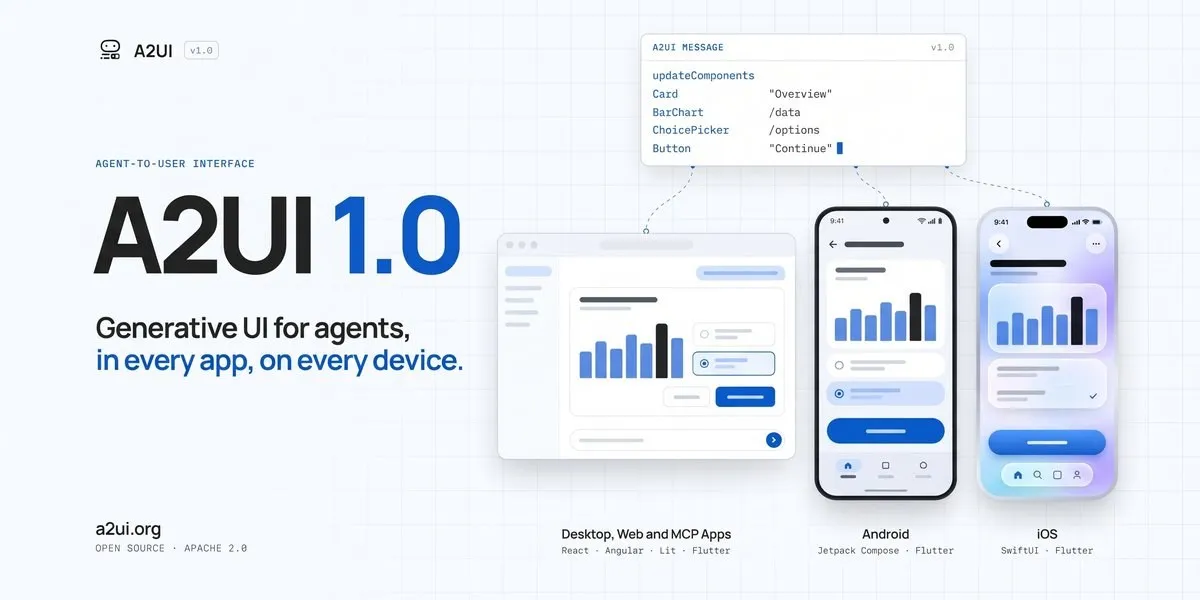
Summary: A2UI PM Vishal Motwani says this is the first stable version of the open protocol for generative UI: the agent describes what to show and each app draws it with the components it registered, so the screen stays in your design system. Version 1.0 adds bidirectional function calls, so a booking picker can check availability on the spot, plus accessibility and custom metadata. Renderers cover React, Angular, Lit, Flutter on mobile, web and desktop, and SwiftUI, with Jetpack Compose still on 0.9.1; agent SDKs cover Python, TypeScript and Dart. The web and Flutter renderers run inside MCP Apps, so A2UI screens can show up in assistants such as Claude and Gemini. Atlassian, Alation, Bloomberg and ByteDance are already building with it.
A2UI 1.0: Build delightful, fast, reliable, agentic experiences- Google Developers BlogDiscover A2UI 1.0, an open protocol for generative UI enabling AI agents to respond with rich, interactive, and native screens across web, mobile, and desktop platforms.developers.googleblog.com- Takeaway 1: Atlassian is bringing A2UI to Jira: when an agent working on an item needs a missing detail or a decision, it asks with an interactive card in the item and the team answers right there, and Alation already shows its A2UI feeds inside Claude
- Takeaway 2: Google says data binding happens on the server so sensitive values never reach the model, and decision models such as Jev, which pick options instead of writing text, can choose the components
Community: iThome covered the cross-platform renderer support in Chinese, and a GDE wrote upgrade notes on what changes in 1.0.
Why I care: This is the Flutter GenUI track of my DevFest talk in December, so I’ll move the demo to 1.0 and add a two-way function call to the live demo.
4. Jensen Huang resigns as Nvidia CEO, and CFO Colette Kress steps in as interim CEO#
medium read · industry · TechCrunch

Why it matters to you: Model and compute prices are tied to Nvidia, so a shake-up there travels all the way to the APIs you use.
Summary: In a regulatory filing, Nvidia said its board accepted Jensen Huang’s resignation as president and CEO on Wednesday, days after he admitted to an affair with an alleged Chinese spy. CFO Colette Kress becomes interim CEO while staying CFO, and board member Harvey C. Jones becomes Nvidia’s first chair of the board and will lead the search for a permanent CEO. Shares fell nearly 12% in early trading Thursday and as much as 19% since Friday, wiping out more than $855 billion in market cap. TechCrunch counts $99 billion in investments and $25 billion in commitments at the end of Q2, including $30 billion in OpenAI and $10 billion in Anthropic; CoreWeave fell about 9% that day and Nebius about 16%. Nvidia reports earnings next Tuesday.
- Takeaway 1: Huang owns only about 3.5% of the shares and has no supervoting rights, so the board could vote him out at any time; he had about 60 direct reports and no heir apparent
- Takeaway 2: Another TechCrunch piece notes Huang was one of open models’ strongest backers, and Nvidia’s Hugging Face acquisition hasn’t closed yet
Community: The HN thread had about 2,556 points, the hottest of the day, and Fireship made a video walking through the whole story (Watch & Listen 1).
Why I care: If you build apps there’s nothing to change this week, but I’ll watch next week’s earnings and what happens to open models, and keep the model provider in my apps switchable.
5. Anthropic’s IPO page goes live: $17.0 billion in Q3 revenue, trading starts November 19#
short read · AI industry · Anthropic

Why it matters to you: The company behind the Claude and Claude Code you use every day is going public, and its costs and margins will shape future pricing and limits.
Summary: Anthropic’s IPO page lists its Q3 numbers: $17.0 billion in revenue, up more than 12x year over year, more than 11,900 customers paying over $100K in trailing revenue, and more than 4x better compute efficiency since Q1 2025. Adjusted operating margin is 15%, but the net loss is $23.3 billion, including a $21.9 billion non-cash charge for the fair value of convertible notes and SAFEs, and the GAAP operating margin is -3%. The roadshow started November 10, pricing is expected November 18 and trading on Nasdaq under ANT on November 19. The page also quotes customers such as Legora, whose CTO Jacob Lauritzen calls Claude brilliant at instruction following and at powering agentic workflows.
- Takeaway 1: Revenue grew more than 12x, but the book net loss is $23.3 billion, mostly a non-cash charge from the higher valuation
- Takeaway 2: Retail investors request shares through a participating brokerage, and allocations are confirmed on the first trading day, November 19
Community: The HN thread had about 749 points and 748 comments; the top comment asked why VCs wouldn’t wait for clear market dominance if the models could really improve themselves, and others said most apps can get by on cheaper models and switching providers is easy.
Why I care: The IPO won’t change what I do, but I’ll watch pricing and usage limits after the listing and track my Claude Code spending month by month.
6. Apple review may be automated now: music app developers face repeated rejections and weeks of waiting#
medium read · App Store · Synth Anatomy
Why it matters to you: If you’re submitting before the end of the year, plan for weeks instead of days, and for rejection reasons that may not match your app at all.
Summary: Synth Anatomy says AI has pushed a flood of new apps into the App Store, with an estimated 10 to 20 new iOS music apps a day. Apple’s guidelines say 50% of submissions are reviewed within 24 hours and 90% within 48, but developers including AudioThing, Igor Vasiliev and Sugar Bytes say new apps sat in review for weeks. Pittsburgh Modular planned a simultaneous launch for the Microvolt 3901, but the VST shipped October 27 and the iOS version only on November 12. Michael Hetrick of Unfiltered Audio says one app was rejected four times, once because the reviewer decided “Polyharmonic” was a licensed audio technology. New developer Marek Dendes says CRUX Synth was rejected four times in a row as design spam made from an app template, going from In Review to Rejected within a second, with no reply five days after his appeal.
- Takeaway 1: Developers suspect automated review because the reasons don’t match the apps and replying with explanations changes nothing
- Takeaway 2: The author warns that anyone shipping before year end could wait three weeks and still get rejected, so submit early
Community: The HN thread is just getting started, and on X someone pointed to an 84% jump in new App Store submissions in one quarter, with review queues growing to match.
Why I care: Anything that must ship before year end, I’ll submit early, with review notes that explain how to test each feature and a demo video recorded in advance so I can appeal right away.
7. Apache HTTP Server’s HTTP/2 module has a remote code execution bug, and Wiz says most cloud environments are exposed#
short read · security · Wiz research blog

Why it matters to you: If Apache sits in front of your API, admin panel or static site, check its version this week.
Summary: Wiz says the bug is a race condition in the assign_headers() function of mod_http2, and a crafted HTTP/2 request could lead to code execution on the server. Affected versions are Apache HTTP Server 2.4.55 through 2.4.70 and the standalone mod_h2 2.0.8 through 2.0.42, fixed in 2.4.71. Anthropic and Google Cloud reported it. Wiz’s data shows 64% of cloud environments have a vulnerable version and 51% have a publicly exposed vulnerable server. No public exploit has been seen yet.
- Takeaway 1: If you can’t upgrade right away, Wiz suggests turning off HTTP/2 with
Protocols http/1.1in the config - Takeaway 2: Distro package versions don’t always match upstream numbers, so check your distro’s own security advisory to confirm the fix
Community: The HN thread had about 350 points and 189 comments; Anthropic and Google Cloud reported the bug, which put AI-assisted bug hunting back on the table.
Why I care: I’ll check the Apache version and HTTP/2 setting on every VM I run, and turn HTTP/2 off on anything unpatched before scheduling the upgrade.
8. RevenueCat rebuilt its AI paywall editor: from JSON patches to letting the model write JSX, with 83% more positive feedback#
medium read · engineering · RevenueCat engineering blog
Why it matters to you: When you build AI editing into an app, letting the model work in a format it already knows beats inventing your own.
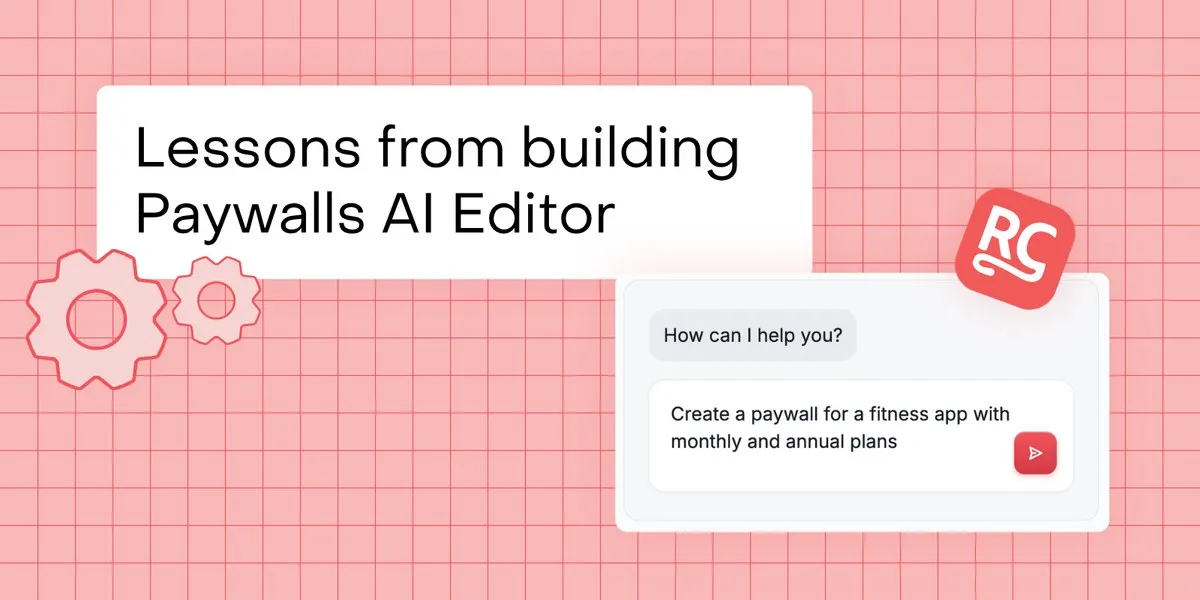
Summary: RevenueCat says its AI paywall editor first had the model output custom JSON patches, which often broke paywalls while the system prompt kept growing. They switched to having the model write JSX directly, checked and repaired by a coding loop with a compiler, iterating the way a coding agent does until it’s right. Afterwards the system prompt was cut by more than half, positive feedback rose 83% and negative feedback fell 40%, across about 46,000 requests. The post also mentions PM Ryan comparing it with Fable in Claude Code to decide where to take it next.
- Takeaway 1: The key move was letting the model output a format it has seen the most (JSX) and feeding compiler errors back, instead of stuffing more rules into the prompt
- Takeaway 2: The prompt got shorter while results improved, which says choosing the right format mattered more than writing more prompt
Community: RevenueCat’s post on X put the switch from JSON patches to JSX front and center.
Why I care: My app uses RevenueCat paywalls, so I’ll try the AI editor for an A/B variant this week, and for my own AI editing features I’ll have the model write a familiar format with a validation loop.
9. Vercel open-sources UI SDK: more than 50 interaction behaviors for React, Vue, Svelte and more#
short read · frontend · GitHub
Why it matters to you: Popovers, focus, drag and drop and accessibility, the behaviors hardest to get right, now have an open, framework-agnostic implementation.
Summary: Vercel Labs released UI SDK, which packs more than 50 interaction behaviors, including popovers, selection, focus management, drag and drop and ARIA, into one core package, @ui-sdk/core, with adapters for React, Vue, Svelte, Solid and Web Components. It is in beta under Apache-2.0, built by shadcn and shuding. There is also an agent skill you can add with npx skills add vercel-labs/ui --skill ui-sdk.
- Takeaway 1: Behavior is separate from styling, so you keep your own design system and use it only for interaction and accessibility
- Takeaway 2: The repo has about 1,016 stars so far and is still beta, so wait for the API to settle before using it in production
Community: Vercel’s launch post had about 2,411 likes, and shadcn’s own post had about 2,223 likes.
Why I care: My site and admin panels are web, so I’ll look at its implementation next time I need a menu or drag and drop, and borrow how it separates behavior from styling for Flutter.
10. Amp drops its low-to-ultra dial and lets each thread pick its own model#
short read · AI tools · Amp

Why it matters to you: AI coding tools are letting you pick the model and effort directly, and are spelling out what switching costs.
Summary: Amp used to map its low, medium, high and ultra modes to GLM-5.3-Flash, Claude Opus 5.5, GPT-6 Astra and Fable 5.2. Now each thread picks its own model and effort, and you can switch mid-thread. Amp warns that the first message after a switch isn’t cached and costs more. The UI also shows which subscription or API key is being billed, and the staff pick is Claude Opus 5.5.
- Takeaway 1: Switching models mid-thread works, but the first message rebuilds the cache, which gets expensive with a long context
- Takeaway 2: The UI shows the billing source, so you don’t burn API key credit by accident
Community: Amp’s Nicolay Gerold explained on X why the dial went away in favor of picking the model directly.
Why I care: I already pick models per task in Cursor, and this is a reminder that switching mid-thread costs a cache rebuild, so long threads are better restarted.
11. Rust 1.100.0: the never type is stable after ten years, and Cargo adds a dependency cooldown#
medium read · languages · Rust blog

Why it matters to you: Cargo’s cooldown setting is a supply-chain defense that other package managers are worth copying.
Summary: Rust 1.100.0 stabilizes the never type (!) after ten years and five attempts. Infallible becomes an alias for it, and type inference fallback changes with it, a rare breaking change. The release also stabilizes part of the allocator API, so Vec and Box can take an allocator, and adds DropGuard. Cargo now warns about unused dependencies and can require new package versions to be published for a while before they’re used, for example [registry] global-min-publish-age = "3 days".
- Takeaway 1: The never-type fallback change can break old code, so run a full build before upgrading
- Takeaway 2: A dependency cooldown gives compromised releases time to be caught, cutting supply-chain risk
Community: The Lobsters thread is discussing the breaking change too.
Why I care: I don’t write Rust, but I’ll borrow the idea for Flutter packages and let new versions sit a few days before upgrading.
12. Testing AWS Lambda Web Functions: memory keeps billing for 5 to 7 minutes after the last request#
medium read · cloud costs · Easel blog
Why it matters to you: If your app backend runs on serverless, most of the bill may be idle time.
Summary: Easel tested Lambda Web Functions across six environments and found memory keeps billing for 313 to 411 seconds after the last request ends, about 1,700 times the request itself, with memory making up about 88% of the cost. Making the function exit after 10 idle seconds got counted as a runtime failure. On their own compute, warm requests were 1.5x to 3x faster and cold starts about 3.5x faster.
- Takeaway 1: Sparse traffic is hit hardest, since every stray request drags minutes of memory billing behind it
- Takeaway 2: Exiting early counts as a failure, so there’s no clean way to skip the idle time
Community: The HN thread had about 61 points, and the author published measurements from all six environments.
Why I care: I’ll check how much of my Cloud Functions bill is idle time and consider merging low-traffic endpoints.
More to Read#
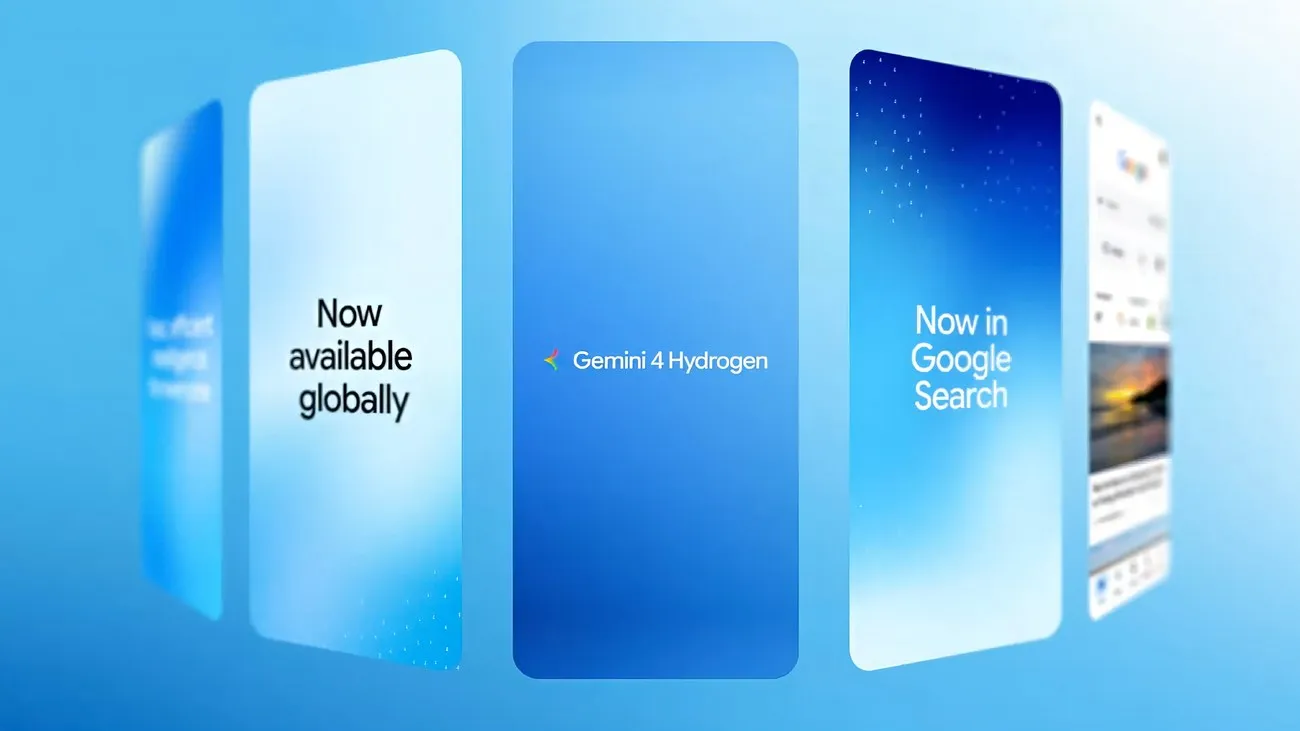
- Google Search gets a major upgrade with Gemini 4 Hydrogen: Why it matters to you: Hydrogen from must-read 2 reached Google Search the same day on every tier, so AI answers in search traffic will only get more common.
- Latent Space: the Jev revolution: Why it matters to you: Latent Space covers system one models that pick options instead of writing prose and talks with Diogo Almeida of TypeSafe AI, a good companion to how A2UI uses decision models to pick components in must-read 3.
- Hugging Face CEO vows to keep fighting for open source AI after Jensen Huang’s exit: Why it matters to you: Nvidia’s $12.9 billion Hugging Face deal hasn’t closed, and Clem Delangue says he’ll keep backing open models, worth watching if you rely on Hugging Face models.
- Let Over Lambda is now free to read online: Why it matters to you: The classic book on Lisp macros and closures is free to read in full, worth a few chapters if you want to understand closures from the ground up.
- Hijacking Samsung TV Smart Hub ads: Why it matters to you: The author used mitmproxy and a leaked eMudhra certificate key to replace the TV’s ads, a thorough hands-on write-up of TLS and device trust chains.
- Hello Baochip: Why it matters to you: Notes from a first session with the open Baochip, from wiring to the first running program, good for software people curious about hardware.
- IBM adds LLMON, an LLM-native markup language, to Granite: Why it matters to you: Granite 4.1’s 3B and 8B models support LLMON, a structured format designed for models to read and write, useful if you need small models to emit structured data reliably.
- Nectar launches an AI agent to automate creator discovery and outreach: Why it matters to you: The piece cites $44 billion in US creator ad spend in 2026, and app marketers should expect more partnership emails written by agents.
- Whoop just launched a social network: Why it matters to you: A wearables company is building a social network, so fitness apps now compete on friends as well as data.
- Import AI 480: Why it matters to you: Jack Clark notes PSI used AI to prove the Aaronson–Ambainis conjecture, another step for AI in mathematics.
- Turning a 22-year-old PostgreSQL type confusion into RCE: Why it matters to you: A full exploitation write-up of CVE-2026-6460, so check that your PostgreSQL version has the fix.
- AgentRun cut its code review bill to 18 cents a run: Why it matters to you: Parcha’s open-source agent runner says its code review used to cost 36 times more and now runs about 18 cents a run.
- 93% of paint splatters are valid Perl programs (2019): Why it matters to you: A 2019 SIGBOVIK April Fools’ paper that ran OCR on paint splatters and found 93% parse as valid Perl; it hit the top of HN again today and makes a fun break.
- An interview with Roblox CEO David Baszucki about aggregating play: Why it matters to you: Ben Thompson and Baszucki talk about how AI is changing game creation and what that opens up for developers and the platform, worth reading if you build for creators.
- BotPsy: an on-device personal assistant with a sub-billion-parameter agentic model: Why it matters to you: The QVAC team describes an on-device model under a billion parameters that can call tools, and is upfront that multi-step information retrieval is still its weak spot, useful if you want offline AI in your app.
Also Worth a Look#
- Five ways Jensen Huang’s ouster from Nvidia could damage the AI industry - TechCrunch (five ways the ouster could hurt the AI industry)
- Jensen Huang agrees to testify before Congress - TechCrunch (Huang agrees to testify before Congress)
- Trump floats Apple chairman Tim Cook as Jensen Huang’s successor - TechCrunch (Trump suggests Tim Cook for Nvidia)
- The Jensen Huang Story Gets Worse, Washington vs. New York, Silicon Valley - Stratechery (Ben Thompson on the Huang story)
- Nebius tests the neocloud playbook with $40 billion in planned spending - TechCrunch (Nebius plans $40 billion in spending)
- SoftBank’s billion-dollar loss may have put a cap on AI’s natural gas ambitions - TechCrunch (SoftBank’s loss may cap AI natural gas plans)
Show all sources (12 more)Show fewer
- Microsoft’s Outlook email hit by new outage - TechCrunch (another Outlook outage)
- No, AI agents did not discover a previously unknown Maya site - The Verge (the AI-found Maya site claim, corrected)
- Phota Labs uses AI to turn everyday photos into professional-looking shots - TechCrunch (AI that turns everyday photos into pro shots)
- Norwest pushes deeper into AI with new $4B fund - TechCrunch (Norwest’s new $4B fund leans into AI)
- We’re bringing Adobe’s creative and productivity tools closer to your everyday Google apps. - Google (Adobe tools come to Google apps)
- Supporting research on AI and children’s safety - OpenAI (OpenAI on research into AI and child safety)
- Chinese frontier AI models carry the fingerprint of export-controlled GPUs - Unemployment Labs (export-controlled GPU fingerprints in model checkpoints)
- A click-fraud bot led me to 5,552 GitHub accounts tied to public inboxes - Substack (5,552 GitHub accounts behind a click-fraud bot)
- Apify Security Incident - Apify (Apify discloses a security incident)
- Talking Zen 6 with Mike Clark at AMD In-Depth - Chips and Cheese (an in-depth Zen 6 interview)
- The Secret of Monkey Island: all 13 versions side by side - monkeyisland.pages.dev (13 versions of Monkey Island side by side)
- Abandoned Quake 4 expansion finished by modders and now playable - ModDB (modders finish an abandoned Quake 4 expansion)
Builder Radar#
1. Flutter explains how Pigeon now uses FFI and JNI so plugins call native code directly#
The Flutter blog published a full explainer on native interop. FFIgen for Objective-C and JNIgen for Java and Kotlin are stable, and Pigeon v30+ can use them under the hood as a preview, on Android, iOS and macOS only, while Windows and Linux keep using platform channels. You turn it on in the @ConfigurePigeon annotation with swiftOptions: SwiftOptions(useFfi: true) and kotlinOptions: KotlinOptions(useJni: true). The team already moved shared_preferences over, and there is a migration skill for coding agents. FlutterDev’s post had about 113 likes.
What it means for your app: If you maintain a Pigeon plugin, migrating is mostly config and a Pigeon rerun, with no serialization round trip and synchronous calls available; it isn’t the recommended default yet, so try it on a branch first.
2. Apple’s Foundation Models framework now reaches Claude and Gemini, free cloud models for small developers#
Apple’s developer page says the Foundation Models framework now reaches server models such as Claude and Gemini through the same Swift API. Developers in the App Store Small Business Program with fewer than two million first-time downloads can use the Apple Foundation Models on Private Cloud Compute with no cloud API cost.
What it means for your app: A Flutter app needs a Swift wrapper over a platform channel or FFI to use it; if you qualify as a small developer, you can try iOS AI features on the free Apple models first and save on API costs.
3. Firebase: set up Analytics and screen view tracking with AI coding agents#
Firebase said on X that AI coding agents can handle two pain points in analytics: the initial setup and adding screen view logging to every screen, so you can see engagement and behavior per screen. The post had about 14 likes.
What it means for your app: Screen views often go missing in Flutter projects, so have an agent add them across your router in one pass and confirm the event names in DebugView.
4. RevenueCat: when your MMP, App Store Connect and Meta all disagree#
RevenueCat shared Hannah Parvaz’s advice: everyone in a growth meeting brings their one true number, the MMP, App Store Connect and Meta all disagree, and the answer is that every number is right and also incomplete.
What it means for your app: When you run ads, decide which question each number answers, such as Meta for campaign efficiency and App Store Connect for downloads, instead of forcing them to match.
5. Starter Story: a lifting app built with no coding background hits $14K a month in 6 months#
Starter Story talked to Max, 22, who couldn’t code before this year and built a lifting, nutrition, sleep and supplement tracker with Claude Code: about $14K in the last 28 days, 1,000+ active subscribers and 20,000+ iOS downloads. The stack is Claude, Supabase, Vercel, Expo and RevenueCat, priced at $24.99 a year with no monthly plan. He films 5 to 10 videos a day, runs the winners as Meta ads at about $250 a day, and says roughly a third of revenue comes from X.
What it means for your app: Filming yourself and running the best performers as ads is something any indie developer can copy, and annual-only pricing is worth testing.
6. LinkedIn traces user actions from app taps to backend services with OpenTelemetry#
InfoQ reports that LinkedIn built an OpenTelemetry telemetry platform that links user actions in its iOS, Android and web apps to the backend services and data stores that handle them. Each request keeps its OpenTelemetry traceId, and a pageForestId ties together the requests from one page, so engineers can debug a single request or look at a whole user journey. Telemetry travels over Kafka.
What it means for your app: The hardest part of an app bug is matching a tap on the client to the backend logs; a Flutter app can send a screen-level id in an HTTP header so backend logs can stitch the whole session together.
What the Community Is Arguing About#
1. Gemini 4 Hydrogen: arguing about the names or the model?#
The HN thread had about 395 points and 258 comments. Many comments joked about the naming, asking whether Oxygen is next or when Lead and Uranium arrive, and some said fast models like this are the ones to watch because they become the daily workhorses. On the other side, a paying user said Gemini still gets the current date and time wrong, so no benchmark makes it trustworthy. The argument is how big the gap between benchmarks and daily use really is.
2. After Humble Bundle’s redesign, users say they could log in without 2FA#
After Humble Bundle’s redesign, a user on the SpaceBattles forum said the new site was vibecoded and much less secure. The HN thread had about 357 points and 218 comments. One commenter said they could log in without 2FA at all, and another said the login code arrived an hour late. Others argued vibecoding isn’t to blame and it always comes down to the people building it. The argument is whether the problem is the AI tooling or the missing review.
3. Nintendo gets 144 repos removed from GitHub in one sweep#
IGN reports that Nintendo sent GitHub four DMCA notices targeting the Switch emulators Yuzu and Citron Neo and mod chip firmware, and all 144 firmware repos were removed. The HN thread had about 238 points and 165 comments. One commenter asked which law they break by running games they own on an emulator with firmware from their own device, while another said most emulators aren’t hosted on GitHub anyway. The argument is where backing up ends and circumventing protection begins.
4. An essay from 2016: why writing correct software is hard#
Ron Pressler’s long 2016 essay uses computability and complexity theory to explain why proving programs correct is fundamentally hard. The HN thread had about 339 points and 155 comments. One commenter was glad to see this outside the AI-does-Lean hype, and another said mathematical correctness and working in the real world are different things, since software has to handle everything users throw at it. The argument is whether AI will make formal verification easy.
Chinese Tech Scene#
1. Jensen Huang’s exit puts the AI supply chain on alert#
(TechNews): TechNews looks at Huang’s resignation from the Taiwan supply chain’s angle; CFO Colette Kress is interim CEO and the board named Harvey Jones chair.
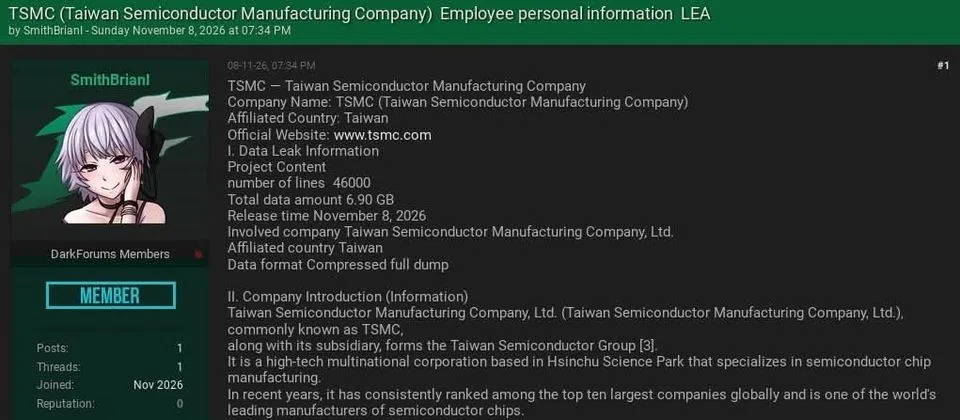
2. Someone claims to sell 46,000 TSMC employee records; TSMC says there’s no sign its systems were breached#
(iThome): Someone on an underground forum is asking 3 bitcoin for 46,000 TSMC employee records. TSMC says some of the data matches records in a cloud provider’s system and is working with the provider and investigators.
3. netiCRM’s provider was breached, and 500+ client servers are being checked and rebuilt#
(iThome): The breached admin server at netiCRM’s provider had access to other hosts, so servers for 500+ nonprofit clients are being checked and rebuilt, and client contact and billing data was confirmed stolen.
4. A Taiwan international school campus is hit by Osiris ransomware#
(iThome): The school got a message on November 6 demanding it download a specific browser and enter a key or have student data leaked, and has reported it to police.
5. Taiwan delays physical-card login for its long-term care system to December after a card reader rush#
(iThome): Taiwan’s health ministry required citizen certificates or health cards to log into the long-term care system, workers rushed to buy card readers, and the rule was pushed to December.
6. ChatGPT lets businesses claim profiles, and US merchants can add a Business Agent#
(INSIDE): Businesses can claim their profile in Business Hub and see how often ChatGPT mentioned them and how many site clicks they got in the past 28 days; US merchants and online services can also add a Business Agent.
7. Who issues AI agents’ passports? The Linux Foundation adopts ANS#
(TechOrange 科技報橘): The Linux Foundation took in the Agent Name Service, which gives AI agents identity, verification and discovery, with 11 organizations including Cisco, Cloudflare and GoDaddy involved.
8. YC holds its first Startup School in Taiwan#
(TechOrange 科技報橘): YC held its first Startup School in Taiwan on the 12th, and a partner suggested founders look at problems AI models still handle poorly, such as hardware design and chip verification.
9. Apple announces the 2027 Swift Student Challenge, and more#
(少數派): Submissions for the 2027 Swift Student Challenge run February 8 to 28 and now accept apps for any Apple platform, with an online session on agentic coding in Xcode on December 10; the same roundup covers Alibaba’s Qwen Code 1.0.
10. Google adopts DPoP for OAuth 2.0 against token theft and replay#
(InfoQ 中文): Google OAuth now supports DPoP for refresh tokens only, binding the token to a client-held key so a stolen token can’t be replayed.
11. Google finally runs PyTorch natively on TPUs#
(InfoQ 中文): Google and Meta launched TorchTPU, a native PyTorch backend for TPUs that drops the explicit compile regions PyTorch/XLA required.
12. More tokens, flat profits: Robin Li wants to redesign the enterprise#
(InfoQ 中文): Robin Li argues companies spend more on AI without better returns because they treat it as a tool instead of redesigning the organization and processes, and proposes an intelligent organization where people and agents share core work.
13. Business travel agents: semantics, preference graphs and context engineering#
(InfoQ 中文): An AICon Beijing talk on how a business travel agent moves from retrieving information to understanding company policy and personal preferences, with context engineering at the center.
14. Academia Sinica builds Taiwan GBA and G-YOLO to help AI understand scenes, not just see them#
(iThome): Liao Hong-Yuan, director of Academia Sinica’s Institute of Information Science, says AI in care, self-driving and robotics must understand behavior and surroundings, not just see them; the institute built the Taiwan GBA behavior analyzer and G-YOLO, using fall detection for older adults at home as the example.
Open Source Picks#
Today’s trending list has two tools that pair with agents, a native Excalidraw app and embroidery software with MCP support, plus three deep-tech projects, including a layer that runs Apple Silicon software on x86 PCs and small models on a TV box. Star counts are checked against the GitHub API today.
1. chocoford/ExcalidrawZ#
Swift | 1,759 stars
A native Excalidraw app in pure SwiftUI for macOS, iPadOS and iOS, with iCloud sync and MCP support, MIT licensed.
2. tylertms/Stela#
Rust | 1,350 stars
A general-purpose Apple Silicon layer for x86-64 PCs that boots from UEFI, translates arm64 to x86-64 and includes a Metal driver for NVIDIA GPUs, presenting itself as an M2 Mac mini, GPL-2.0 licensed.
3. HybridRobotics/supermimic#
Python | 1,301 stars
Humanoid whole-body motion tracking with one differentiable world model, Apache-2.0 licensed.
4. hyperionaidev/smolmaxxing#
C | 234 stars
Runs LLMs on the smallest devices possible; the README shows Qwen3.5-2B at 7.7 tokens per second on a Xiaomi TV box and on a 2013 iPad Air, MIT licensed.
5. simpsoka/zigzag#
Rust | 184 stars
Free, open-source embroidery software for Mac and Windows that turns SVG into machine embroidery, lets you edit stitches visually and works with AI agents over MCP, Apache-2.0 licensed.
Watch & Listen#
1. Fireship: Jensen Huang just pulled out of Nvidia…#
Channel: Fireship
Why it matters to you: Must-read 4 covers the outcome, and this video explains the export controls and the Singapore company behind it.
- Takeaway 1: The video says US rules only look at where a chip sits and who owns the buyer, so Singapore’s Megaspeed bought GPUs, racked them in Malaysia and Indonesia and rented the compute to Alibaba
- Takeaway 2: Investigators showed Megaspeed’s balance sheet going from $33 million to $3 billion in one year, from a source nobody could name
- Takeaway 3: The video explains this small company bought $4.8 billion of Nvidia GPUs, which is why the affair became a national security issue
2. 20VC: Sequoia leaves London, and NASDAQ loses $2.5T in 24 hours#
Channel: 20VC

Why it matters to you: Jason Lemkin and Rory O’Driscoll cover Sequoia’s restructuring, the Nvidia investigation and the Anthropic IPO in one episode, useful if you want an investor’s view of must-reads 4 and 5.
- Takeaway 1: Sequoia is leaving London and ending its scout program and evergreen fund, and they discuss why
- Takeaway 2: They think China may lose the most from the Nvidia investigation, since hosting GPUs across the border will get harder
- Takeaway 3: On the Anthropic IPO, they say it’s far better to price low and go up than to price high and come back down
3. Dwarkesh Patel: How Robert Moses got everything built, with Robert Caro#
Channel: Dwarkesh Patel

Why it matters to you: Not a tech story, but it’s about how one person got huge projects finished, which anyone shipping products will relate to.
- Takeaway 1: By 1964, Moses had built 672 of the 899 miles of highway completed in New York State
- Takeaway 2: Caro says Moses himself was money honest, but he built a machine where banks, unions, lawyers and party bosses all benefited from new construction
- Takeaway 3: Those beneficiaries would call anyone who stood in his way, from a borough president to the governor
Today’s Take#
First, I’m trying Expo Simulators. I’ll make a simulator build of a small Flutter project, have a Cursor cloud agent fix a simple UI bug, see whether the recording and screenshots it brings back are enough for me to decide on the merge, and work out how many minutes one PR costs.
Next, I’m moving my DevFest GenUI demo to A2UI 1.0. Two-way function calls are great for a live demo, like an agent answering with a booking picker that checks availability on the spot. I’ll switch the demo to Hydrogen too and see whether latency improves.
I’m taking the Apple review reports seriously. Anything that must ship before year end goes in early, with review notes that explain how to test each feature and a demo video ready so I can appeal right away.
On the industry side I’m watching two things: Nvidia’s earnings next Tuesday and Anthropic’s pricing after it lists on November 19. Both could move model API prices, so I’ll keep the model provider in my apps switchable instead of locked to one vendor.
Last, routine security: check the Apache version on my VMs and turn off HTTP/2 on anything unpatched, and borrow Cargo’s cooldown idea for Flutter packages by letting new versions sit a few days before upgrading.