Apple plugs Xcode into Claude Code while Goldman pulls it from traders
Apple's official plugin lets agents build and test iOS apps; Goldman limits Claude Code to engineers; one heavy user switches to Pi

Spend 1% of your day keeping up with tech.
Quote of the Day#
“Ultimately, CC feels like a product without a strong vision or direction.” — Caleb, author of Goodbye Claude, Hello Pi (source)
“
.claude/settings.local.jsonis meant to stay local. This is not a file you should check into source control. We automatically gitignore it when Claude creates the file.” — Boris Cherny, Claude Code team (source)
Today’s Theme#
This weekend Claude Code got pulled in several directions at once, and I kept scrolling with a big grin.
Good news first. An Xcode plugin signed by Apple itself landed in the official Claude Code marketplace. Agents can build, run tests, render SwiftUI previews, and drive the simulator. Apple never put out a press release, just a merged PR, and X went wild anyway. If you ship iOS, you can try it next week.
At the same time, Goldman Sachs took Claude Code back from traders and bankers and left it with engineers only. The logic is easy to follow: a tool that writes and runs its own code, sitting on machines that touch client data, with nobody reviewing it, is risky. Another HN thread was blunter: plenty of people pushed .claude/settings.local.json, passwords included, straight to GitHub.
Some people just left. Caleb wrote a goodbye post saying Claude Code ships too often and keeps changing its system prompt, so he moved to the open source Pi. The comments got heated.
My take: the stronger the tool, the more you have to draw the boundaries yourself. I will install the Xcode plugin, but the settings file goes into .gitignore first, and permissions start tight before I loosen them.
App builders, take one more look at Builder Radar: a big chunk of Google Play subscription cancellations are failed payments that have nothing to do with your product. Turn on the grace period in Play Console first.
Must Read#
- Apple’s official Xcode plugin joins the Claude Code marketplace: agents can build, test, and open the simulator
- Goldman Sachs takes Claude Code back from traders and bankers, leaving it with engineers
- Claude Code’s “Don’t ask again” writes passwords into a settings file, found in 1,122 public GitHub files
- Goodbye Claude, Hello Pi: why one heavy user replaced Claude Code
- Latent Space: how Stanford CS146S teaches AI-native engineering, with homework reviewed by open source maintainers
- Alibaba Cloud CIO Jiang Linquan: AI code share soars, so why is end-to-end delivery not faster
- The Verge: Apple speeds up turning Siri into an agent, aiming to control third-party apps by spring
- llama-modchip: 284B DeepSeek-V4-Flash on 64GB of RAM and zero GPUs
- ReadyOn builds four layers of tenant isolation on EKS, and engineers say you still need to see whether the walls hold
- Hookshot: a static recompilation of the Switch 2 Ocarina of Time, running natively on Windows and Linux
- Nvidia’s board opens an independent investigation after reports that Jensen Huang was a foreign intelligence target
- TechCrunch: nine apps to replace doomscrolling, and how they price
1. Apple’s official Xcode plugin joins the Claude Code marketplace: agents can build, test, and open the simulator#
short · iOS/dev tools · GitHub/X

Why it matters to you: If you write iOS, or ship the iOS side of a Flutter app, agents can finally compile, run tests, and look at the screen themselves, so you stop pasting errors between Xcode and the terminal.
Summary: Anthropic’s claude-plugins-official merged PR #6338 on November 6 at 00:55 UTC, adding an xcode plugin whose author is listed as Apple Inc. The description is direct: build, run, and test schemes, render SwiftUI previews, drive simulators and devices, read build logs and diagnostics, and search Apple developer docs. Install with /plugin install xcode@claude-plugins-official; you need a Mac and a recent Xcode. The plugin is not downloaded from the marketplace. Its source is the local command xcrun agent plugin path --plugin-format claude, so the version follows your installed Xcode. CellCog’s write-up notes the PR was opened on September 30 and Apple has made no announcement; the underlying Xcode MCP has existed since Xcode 26.3, and the plugin just packages the setup. The news spread from a RoundtableSpace post on X, which showed about 6,155 likes and 647K views.
- Takeaway 1: Xcode stays in the loop; Apple’s docs require you to open the project in Xcode and allow external agents first
- Takeaway 2: Codex can use the same MCP route (
xcrun mcpbridge); Claude Code just gets a one-line install
Community: Greg Isenberg posted the next day a full playbook for using Claude Code plus the Xcode plugin to find ideas, build apps, and ship, with about 2,764 likes and 200K views.
Why I care: Every Flutter app I work on ships to iOS, and the biggest time sink is failed builds and checking screens in the simulator. I will install it in a test project first and see whether the agent can read logs and fix Podfile and signing issues on its own before it goes near a real project.
2. Goldman Sachs takes Claude Code back from traders and bankers, leaving it with engineers#
long · enterprise adoption/security · Hacker News

Why it matters to you: If your company plans to give coding agents to non-engineers, Goldman just showed the other path: pull it back first, then work out who owns the code.
Summary: State of AI, citing Bloomberg, says Goldman updated internal guidance in October: Claude Code and GitHub are open to engineers only, and most trading and investment banking staff can no longer use them; strats, who span trading, quant, and engineering, keep access. Those users had used agents to track client flows, model positions, and build charts. The same CIO, Marco Argenti, praised tools built by non-technical staff through vibe coding as recently as July; engineers make up more than 12,000 of Goldman’s roughly 47,000 employees. In April it had already removed Claude from Hong Kong investment banking. Goldman and Morgan Stanley are both lead underwriters on the Anthropic IPO. The risk the piece highlights: agents read, write, and execute with the user’s own permissions, so a trader’s script might run daily without review and cross information barriers. About 479 points on HN.
- Takeaway 1: Goldman’s in-house multi-model assistant stays open; the limit targets third-party agents that write and run code
- Takeaway 2: Barclays is going the other way, expecting half its developers on Claude Code by year end
Community: One HN commenter named the “lethal trifecta” outright: private data, external input, and execution, all present on a trader’s machine. Others wondered about the timing, with the news landing weeks before the IPO.
Why I care: When I push agents inside a team, I will copy one rule: any tool a non-engineer builds with an agent needs a named engineer who owns it before it touches production data.
3. Claude Code’s “Don’t ask again” writes passwords into a settings file, found in 1,122 public GitHub files#
discussion · security · Hacker News
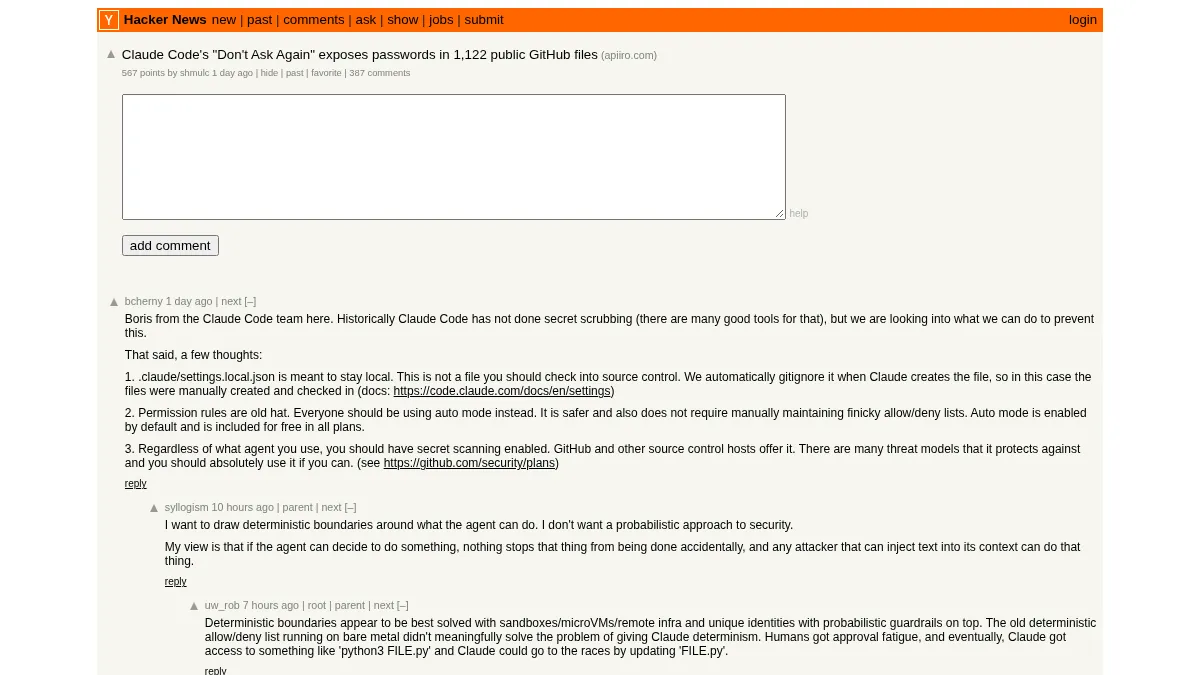
Why it matters to you: When you click “Don’t ask again” in Claude Code, the command and its arguments get written to .claude/settings.local.json. If that includes a password and the file gets committed, it leaks.
Summary: Security firm Apiiro’s report hit 563 points and 387 comments on HN; its headline says it found 1,122 settings files with secrets on public GitHub. The mechanism is simple: an allow rule stores the whole command, including any token or database password you pasted. Boris Cherny from the Claude Code team replied that settings.local.json is meant to stay local, Claude adds it to gitignore automatically when it creates the file, and the leaked ones were mostly created by hand and then git add-ed. He said the team is looking at prevention, and recommended the default-on auto mode over hand-maintained allow/deny lists. He closed by saying that whatever agent you use, you should turn on GitHub secret scanning.
- Takeaway 1: Commenters pointed out that “public” depends on repo settings, and private repos can still be read by insiders
- Takeaway 2:
git add .got named as the usual culprit
Community: One camp wants official secret scrubbing; another says users committed without looking. Some used the thread to pitch open source harnesses.
Why I care: I will add the whole .claude/ folder to my global gitignore and run GitHub secret scanning over old repos. Passwords stay in environment variables, never pasted in plain text into a chat.
4. Goodbye Claude, Hello Pi: why one heavy user replaced Claude Code#
long · dev tools · Hacker News
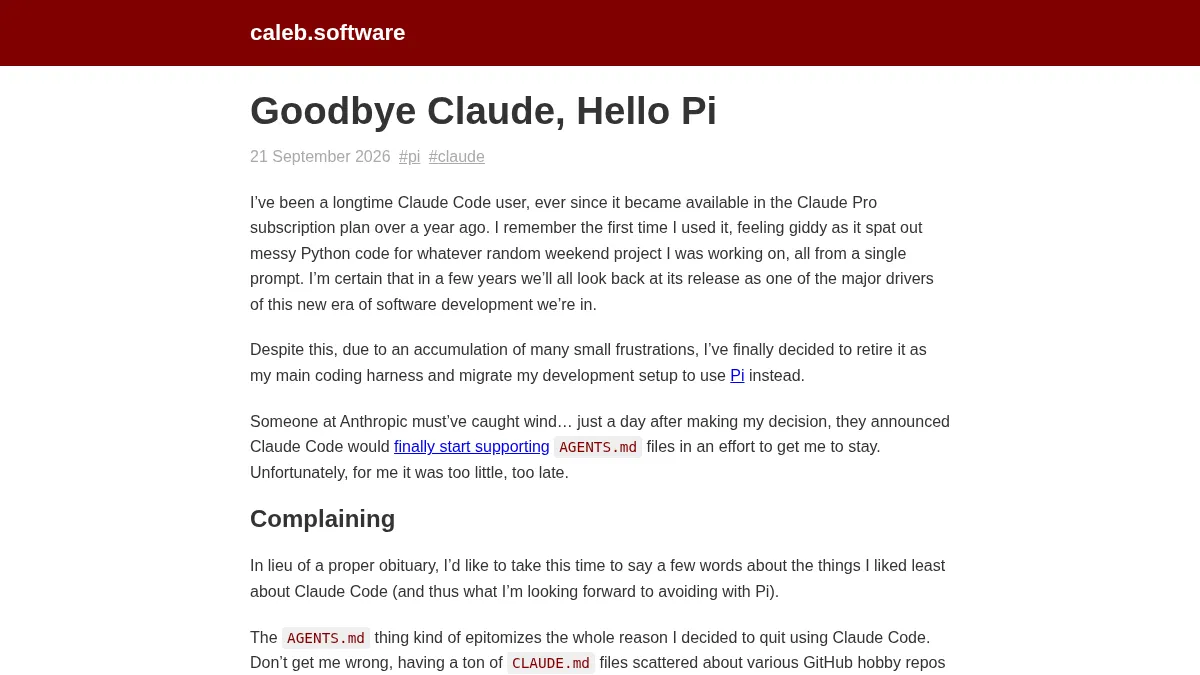
Why it matters to you: How often your coding harness ships, its system prompt, and its IDE integration all shape how the model works; this post lists a heavy user’s complaints in concrete terms.
Summary: Caleb has used Claude Code since it came to the Pro plan and finally moved his main harness to the open source Pi. His pain points: in VS Code only one session can connect to the IDE at a time, and selected text only goes to the first tab, a bug reported back in December 2025; half the slash commands do not work in the GUI extension, there is no custom status line, and subagent output gets mixed into the main conversation. He counts 244 Claude Code releases this year, more than three quarters of which changed the system prompt or tool descriptions; the default Bash tool description is nearly 3,000 tokens. The day after he left, Anthropic announced AGENTS.md support, which he says came too late. On Pi, he spent about 20 minutes writing a plugin that fixed multi-tab selection. About 658 points and 413 comments on HN.
- Takeaway 1: The author thinks Claude Code lacks someone whose job is to say no, so features keep piling up
- Takeaway 2: He estimates that saving 1,000 tokens across 100 million daily requests would cut inference costs by millions of dollars a year
Community: Some say Pi is the best harness because the whole thing is yours; others warn that plugging an Anthropic subscription into a third-party harness may break the terms, and that Pi has no built-in auto mode to block dangerous commands.
Why I care: I use Claude Code, Codex, and Cursor, so I am noting his point about AGENTS.md: write project rules once, every harness reads them, and switching tools costs the least.
5. Latent Space: how Stanford CS146S teaches AI-native engineering, with homework reviewed by open source maintainers#
121 min · interview/education · Latent Space

Why it matters to you: A coding agent can finish last year’s homework in one prompt, so how schools change their courses tells you early what new hires should know.
Summary: To mark the AI Engineer YouTube channel passing one million subscribers, Latent Space hosted Mihail Eric, who teaches Stanford’s CS146S “The Modern Software Developer” and leads the AI team at Monaco. The second run of the course brings in open source maintainers: students must understand an unfamiliar repo, propose a change, and then explain the patch to the person who might merge it. He walks through the ten-week syllabus: agent loops, tools and harnesses, context engineering for large codebases, and the skill of actually understanding a diff. At Monaco they built their own agent workspace, bought an off-the-shelf code review tool, and let an on-call agent read Datadog and GitHub; his rule is “buy to learn, build to keep.” There is also a second page on the same episode.
- Takeaway 1: A whole segment covers what to do when code review becomes the bottleneck
- Takeaway 2: Stripe’s background coding agent Minions comes up as a reference
Why I care: When I mentor new people, I will borrow his assignment design: after the agent writes it, you must explain to the reviewer why the change looks this way, and if you cannot, it does not merge.
6. Alibaba Cloud CIO Jiang Linquan: AI code share soars, so why is end-to-end delivery not faster#
50 min · organization/engineering management · InfoQ China

Why it matters to you: When your boss asks why AI has not made things faster, this piece gives you an answer you can actually calculate.
Summary: Jiang’s team went all-in on AI coding at the end of 2024, and the AI-generated share of code quickly passed 30%, but the headcount needed to deliver a requirement did not change. His breakdown: coding is about 20% of the whole process, and the parts AI is good at (CRUD, UI, tests, glue code) take less than 35% of coding time. 20% times 35% is about 7%, the theoretical ceiling; peers report 3% to 5%. Worse, senior engineers got “DDoSed” by AI-generated code and review jammed. Their fix: shift testing and observability left to developers, require a live demo at every requirements review, and merge six job types into two, PDFE and ABE. From December 2024 to March 2026, effective throughput rose roughly 2 to 3 times. After business systems were opened to general agents through Headless MCP, agent calls grew about 1,000 times in four months.
- Takeaway 1: His slogan is “skills inflate, taste deflates”: building is no longer scarce, judging what to build is
- Takeaway 2: Agents acting for staff inherit their permissions, so you need accounts, authentication, authorization, and auditing
Why I care: I will take that 7% math straight to my team: first measure where the time goes, then decide where AI belongs.
7. The Verge: Apple speeds up turning Siri into an agent, aiming to control third-party apps by spring#
short · iOS/AI · The Verge

Why it matters to you: Once Siri can operate third-party apps, whether your app exposes its actions decides whether users still need to open it.
Summary: The Verge, relaying Bloomberg’s Mark Gurman, reports that CEO John Ternus is pushing Craig Federighi to speed up the Siri roadmap, aiming for an agent that can compete with OpenAI’s Dots and Meta’s Muse. Two steps come next: iOS 27.3 lets Siri make fine-grained changes inside Apple’s own apps, such as rotating and cropping in Photos or organizing Safari tabs; deeper third-party integration is expected in spring, like ordering through Grubhub or booking with OpenTable. Gurman thinks Apple could let Siri track goals and decide next steps on its own as soon as next year. The same day The Verge also found a “Conversational Apps” flag in iOS 27.3, hinting that chatbots may come to HomeView.
- Takeaway 1: Inside Apple, people do not think they are keeping up with rivals
- Takeaway 2: The direction is moving from single commands to ongoing tasks
Why I care: I will check which actions my apps expose through App Intents. Greg Isenberg’s playbook also lists “let Siri and personal agents use your app” as a must.
8. llama-modchip: 284B DeepSeek-V4-Flash on 64GB of RAM and zero GPUs#
repo · local inference · Hacker News

Why it matters to you: If you want to run a big model on your own machine without buying a GPU, this project brings the bar down to a 64GB desktop.
Summary: llama-modchip is a set of ggml/llama.cpp kernel patches, a quantization converter, and tools. It squeezes DeepSeek-V4-Flash, with 284.33B total and 13.17B active parameters, into 56.56 GiB (1.71 bpw), with peak memory of about 57.61 GiB at 256K context and no swap. On a 16-core Zen 5, prefill runs about 44.36 tok/s and generation about 9.1 to 14.7 tok/s; a 30B MoE runs about 25 to 111.6 tok/s on CPU. Another selling point is KV cache restore for agents like Claude Code, about 13.1 ms from /dev/shm. Apache-2.0, about 449 GitHub stars, about 323 points and 123 comments on HN.
- Takeaway 1: All 6 routed experts are computed by default, with no pruning
- Takeaway 2: For 16 to 32GB laptops it recommends Nemotron 30B instead
Community: The most common HN question was about bits per weight; 1.71 bpw is roughly 2-bit territory, and people worry about quality. antirez added that on 128GB of unified memory it already runs close to usable speed for a coding agent.
Why I care: I will treat it as a reference point for how far local agents can go. Real work stays on cloud models, and I will not trust 2-bit quality until I test it myself.
9. ReadyOn builds four layers of tenant isolation on EKS, and engineers say you still need to see whether the walls hold#
4 min · architecture/security · InfoQ China

Why it matters to you: If your SaaS runs multiple customers on one Kubernetes setup, this is an isolation checklist you can copy.
Summary: ReadyOn’s Harmony platform handles payroll and org data on Amazon EKS. Layer one gives each tenant a namespace with RBAC, quotas, admission control, and default-deny network policies, generated from Git with Argo CD ApplicationSets. Layer two uses Karpenter with double taints to give each tenant a dedicated node pool. Layer three gives each tenant its own VPC security group, with a private EKS API endpoint behind VPN plus OIDC plus MFA. Layer four gives each tenant its own Aurora cluster instead of row filtering in a shared database, plus tenant-scoped Secrets Manager paths and short-lived IRSA credentials. The threat model it checks against has 10 stages, and red-team exercises have found no cross-tenant path so far.
- Takeaway 1: AWS docs also say namespaces and RBAC are only logical isolation and do not stop shared nodes
- Takeaway 2: Commenters warn that however deep the isolation, without observability it is only a feeling of safety
Why I care: When I plan multi-tenancy for a project’s PHP backend, I will get to the separate-database layer first and add the rest as customers grow.
10. Hookshot: a static recompilation of the Switch 2 Ocarina of Time, running natively on Windows and Linux#
repo · games/compilers · GitHub

Why it matters to you: Static recompilation translates a whole game into C and compiles it to a native program, which makes it a great way to learn binary translation and Vulkan rebuilds.
Summary: Hookshot translates the code of the Switch 2 version of The Legend of Zelda: Ocarina of Time into C and compiles it into a Windows or Linux program. System software is reimplemented and graphics are rebuilt on Vulkan, all on your machine using your own game files. The repo contains no game, keys, or executables. Requirements: a GPU with Vulkan 1.3 plus mesh shaders (RTX 20 or newer, RX 6000 or newer, or Intel Arc), 16GB of RAM, and about 60GB of space to build. It is experimental: Kokiri Forest is playable, while areas like Hyrule Field still have known issues. GPL-3.0, created November 5, about 2,939 GitHub stars.
- Takeaway 1: Only a specific version of the game files is supported
- Takeaway 2: AMD and Intel GPUs report more problems
Why I care: I care more about the engineering than the game: the README lays out a support matrix, known issues, and linked issues in a table, a good example of an open source project managing expectations.
11. Nvidia’s board opens an independent investigation after reports that Jensen Huang was a foreign intelligence target#
short · industry · The Verge

Why it matters to you: Nvidia sits at the center of the AI compute chain, and an investigation involving its CEO feeds into export control and supply debates.
Summary: The Nvidia board’s statement says that, given reports that Jensen Huang was the target of a foreign intelligence operation, a committee of independent directors with outside counsel has opened an investigation; the board has “no reason to believe” national security or company secrets were compromised, and Huang is fully cooperating. The Verge notes that The New York Times reported last month on his close relationship with Megaspeed executive Alice Huang, which he later acknowledged as romantic in an internal memo; US officials believe she was recruited by China’s Ministry of State Security. Megaspeed is an Nvidia customer under Commerce Department investigation for possibly smuggling AI chips into China. TechCrunch covered it too.
- Takeaway 1: The board says it still trusts Huang and the management team
- Takeaway 2: Outside attention is on whether information from his White House contacts leaked
Why I care: I do not write apps on Nvidia chips, but cloud GPU prices and supply follow export controls, so the next few weeks are worth watching.
12. TechCrunch: nine apps to replace doomscrolling, and how they price#
list · consumer apps · TechCrunch

Why it matters to you: If you build habit or learning apps, this list doubles as a competitor pricing sheet.
Summary: TechCrunch first published this list in March and keeps updating it. It opens with last year’s survey: 64% of Americans say they doomscroll. The nine picks: Finch, where you care for a virtual pet to build habits; Libby for borrowing library ebooks; Dudel Draw, which gives you one shape a day to draw; Radio Garden with more than 25,000 stations worldwide ($2.99 a month to remove ads); Elevate with 40-plus brain games ($39.99 a year); Vocabulary ($4.99 a month, $59.99 a year); Seterra with 300-plus geography games; NYT Games ($5.99 a month, with Wordle and others free); and Drops with 45-plus languages ($11.99 a month, $79.99 a year).
- Takeaway 1: Most use “free with limits” and then an upgrade; Elevate’s free tier gives three games a day
- Takeaway 2: The annual price is roughly five to seven times the monthly price, so the yearly discount is large
Why I care: I will check these numbers against the HerFIT subscription page: similar apps land at $40 to $80 a year and $5 to $12 a month.
More to Read#

- Ex-Secret Service agent turned security VC raises a second fund of about $250M: Why it matters to you: Stephen Ward says the best years to sell a security startup are years three to seven; after his team reviewed them by hand, only 30 of 278 “AI security” deals on PitchBook in the first half actually fit the label.
- A bit about email: Why it matters to you: MX, the SMTP conversation, SPF, DKIM, and quoted-printable in one post on how a message gets delivered; handy if you self-host mail or chase bounces.
- datasette #3046: do not send link rel=next to Firefox on HTML pages: Why it matters to you: Simon Willison found that Firefox prefetches the next page based on the HTTP header, so pagination headers can make your server do twice the work.
- Chatbots might be coming to Apple’s HomeView: Why it matters to you: iOS 27.3 code includes a “Conversational Apps” flag, so home devices may become a new entry point for third-party chat apps.
- RAM Altman: a script that emails Sam Altman how much RAM your machine is not using: Why it matters to you: gallows humor for the RAM price spike, about 202 points on HN.
- Elvis and Eminem rights holders sue Suno: Why it matters to you: two more AI music lawsuits; if you build generative audio, watch where your training data comes from.
- Epic Games Launcher officially supports SteamOS: Why it matters to you: Epic confirmed the Linux launcher will support SteamOS and the Steam Deck, another step for Linux gaming.
- TechCrunch Mobility: the Cybertruck experiment is over: Why it matters to you: Tesla ends Cybertruck production next year and gives the line space to Cybercab.
- From autonomous agents to cognitive symbionts: Why it matters to you: a position paper with about 116 votes on HuggingFace Papers arguing AI should augment human judgment, a useful contrast with Goldman’s choice today.
- Agent memory needs its OpenTelemetry moment: Why it matters to you: every agent tool uses its own memory format and none talk to each other; the author surveys existing formats and proposes a shared data model.
- Cloudflare: the post-quantum future of privacy protocols: Why it matters to you: privacy-preserving anti-abuse cryptography also has to face quantum threats, and Cloudflare explains where its research is heading.
- Vercel AI Gateway adds DeepSeek Search and Fetch: Why it matters to you: any model that supports tool calls can search the web and fetch pages with one API key.
- Dux: an open source Wayland desktop shell: Why it matters to you: a desktop suite tuned for niri, Hyprland, Sway, and others, with a file manager and themes.
- PacketHound: Little Snitch for Windows: Why it matters to you: a free outbound firewall that asks you to allow or block each app the first time it connects, good for catching sneaky connections on a dev machine.
- Media’s second pivot to video will not stop: Why it matters to you: publishers just figured out vertical video and platforms are already eyeing the next format, so content teams should get ready to switch again.
Also Worth a Look#
- DeepSeek V4.1 Flash 1017 Ultrafast now available on AI Gateway - Vercel Blog (call the new DeepSeek with one key)
- Ampersand from Humans& now available on AI Gateway - Vercel Blog (another model on the gateway)
- Partnering with Hacktron to find vulnerabilities in OpenAI’s systems - OpenAI (a partnership to find bugs in its own systems)
- Measuring how AI agents handle everyday wet-lab science - OpenAI (an eval of agents doing wet-lab work)
- Outlook.com Is Quietly Rejecting Email from Domains Without DMARC - Hacker News (mail from domains without DMARC gets blocked)
- NetBSD 11 desktop on a Raspberry Pi 4 - Lobste.rs (a NetBSD desktop on a Pi)
- iSponsorBlockTV - Hacker News (skip YouTube sponsor segments on your TV, 6,898 stars)
- Apple’s M5 MacBook Air is down to its lowest price since July - The Verge ($200 off both sizes)
- Ask HN: What are you working on? (November 2026) - Hacker News (the monthly projects thread)
- Writing as a thinking tool - Hacker News (writing as a way to think)
- systemd loves Rust - Lobste.rs (systemd now accepts Rust for leaf binaries; the shared library stays C)
- Dear Open Source Developers: It’s OK not to embargo - Lobste.rs (embargoes, starting from curl’s change to how it discloses low-severity bugs)
- I’m not a fan of Deno’s security model (2024) - Lobste.rs (a 2024 critique of Deno’s permission model, back in discussion this week)
- Vercel Tracing is now generally available - Vercel Blog (all plans, zero setup for new Next.js projects, traces kept 14 days)
- Sequoia partners reportedly blindsided when Roelof Botha joined SpaceX board - TechCrunch (how Sequoia insiders reacted to Botha joining the SpaceX board)
Builder Radar#

1. RevenueCat: about 32% of Google Play cancellations are failed payments, versus 15% on the App Store#
RevenueCat’s 2026 report covers more than 115,000 apps and $16 billion in revenue: on Google Play, 32.3% of cancellations are involuntary payment failures, versus 15.2% on the App Store. Expired cards, drained prepaid balances, banks blocking charges: these people were willing to pay. On iOS the advice is to set Billing Grace Period to 28 days; Apple’s data says 90% of billing issues resolve within that window. dev3mike reminded people on X: before you buy more Android installs, check grace period and account hold in Play Console.
What it means for your app: A big share of Android subscription churn has nothing to do with the product. I will turn on grace period and account hold first, then use RevenueCat’s BILLING_ISSUE event to send a push asking users to update their payment method.
2. RevenueCat Early Payouts: store revenue as soon as the next business day#
Stores can make you wait up to two months to get paid. Early Payouts advances up to 80% of App Store and Play revenue for a 2.5% fee, with automatic daily payouts above $5,000 in monthly revenue; anything not advanced arrives on the store’s normal payday. Timothy Lindblom said on X it currently needs a US company, with 13 more countries coming soon.
What it means for your app: Apps that grow through paid acquisition get cash flow stuck in store payout cycles. Whether 2.5% is worth the time depends on your payback period; developers in Taiwan should watch the country list first.
3. Greg Isenberg: an iOS playbook from finding an idea to shipping, with Claude Code and the Xcode plugin#
About 2,764 likes and 200K views. The flow: sort utilities by revenue in Appfigures and find ones rated below 3.5; pull reviews of the top 20 and have an agent summarize the one- and two-star complaints; use the Xcode plugin, XcodeBuildMCP, and ios-simulator-mcp so the agent builds, taps, and screenshots on its own; run the most-complained-about flows with Maestro; RevenueCat for subscriptions, Superwall to test paywalls, with the paywall after the first success, annual plus a three-day trial as the default, and weekly as the anchor.
What it means for your app: The list is long, so I am picking two: turn the top five review complaints into an agent skill and check every feature against it; move the paywall from app launch to after the user finishes their first task.
4. Two small subscription review traps: plans that fail to load get rejected, and the real charge must be most prominent#
Linzec shared a rejection under Guideline 2.1(b) with the message “subscription plans could not be loaded”; the fix was submitting the first subscription together with the app version, giving the paywall clear loading and retry states, and testing sandbox purchases on iPad too. PaulBuilds added one more: the most prominent price on screen must be the amount actually charged, with any per-month breakdown as secondary info. Both posts had very low engagement, so treat them as shared experience.
What it means for your app: Before submitting, I will run a sandbox purchase on the iPad simulator and make sure the annual total on the paywall is bigger than the “only per month” line.
5. A nine-year iOS developer account terminated under 3.2(f), with no specific reason given on appeal#
Vladyslav says Apple rejected his appeal and terminated his developer account. The app was rejected a few times during its 1.0 review in 2025, passed after changes, then went through four updates without a rejection, and after more than a year without updates it was judged not to have fixed the issue. He admits he sent his appeal 30 to 50 minutes after the notice, which was too fast. His earlier post had about 114 likes and 49K views.
What it means for your app: When you get rejected, fix things under the broadest reading of the review notes and keep a change log; when you get a termination warning, gather evidence before replying instead of rushing an appeal.
6. A first game hits number three on the Romanian App Store, with subscriptions through RevenueCat#
Cosmin Trica shared his first game, PULSEBOUND: a rhythm roguelite where every weapon is an instrument and each run composes a new song. It ranks third on the Romanian App Store, is in the top 100 in more than 7 countries, and he thanked RevenueCat for a smooth integration. The post had very low engagement, so read it as a personal share.
What it means for your app: Rankings are easier to crack in small markets, so early on you can pick a few local markets, push for rank, and use the screenshots as social content; leave subscriptions and in-app purchases to an existing SDK and spend your time on the gameplay.
What the Community Is Arguing About#
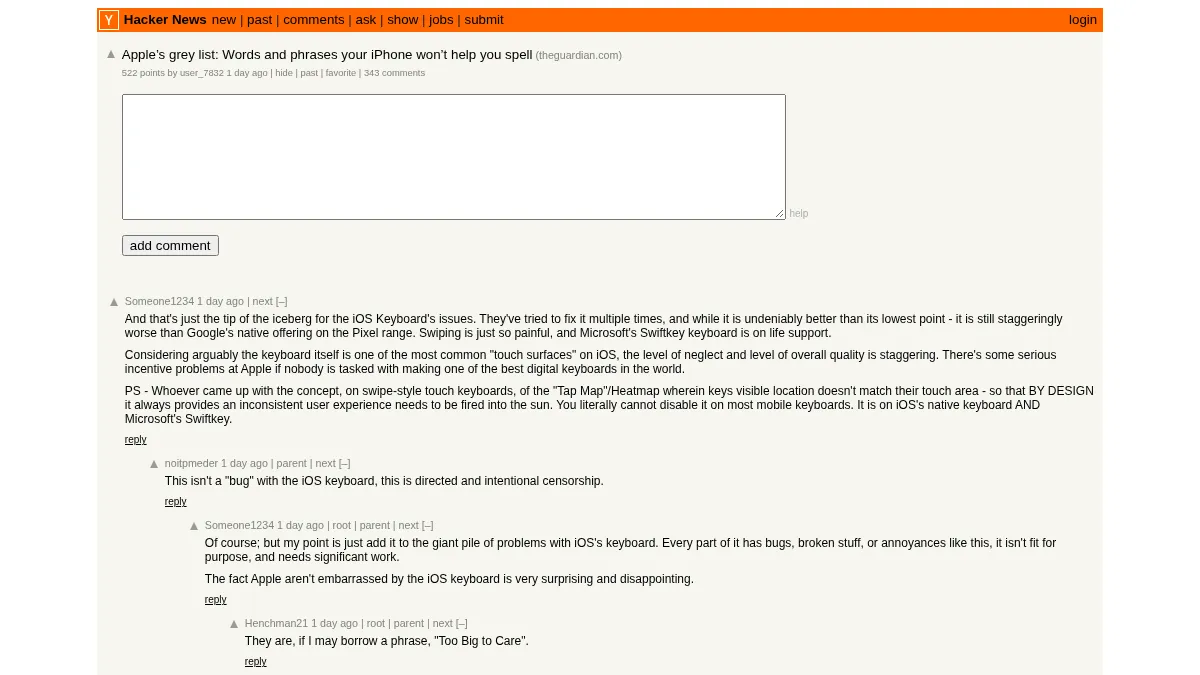
1. Apple’s grey list: more than 100,000 words your iPhone’s predictive text will not complete#
The Guardian reports that researchers found Apple restricts predictive completion for more than 100,000 words. About 521 points and 343 comments on HN. One side calls it censorship; the other says predictive text is a guess anyway, and not guessing controversial words is not censorship since you can still type them. Some used the thread to complain that the iOS keyboard is worse than Pixel’s overall. The fight: does a prediction model choosing not to suggest something amount to making a value judgment for the user?
2. Should Lobsters crowdsource LLM detector scans of submitted articles#
wofo proposed scanning submissions with Pangram and building a shared index so nobody has to pay to scan alone; he later clarified that Lobsters itself would not need to change and what he wants is a browser extension. Opponents say detector error rates are unknown, that even handwritten-then-digitized pieces get flagged as AI, and that some people have stopped posting long pieces because of it; supporters posted Pangram’s technical report. The fight: to keep out slop, can you accept a machine grading your writing style?
3. Will selling software become a non-question#
On V2EX’s programmers board, the original poster relays Meng Yan’s view: AI lets anyone talk an app tailored to their needs into existence, making money from apps will get harder, and roles like PM, engineer, and designer may disappear. About 55 replies. It runs opposite to today’s Greg Isenberg playbook: one says everyone builds their own, the other says mining reviews for gaps still pays.
4. Claude accounts keep getting banned, how is everyone coping#
Someone on V2EX asked whose Claude account has never been banned, drawing about 32 replies. Chinese-language discussion of bans this week spread to ChatGPT too, and someone on X tied the timing to Cat Wu moving from Anthropic to OpenAI, which is speculation. The fight: model providers’ regional and risk policies make it hard for developers in unsupported regions to rely on one stable toolset.
Chinese Tech Scene#

1. AI makes apps optional, and the entry point for consumer software shifts to the message box#
(TechNews): Using the AI assistant Pally as an example, the team built a full app and then found users finishing tasks right inside messages, the same line as Siri learning to operate third-party apps today.
2. AI-automated attacks succeed in seconds, so defense cannot just be about speed: three security decisions every company needs#
(TechNews): At Taiwan’s security incident response conference, CyCraft’s Chiu Ming-chang discussed defense after recent incidents at 91APP, Wowprime, and Bank SinoPac.
3. OpenAI publishes more than 700 AI math papers, and a mathematician calls them groundbreaking but poorly done#
(TechNews): Frank Calegari, guest posting on Terence Tao’s blog, calls it a milestone but says the papers are badly written, break citation norms, and contain errors.
4. Has the era of AI building AI arrived? The promise of recursive self-improvement and the risk of cheating#
(TechNews): Why research on letting AI help design and train the next generation of models is heating up, and the risk of benchmarks being gamed.
5. Does auto-routing really save money? When a cheap model errs, an hour of human fixing may cost more#
(InfoQ China): Cloudflare Auto Router judges risk only from the last few turns of conversation; the human cost after a cheap model makes a mistake is often ignored.
6. From constraints to evolution: ontology and AI self-iteration in practice, AICon Beijing#
(InfoQ China): Enterprise AI struggles because knowledge lacks structure and constraints, echoing the Alibaba Cloud CIO’s “concept dictionary” idea.
7. When will AI video generation stop feeling like a gacha pull? The rework and cost behind fast generation#
(InfoQ China): How far multimodal generation is from getting it right in one shot, and how to count rework and cost.
8. Tech Breakfast: Masayoshi Son’s $5.4B robotics deal blocked, and NVIDIA completes a $1B stake in NAVER#
(TechOrange): China blocked SoftBank’s purchase of ABB’s robotics business in China; the global deal has not been called off.
9. Top AI labs are becoming talent black holes: a former Claude Code engineer speaks for the first time after leaving#
(InfoQ China): Three core members left the Claude Code team in just over ten days; Thariq Shihipar said in an interview that courage is scarcer than genius.
10. Can AI chatbots pass as scholars? An experiment exposes a new threat to academic publishing’s defenses#
(TechNews): The author worked with IEEE Access on an experiment, using free ChatGPT and Gemini over many rounds to generate a fake optical soliton paper and see whether peer review would catch it.
11. The best opportunity in the AI era is not chasing trends: Altman tells young people not to build the next OpenAI but something bigger#
(TechNews): In a Stanford GSB interview, Sam Altman said he has long been disappointed in MBA students and urged young people not to chase five-year-old trends.
12. Argonne gets 100x GPU memory and new AI compute, opening a new era of autonomous labs#
(TechNews): Argonne National Laboratory expanded its inference service so researchers can use more models and bring AI into scientific workflows.
Open Source Picks#

1. sarpstar/cinecode#
Python | 1,558 stars
Make films with code: a coding agent writes the script, generates every frame in code, adds sound effects, and hands you an MP4.
2. Sandflow-ai/sand3d#
HTML | 1,370 stars
A Python 3D modeling tool designed for LLMs.
3. libracoder/kiri#
Rust | 1,176 stars
A small, fast container runtime for macOS, Windows, and Linux.
4. egoist/mygo-music#
Go | 966 stars
A native music player you can extend with plugins.
5. shanselman/gputaskman#
Python | 956 stars
A GPU task manager for Windows, Linux, and WSL that shows per-process VRAM plus LLM model and KV cache usage.
Watch & Listen#
1. Lenny’s Podcast: Gemini product lead Tulsee Doshi on why PMs are valuable again#
Channel: Lenny’s Podcast

Why it matters to you: The product lead for Google’s frontier models explains how to write your first eval, which anyone building AI features can use right away.
- Takeaway 1: Her 60-20-20 framework balances features that work now with features that will work soon
- Takeaway 2: Model development is like potions class: you need both evals and feel
- Takeaway 3: About 59 minutes; the episode page has the highlights in text
2. YC: Paul Graham talks with Replit’s Amjad Masad#
Channel: Y Combinator

Why it matters to you: Amjad says a company used $250K of Replit to replace a software project originally estimated at $10M, the opposite enterprise choice from Goldman pulling agents back today.
- Takeaway 1: Replit had an agent that fixed its own errors and set up infrastructure back in 2024
- Takeaway 2: He talks about the “self-driving company” after vibe coding
- Takeaway 3: One segment is about mourning the craft
3. YC Paper Club: is AI good enough to cure cancer yet#
Channel: Y Combinator

Why it matters to you: Since sequencing costs collapsed, there is more biological data than anyone can mine, and this episode covers how models are catching up.
- Takeaway 1: Treating cancer care as a data problem for each patient
- Takeaway 2: Modeling cells, not just molecules
- Takeaway 3: In-context learning nobody trained for shows up inside DNA language models
Today’s Take#
The Xcode plugin makes me want to try it right now. My apps are all Flutter, and the most grinding part of the iOS side is signing, Pods, and checking screens in the simulator. If an agent can build, read logs, and open the simulator for screenshots on its own, the time I save each week is real. I will run it on a test project first and see what it does when it hits a provisioning profile error.
I read the Goldman story twice. Taking the tool away is easy; the hard part is catching the needs traders were using it for. I lean toward State of AI’s view: a tool built by a non-engineer needs an engineer whose name is on it, and none of the information barrier or permission rules get skipped.
The password leak thread is a reminder too. “Don’t ask again” is convenient, and the price is that it remembers every argument you ever pasted. Today I am adding .claude/ to my global gitignore and running a secret scan.
Caleb’s move to Pi resonates with me, but I will not follow. I use all three harnesses, and the practical move is to write rules into AGENTS.md so switching someday does not hurt.
I want to bring Jiang Linquan’s 7% ceiling math to my team. Coding is only a fifth of the process, so however fast AI gets it can only save that slice; the rest, requirement checks, integration, testing, is where the organization has to change.
After the Play payment failure numbers in Builder Radar, I went straight to Play Console to check the grace period. About a third of cancellations have nothing to do with product quality, which is the churn that should never happen; on iOS I will also push Billing Grace Period to 28 days. I am holding off on the early payout plan, since a 2.5% fee is not cheap for a small app; I will decide after measuring a month of real payout timing.