Too-long passwords get you in, and scanners find privilege-escalation paths in bulk
On Alpine, OpenSSH accepts any password longer than 256 characters; OpenAI spent $1.2M in API credits to find 948 Linux privilege-escalation paths

Spend 1% of your day keeping up with tech.
Quote of the Day#
Accounts whose password field is * should never accept a password; on musl, any password longer than 256 characters works. — ozgun kultekin, author of sshhole, Wakefield (source)
For a well-resourced threat actor, a low-privileged account on a system that isn’t fully patched should be treated as functionally equivalent to root. — OpenAI Cyber team, OpenAI Cyber team (source)
Today’s Theme#
I’ve been watching how fast holes open today. Alpine’s OpenSSH has carried a * hole since 2016: key-only accounts accept any password longer than 256 characters. OpenAI’s cyber pipeline spent $1.2M in API credits in one run and validated 948 local privilege-escalation paths in the Linux kernel. Same day, Claude Code product lead Cat Wu joined OpenAI, Meta Muse got realtime voice, Gemini Omni 1.2 Flash stretched clips to 15 seconds and cut price 30%, and DeepSeek open-sourced a 19,445-star dsh-superagent prototype. On the builder side, RevenueCat walked through Apple Retention Messaging, and Cloudflare published “Agents aren’t humans (but they kinda are).”
Must Read#
- sshhole: on Alpine/musl OpenSSH, key-only accounts accept any password longer than 256 characters — Lobste.rs
Security - OpenAI: one run found 948 Linux local privilege-escalation paths for $1.2M in API spend — Hacker News
Security - DeepSeek open-sources dsh-superagent: listens to GitHub/Feishu, opens its own work items, interrupts less — GitHub
AI - Declarative Dragging: declare future states instead of hand-coding drag geometry — UIST 2026 Best Paper — Lobste.rs
AI - Meta Muse ships realtime voice: avatars animate while talking, US app first — The Verge
AI - Gemini Omni 1.2 Flash: native 15-second video, multi-turn edits, 30% cheaper — Google AI
AI - Claude Code product lead Cat Wu joins OpenAI for core products — InfoQ China
AI - Dropbox buys Tigris Data for $350M to build DBX Agent Cloud — TechCrunch
AI - Servo September update: rounded rects, progress, typed arithmetic landing — Lobste.rs
Web - Discord drops Electron: desktop client goes all-Rust; CTO shows ~290MB RAM — The Verge
Dev - Cloudflare: agents aren’t humans, but sites still need human-grade identity for them — Cloudflare Blog
AI - Motorola Signature 27 teased with GrapheneOS support — another unlockable privacy phone — Hacker News
Privacy
1. sshhole: on Alpine/musl OpenSSH, key-only accounts accept any password longer than 256 characters#
12 min · vuln write-up · Lobste.rs
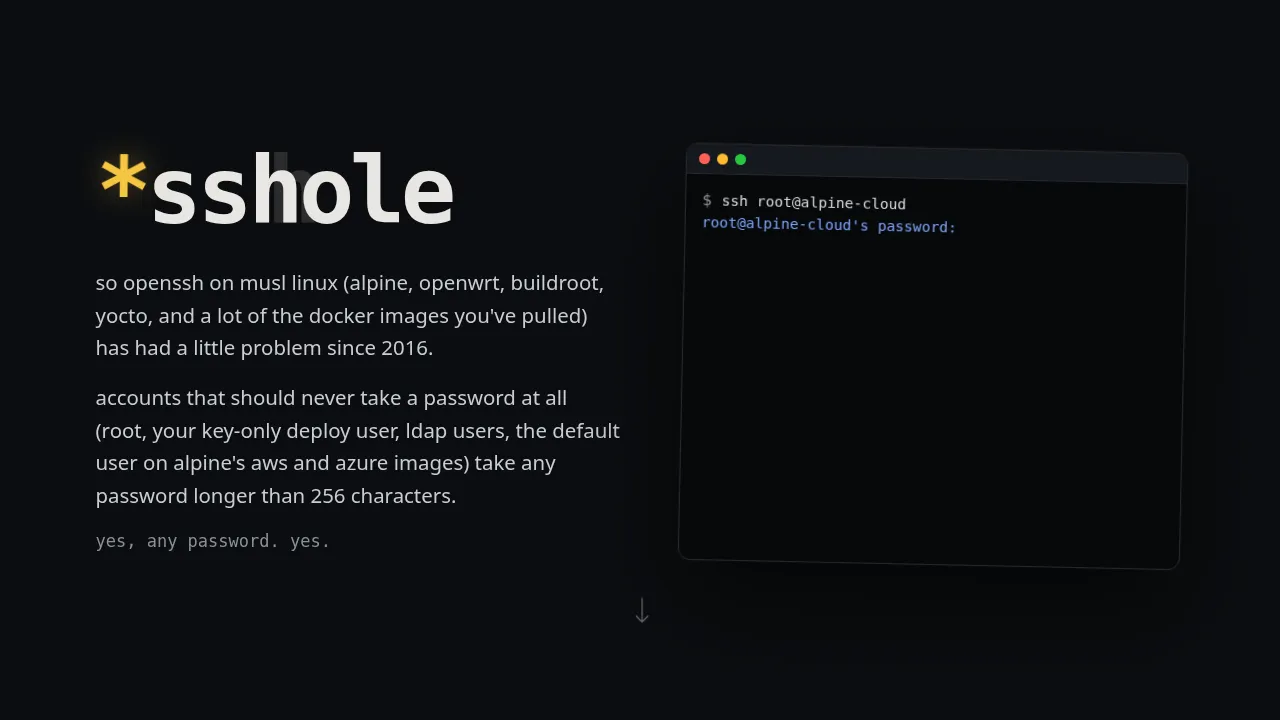
Why you should care: Docker images, OpenWrt boxes, and Alpine AWS/Azure images with password auth on can let attackers into key-only accounts with any long password.
Summary: ozgun kultekin’s sshhole.com walks the bug from 1980 to 2026. Unix marks never-login accounts with *; musl (2012) made failed crypt() return *, then capped passwords at 256 bytes so longer ones fail: and return *. OpenSSH’s timing fix for user enumeration hashes invalid users with another account’s salt; when a * account meets a 257–1024 byte password, crypt fails with *, matching the shadow field. Alpine’s advisory says upgrade openssh and restart sshd now, or set PasswordAuthentication no. Official AWS/Azure images ship the alpine user as * with passwordless doas.
- Key point 1: You’re hit if: musl OpenSSH (Alpine/OpenWrt/Buildroot/Yocto), no PAM or UsePAM no, PasswordAuthentication yes, a * account plus any $5$/$6$ password account
- Key point 2: Fixed in OpenSSH 10.6p2; package upgrade alone is not enough: restart sshd. glibc, PAM, Dropbear, OpenBSD are fine
Community reaction: Lobsters 120 / 31 comments (thread); Alpine advisory HN 515 / 104 (thread). Author found it by throwing ~17,600 weird logins with agent swarms.
Why it matters: I have Alpine containers and OpenWrt boxes. Today I’ll grep PasswordAuthentication, shut it off where needed, apk upgrade openssh, and restart. I no longer treat “no password set” as safe.
2. OpenAI: one run found 948 Linux local privilege-escalation paths for $1.2M in API spend#
long read · research · Hacker News

Why you should care: Once discovery costs fall, an unpatched low-privilege account is effectively root for a well-resourced attacker.
Summary: OpenAI Cyber describes an autonomous vuln pipeline: Scouts picked ~5,034 audit targets (~2.8M LOC, ~7% of the kernel); Analysts produced 2,308 candidates in 12 hours; dynamic validation reproduced 1,724 vulns in 30 hours; then 948 working LPEs under stock protections (SMEP/SMAP/KASLR) plus candidate patches. Total API cost $1,213,430: about $1,279 per LPE. July’s GPT-5.6 Sol found 166; the October cyber model found >5× more. Sampling 166 exploits turned up ≥10 techniques that were new even to experts. A kernelCTF-style run added 21 LPEs for ~$32,936.
- Key point 1: Five stages: discovery, dynamic validation, exploitability, patch generation, human review; only 3.1% of candidates were wrong analysis
- Key point 2: During the 10-day scan, the community already patched or staged >100 LPEs with ~300 more discussed; OpenAI is sending critical reports first via Patch the Planet partners
Community reaction: HN 468 / 349 comments (thread). X news digests also listed it among today’s top tech stories.
Why it matters: I’m keeping their takeaway: within a few years, if a hole exists, frontier models will likely find it. Kernel and package updates on servers and CI runners move to “ship when ready,” not the next maintenance window.
3. DeepSeek open-sources dsh-superagent: listens to GitHub/Feishu, opens its own work items, interrupts less#
repo · 19,445 stars · GitHub

Why you should care: If you’re assembling a team-level coding agent, this prototype lays out auth, execution, a panel, and the philosophy docs in one place.
Summary: DeepSeek labels it a research prototype, not a product: MIT, TypeScript, bundled for DeepSeek Harness. It listens to GitHub and optionally Feishu; when someone on the allowlist asks, it opens a work item, works in its own session and directory, and replies with a PR or in the original thread. A web panel lists items that need a human. The README’s rule: take as little attention as possible, give as much value as possible; act only when asked or when a team-written rule allows. Docs run from 000 Philosophy to 008 Cookbook; setup tells you to have your coding agent read SETUP.md with you. Repo created Oct 31; ~19,445 stars today.
- Key point 1: Authors warn much of the engineering was written by coding agents, style may be uneven, review before production use
- Key point 2:
pnpm checkruns typecheck, tests, and build; authorization and execution each have dedicated docs
Why it matters: I’ll start with 000 Philosophy and 002 Authorization. Team agents easily become noisy; writing “when to speak” as a principle is worth copying.
4. Declarative Dragging: declare future states instead of hand-coding drag geometry — UIST 2026 Best Paper#
paper/demo · Lobste.rs

Why you should care: If you build diagrams, editors, or teaching UIs, drag logic is usually a pile of geometry and animation noise: this paper flips the problem.
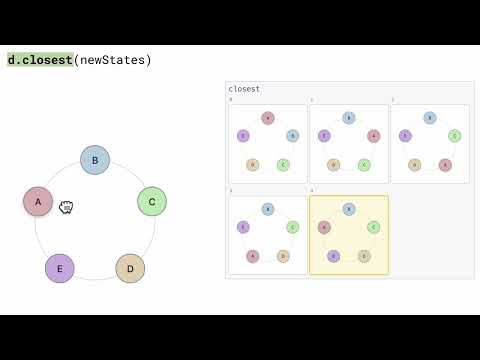
Summary: Joshua Horowitz, Andrew Blinn, and Jeffrey Heer won Best Paper at UIST 2026. Instead of coding geometry, feedback, and animation, authors declare which future model states dragging an element should reach; the engine speculatively renders those states, reads positions, and synthesizes smooth drag-and-drop. The library is Dragology, with a PDF, a five-minute video, an explorable supplement, and an npm package. Lobsters 109.
- Key point 1: Model-driven: authors declare reachable states; the engine merges possible worlds into one drag interaction
- Key point 2: Stated audience: educators, game designers, math tools, creative tools: people who don’t want boilerplate for every drag
Community reaction: Lobsters 109 / 3 comments (thread).
Why it matters: Flutter’s Draggable/DragTarget is still imperative. Next time I build a snap/align editor, I’ll sketch a reachable-state table before deciding whether to wrap it declaratively.
5. Meta Muse ships realtime voice: avatars animate while talking, US app first#
3 min · product · The Verge

Why you should care: Consumer personal agents are moving from typing to voice: default interaction will change.
Summary: Jay Peters tried it after Zuckerberg’s Threads post: the US iOS app now supports realtime voice with Muse, and the avatar at the top animates with speech. Tone can be asked for in chat or picked in avatar settings. Replies are mostly quick, with pauses when looking things up. US app first; Meta AI glasses “soon”; the Muse Charm gadget due this year will get it too. TechCrunch separately notes US users can video-chat with Muse avatars.
- Key point 1: Meta’s Newsroom post is titled Introducing Muse AI Voice & Expressive Avatars
- Key point 2: Peters set his Muse avatar to Zuckerberg and called talking to a digital Zuck uncanny; he also couldn’t match the real voice
Why it matters: As voice agents spread, copy that reads aloud matters. I’ll keep error strings shorter and cut symbols that only work on screen.
6. Gemini Omni 1.2 Flash: native 15-second video, multi-turn edits, 30% cheaper#
product update · Google AI

Why you should care: If you generate short video or ad variants via API, length, unit price, and “tweak without regenerating” decide cost.
Summary: DeepMind PM Anish Nangia launched Gemini Omni 1.2 Flash GA on the Gemini API and Google Cloud. Native clips go to 15 seconds (was 10), selectable per second from 3–15; multi-turn chat can swap backgrounds, products, lighting, or aspect ratio without regenerating; reference images, motion clips up to 3s, and audio cues stick better. 720p is $0.07/sec: 30% below 1.1. Suggested flow: draft at 360p/720p, edit, then upscale to 1080p/4K. Outputs carry SynthID; Provisioned Throughput is available.
- Key point 1: Flow, Google Vids, Gemini app (AI Ultra), and Google Ads will pick up 15-second support
- Key point 2: Google still lists fast sports action, rapid script changes, and complex physics as ongoing work
Why it matters: I’ll switch short-video pipelines to cheap drafts, multi-turn edits, then upscale. Fifteen seconds is enough for one IG/Threads explainer without stitching two 10-second clips.
7. Claude Code product lead Cat Wu joins OpenAI for core products#
3 min · people · InfoQ China

Why you should care: The person steering the coding agent you use daily just switched sides.
Summary: InfoQ China reports Cat Wu left Anthropic on Oct 30 and posted on X Nov 4 that she’s joining OpenAI for core product management, working with Tibo (Thibault Sottiaux) on agents users stay in control of. She joined Anthropic in 2024, pushed Claude Code from internal tool to developer product with Boris Cherny, and worked on Cowork. In 2025 she briefly left with Cherny for Cursor, returned, and has now left again. X news digests tie the Anthropic to OpenAI talent flow to Anthropic’s IPO prep.
- Key point 1: She recalls first using Claude Code: dozens of hours guiding a model to build an RL environment without writing a line herself: then she joined the team
- Key point 2: Her two-year contrast: early on most steps needed approval and use was Q&A/tests; now it runs large migrations and can build products from scratch
Community reaction: Related X trend posts group her exit with Austin Lau and others.
Why it matters: Tools follow their PM’s taste. I won’t drop Claude Code tomorrow, but I’ll watch OpenAI’s public agent roadmap more closely.
8. Dropbox buys Tigris Data for $350M to build DBX Agent Cloud#
4 min · M&A · TechCrunch

Why you should care: Object storage is being repackaged as “cloud for agents”: another big-vendor S3-compatible option.
Summary: Lauren Forristal: Dropbox is paying $350M for Tigris Data, apparently its largest deal, expected to close in Q4 2026, with no planned cuts (after a 9% global layoff last month). Goal: strengthen AI infra and launch DBX Agent Cloud for businesses and developers building models/agents. Phase one is standalone object storage compatible with existing S3 tools. Dropbox also says the core product will let users run AI on files, pick models, and connect to ChatGPT, Claude, Muse, and others.
- Key point 1: DBX Agent Cloud starts as object storage sold alone, stressing Amazon S3 API compatibility
- Key point 2: The same piece says more agent-cloud capabilities are planned without detailing them yet
Why it matters: Agent workloads are getting branded storage. I’ll stay on S3/GCS for now, but add Dropbox’s layer when deciding where agent artifacts should land.
9. Servo September update: rounded rects, progress, typed arithmetic landing#
engine monthly · Lobste.rs
Why you should care: A non-Chromium engine is still moving: another option for WebView/embedded cases.
Summary: Servo’s September 2026 report covers rounded-rectangle work, the :checked pseudoclass, user-select, <progress>, CSS typed arithmetic, alpha(), font-width, and more DOM APIs (including CSSRule.parentRule). Lobsters 46; also on HN.
- Key point 1: Credits sit on individual PRs; the monthly is feature-oriented, not a benchmark dump
- Key point 2: Servo keeps rewriting the browser stack in Rust for embeddable, experimental use
Community reaction: Lobsters 46 (thread).
Why it matters: I’m not switching daily browsers, but for a desktop shell that only shows specific pages I’ll check Servo embed again.
10. Discord drops Electron: desktop client goes all-Rust; CTO shows ~290MB RAM#
2 min · architecture · The Verge

Why you should care: Electron desktop apps have been roasted for RAM for years: a major app is actually leaving.
Summary: Tom Warren: Discord CTO Stanislav Vishnevskiy posted that Discord has used Rust since 2018 across infra, voice, and parts of the client; the “holy grail” is the whole client, killing Electron and React Native. Mobile keeps native UI but shares app code with desktop via Rust. He showed a Windows client around 290MB RAM versus 1GB+ after joining a few servers today. No ship date: “hope to get it into testing with users soon.” HN 344 / 298 comments.
- Key point 1: Mobile: native UI + shared Rust application layer with desktop
- Key point 2: Timeline unset; official line is hope to get it into testing with users soon
Community reaction: HN 344 / 298 comments (thread).
Why it matters: I don’t ship Electron shells, but clients ask why desktop apps eat RAM. This is a clean “big vendors admit they should leave” example.
11. Cloudflare: agents aren’t humans, but sites still need human-grade identity for them#
15 min · architecture · Cloudflare

Why you should care: If personal agents start operating your API/site, identity, reputation, and accountability become mandatory questions.
Summary: Bryan Becker argues hosted Personal AI Agents (Muse, OpenAI dots, etc.) are intermediaries: the site sees the Agent, not the User, and one Agent may act for many Users. Blocking intermediary traffic stops working when agent traffic becomes the majority. His Intermediation Principle: business relationships and security duties between Users and Sites must hold regardless of layers in between: still Identity, Reputation, Accountability. Local/open-source on-device agents are out of primary scope.
- Key point 1: Remote hosted agents are the focus; local OpenClaw or in-browser agents are set aside
- Key point 2: Long essay; the ask is ecosystem mechanisms so sites can still recognize the user behind an agent
Why it matters: If Flexii/HerFIT ever lets agents act for users, I’ll require verifiable user delegation: no anonymous cloud-browser free-for-all.
12. Motorola Signature 27 teased with GrapheneOS support — another unlockable privacy phone#
hardware · Hacker News

Why you should care: Non-Pixel GrapheneOS options have been scarce; this lit up HN.
Summary: Motorola News says the Signature 27 line will support GrapheneOS. HN 342 / 242 comments focused on whether non-Pixel hardware can keep GrapheneOS’s security model and on launch details.
- Key point 1: Still an announced/support report; unlock flow depends on later Motorola and GrapheneOS docs
- Key point 2: Thread compares AVB/unlock limits outside Pixel
Community reaction: HN 342 / 242 comments (thread).
Why it matters: I’m staying on Pixel, but I’ll point friends asking for non-Pixel GrapheneOS at this as a watch item.
More to Read#
-
Inside GitHub’s new Git storage architecture — GitHub Engineering breaks down the new Git storage architecture — how they carry objects and traffic at scale.

-
Scaling Slack and GitHub with Maude Lemaire — Pragmatic Engineer interviews Maude Lemaire on scaling work at Slack and GitHub.
-
Analytics has changed. Here’s what to do about it — PostHog’s newsletter on how analytics products shifted — worth checking against your event model.
-
Claude Personal Finance tool plugs into your bank — Claude adds a Personal Finance tool for spending analysis; The Verge notes bank-account connect.
-
OpenAI acquires Pierre to expand Codex code storage and review — iThome: OpenAI buys Pierre to strengthen Codex code storage and review; same consolidation wave on X.
-
US OCC banks AI framework flags autonomous payment agents as top risk — TechOrange on the US OCC bank AI supervisory framework — autonomous payment agents ranked highest risk; human oversight is central.
-
NVIDIA Cosmos 3 open models for interactive world simulation — Hugging Face Blog: NVIDIA open-sources Cosmos 3 for interactive world simulation.
-
[AINews] It’s Swapping Season — Latent Space weekly: a week of talent and model swaps — pairs with the Cat Wu news.
-
Box taps Nvidia Nemotron for agent-first content retrieval — Box uses Nvidia Nemotron for an agent-first content retrieval system.
-
Vercel Token Pass credit applies automatically across AI Gateway — Vercel: Token Pass credit now applies automatically across AI Gateway.
-
Awesome repositories are no longer awesome — Erik Gahner on awesome-list quality declining; HN 263. Complements today’s security and agent themes.
-
Software Line Specialist — Lobsters career note: what a software line specialist actually does.
-
MCP C# SDK 2.0 defaults to stateless HTTP, adds multi-turn requests — InfoQ China: MCP C# SDK 2.0 defaults to stateless HTTP and adds multi-turn requests.
-
Stratechery interview: Intuit CEO Sasan Goodarzi on accounting and AI — Stratechery interviews Intuit CEO Sasan Goodarzi on accounting software and AI.
-
Hands-on: MacBook Pro with PROLED XDR — sspai hands-on with the new MacBook Pro PROLED XDR display. Complements today’s security and agent themes.
Also Worth a Look#
- patch-gg/pixelfx — GitHub (244 pixel-art effects plus a Claude Code skill, 5,245 stars)
- Meta says US users can now video chat with their Muse AI avatar — TechCrunch (same product line as Must Read Muse voice)
- OpenAI released a new cybersecurity model. Is that enough? — TechCrunch (example finding a severe Ubuntu bug via Daybreak Blue)
- OpenAI president Greg Brockman says company could be IPO ready in 2027 — TechCrunch (IPO timing talk)
- Lemmings CSS Animation — Hacker News (pure CSS toy)
- Goodbye from Salon — Hacker News (publication wind-down)
- Accessibility statements now have a home on GitHub — GitHub Blog (a11y statements for maintainers)
- OpenAI on AI assistant personalization limits — iThome (personalization bottleneck)
- Serve Robotics launches new business to become the AWS for robots — TechCrunch (robot cloud)
- Debian/Ubuntu patch high-risk APT package vuln — iThome (supply chain / package mgmt)
- Zyxel GS1900 zero-day used to steal sensitive data — iThome (switch 0-day)
- PHP patches two actively exploited RCE bugs — InfoQ China (continues yesterday debt theme)
- Google uses Gemini 4 Argon to rewrite 200k lines of ADK overnight — InfoQ China (model rewriting its own codebase)
- I wish tech companies knew more about me — Hacker News (counterpoint on privacy vs personalization)
Builder Radar#
1. RevenueCat: wiring Apple Retention Messaging into subscription win-back#
how-to video · RevenueCat
Why you should care: App Store Connect Retention Messaging is live - different copy for trials vs subscribers, plus A/B offers.
RevenueCat’s X account shared a setup video (~1,850 impressions) on connecting their SDK/dashboard to Apple Retention Messaging: split trial vs subscriber copy and test offers. Title: Implementing the Apple Retention Messaging API.
What it means for your app: If Flexii/HerFIT stay subscription-based, win-back can’t be one generic email. I’ll start a small-traffic trial-only copy test in RevenueCat.
2. How sites can still recognize the user behind an agent#
architecture essay · Cloudflare
Why you should care: Personal agents are starting to browse, click, and fill forms for people - backends hit identity first.
Cloudflare’s Intermediation Principle restates Identity / Reputation / Accountability for hosted Personal AI Agents.
What it means for your app: If we ever allow agent-driven actions, I’ll require short-lived, revocable user-delegation tokens and meter agent traffic apart from humans.
3. Vercel Token Pass credit auto-applies on AI Gateway#
Changelog · Vercel
Why you should care: If you bill tokens through Vercel AI Gateway, the credit rule changed.
Changelog: Token Pass credit now applies automatically across AI Gateway.
What it means for your app: Projects with Token Pass should verify this month’s Gateway usage already draws down the Pass.
4. US OCC bank AI framework ranks autonomous payment agents as top risk#
regulation · TechOrange

Why you should care: If your app lets agents move money, supervisors already painted that cell red.
OCC’s first bank AI supervisory framework calls out autonomous payment / agentic actions and writes human oversight in.
What it means for your app: Payment automation stays “show the plan, confirm, then submit” - no one-click agent transfers.
5. PostHog: analytics products changed - so should your event model#
newsletter · PostHog

Why you should care: If the app still logs events like old pageviews, reports drift.
PostHog’s issue covers how analytics products shifted and how teams should retune events and funnels. Good checklist against our PostHog projects.
What it means for your app: I’ll rename Flexii/HerFIT core conversion events once so agent auto-instrumentation doesn’t spawn unread noise.
6. Claude Personal Finance: assistants reading spend - even bank links#
product · TechCrunch/The Verge

Why you should care: Consumer assistants are touching accounts and money flows - permission and revoke become exam questions.
TechCrunch covers Claude’s Personal Finance spend analysis; The Verge notes bank linking. Same regulatory story as OCC ranking autonomous payment agents high risk.
What it means for your app: If we ever ship “assistant reads your subscription bill,” it stays read-only with one-tap revoke - no write access to transfer.
What the Community Is Arguing About#
1. Ask HN: What’s your current AI agentic setup?#
614 comments - one of today’s longest threads. People paste Claude Code / Codex / Cursor / self-hosted harness combos. Fight centers on whether agents should touch prod credentials and one-agent-per-repo vs one shared box. Nice foil to DeepSeek’s dsh-superagent drop the same day.
2. OpenAI’s 948 LPEs — can defenders keep up?#
349 comments. One side runs API cost vs bounty multiples; the other worries disclosure outruns maintainers. Several stitch this to yesterday’s PHP2Shell and today’s sshhole as “AI makes old holes expensive.”
3. Discord dumps Electron — is Rust desktop actually lighter?#
298 comments. Celebration mixed with “how do you keep cross-platform UI,” plus people comparing their Electron RSS numbers to the 290MB screenshot. Mobile “native UI + shared Rust” gets treated as a template.
4. GrapheneOS on non-Pixel — does the trust boundary hold?#
242 comments. Focus is unlock, AVB, and update channels more than Motorola marketing. Privacy-phone shoppers are waiting for GrapheneOS’s own support wording. Overlaps today’s security/agent Must Reads; practical details in the comments are worth a skim.
Chinese Tech Scene#
1. Claude Code lead Cat Wu joins OpenAI#
(InfoQ China): Cat Wu left Anthropic Oct 30; Nov 4 joined OpenAI core PM to build user-controlled agents with Tibo.
2. OpenAI acquires Pierre for Codex#
(iThome): OpenAI buys Pierre to fold code storage and review into Codex; Trees/Diffs stay open during transition.
3. OCC bank AI framework#
(TechOrange): OCC framework ranks autonomous payment agents highest risk and requires human oversight.
4. OpenAI on assistant personalization limits#
(iThome): OpenAI discusses assistant personalization limits: models still struggle to use prior chat context.
5. MCP C# SDK 2.0#
(InfoQ China): .NET MCP 2.0 defaults to stateless HTTP and adds multi-turn requests.
6. MacBook Pro PROLED XDR hands-on#
(sspai): sspai hands-on with the new MacBook Pro display and battery details.
7. Taiwan highway bureau expands drone AI inspection#
(iThome): Taiwan’s highway bureau expands drone AI inspection for bridges and slopes with 3D modeling.
8. NIKKE supply-chain attack#
(iThome): Game update channel compromised; stealer risk for players: another supply-chain case.
9. Debian/Ubuntu patch high-risk APT package vuln#
(iThome): High-risk APT vuln: MITM can swap packages for root: patch now.
10. PHP patches two actively exploited RCE bugs#
(InfoQ China): PHP patches two in-the-wild RCEs: continues yesterday’s PHP2Shell debt thread.
11. Tech breakfast: Google-Anthropic $19B lease; SpaceX-Qualcomm 5G#
(TechOrange): Morning brief: Google-Anthropic data-center lease and SpaceX-Qualcomm 5G.
12. Beyond the model: what else is Tencent filling in?#
(InfoQ China): What Tencent is filling in beyond the model itself.
Open Source Picks#
1. deepseek-ai/dsh-superagent-prototype#
TypeScript | 19,445 stars
DeepSeek research prototype: coding agent on GitHub/Feishu with auth model and panel. MIT.
2. patch-gg/pixelfx#
JavaScript | 5,245 stars

244 pixel-art effects plus a Claude Code skill to author new ones.
3. worldonlyu/Google_AI_Pro_2Year_ZeroCost_Auto#
Shell | 2,258 stars

Script-oriented repo around Google AI Pro flows: review scripts and permissions before use.
4. declarative-dragging/dragology#
TypeScript | 0 stars

Reference implementation Dragology for the Declarative Dragging paper; see site/paper for details.
5. thearkxd/store-screenshots-skill#
n/a | 0 stars

AI skill shared on X to turn real app screens into App Store/Play screenshots.
Watch & Listen#
Implementing the Apple Retention Messaging API#
— views · 2026-11-05 · RevenueCat
Why you should care: Shortest path for subscription apps to wire Apple win-back messaging.
- Separate copy for trials vs subscribers
- A/B offers supported
- RevenueCat dashboard walkthrough
- Full transcript not fetched; points from title, description, related posts
Declarative Dragging (UIST 2026 five-minute intro)#
— views · 2026-11 · JH
Why you should care: Companion video from the Must Read paper authors.
- Declare future states instead of hand-coding drag
- Live demo of synthesized dragging
- Best Paper context
- Full transcript not fetched; points from title, description, related posts
Which AI is the best liar?#
— views · 2026-11 · Dwarkesh Patel

Why you should care: Alignment-flavored look at which models deceive best: solid commute listen.
- Compares deception across models
- Alignment/safety framing
- Interview pacing
- Full transcript not fetched; points from title, description, related posts
Today’s Take#
I keep sshhole next to OpenAI’s write-up. One is a 2016 logic hole at the musl/OpenSSH boundary, found by throwing about 17,600 weird logins with agent swarms; the other spent $1.2M in API credits so a newer cyber model could surface 948 Linux LPE paths in one run. Same lesson: discovery outruns patching, and the gap is widening.
Concrete moves: disable PasswordAuthentication on Alpine images and restart sshd, then apk upgrade openssh; ship server patches when they land; keep interview and third-party repos in VM or devcontainer isolation. I will paste OpenAI’s line into the team channel: an unpatched low-privilege account is effectively root for a well-resourced attacker. Home OpenWrt boxes and Alpine CI images are in scope too.
Cat Wu to OpenAI, Muse speaking aloud, Gemini Omni longer and cheaper: that is the other line the same day. Agent products still race for people and for the interaction surface. Cloudflare warns sites will have to recognize users behind agents; RevenueCat wires Apple Retention Messaging into subscription win-back; OCC paints autonomous payment agents red. I will not swap tools tomorrow, but agent credentials and user delegation go on this week’s list, and payment automation stays show-the-plan-then-submit.