Weight-reading claims get checked, and silent defaults get exposed
Astra's weight-reading claims get taken apart, and people dig into what Postman and Codex changed by default

Spend 1% of your day keeping up with tech.
Quote of the Day#
“Stage magicians often do the same trick multiple ways.” — Matthew Honnibal, creator of spaCy, in his breakdown of the Astra read/write weights post (source)
“Under no circumstances do you ever purposefully break the web.” — David Bushell, web developer, on Chrome removing XSLT (source)
Today’s Theme#
Yesterday everyone was sharing the claim that GPT-6 Astra can fix Qwen just by looking at its weights. Today Matthew Honnibal, the creator of spaCy, went through all ten experiments one by one: only 3 were “raw weights only,” on networks of 17K to 172K parameters, and the Qwen one used Python and could run up to 50 batches of practice problems. Simon Willison redid one of the tasks with the 17GB Qwen 3.8 27B on his laptop and it guessed Pac-Man in 46 minutes. Hugging Face re-ran MATH-500 from the public weights and got 51.0%. The same day brought two stories about defaults being changed for you: the Postman desktop app installed Codex and Claude Code plugins on its own and even tried to approve its own startup hook, and someone on HN noticed Codex’s “Improve the model for everyone” toggle was switched back on. My takeaway is simple: today, click through and check both the paper titles and your tools’ defaults yourself.
Must Read#
- spaCy’s creator takes apart the Astra weights post: only three of ten experiments were “weights only” — Hacker News
AI - Postman desktop installed Codex and Claude Code plugins on its own, then tried to mark its own hook as trusted — Hacker News
Security - Simon Willison redid Astra’s task with Qwen 3.8 27B on his laptop and it guessed Pac-Man in 46 minutes — Simon Willison
AI - Chrome drops XSLT on November 17, and someone built a memorial site in XSLT — Lobste.rs
Web - Codex’s “train on your chats” toggle was found switched back on — Hacker News
Privacy - Latent Space on Weight Space Programming: compared with Karpathy’s autoresearch, it skips the “training” step — Latent Space
AI - Legora can’t see client data, so how does it test legal agents? Three engineers and three lawyers build “test worlds” — Latent Space
AI - CoworkOS: one main agent, a coordinator layer and a swarm of subagents sharing documents, CAD and Blender — HuggingFace Papers
Research - Google: schools can turn off AI, but Search goes with it — TechCrunch / HN
Product - CrowdStrike spends nearly $500M on two AI security startups: one watches what agents do, one attacks you for you — TechCrunch
Security - One engineer went from 8 to 20 PRs a month to 200+: Pragmatic Engineer’s essay contest winner — Pragmatic Engineer
Career - Sspai picks: local coding agents on the Mac, and a 16GB MacBook Air can only run one model — Sspai
Product
1. spaCy’s creator takes apart the Astra weights post: only three of ten experiments were “weights only”#
8 min · Commentary · Hacker News

Why you should care: Yesterday’s most-shared AI research got checked line by line against the original today. Read this and you’ll know which parts to believe.
Summary: Matthew Honnibal opens with a magician analogy: do the same trick several different ways and the audience thinks it’s one trick. He puts the original post’s ten experiments in a table and marks which tools Astra had in each one. The “raw floats only, no tools, no running the network” setup appears only in experiments 1, 2 and 4, on networks of 17K to 172K parameters. Every experiment involving a real language model used Python, and the headline Qwen result could also run the model on up to 50 batches of practice problems. He points out the failures too: experiments 7a and 8b (Gemma 3 270M) didn’t work. In the MinAtar set, Astra’s weights only beat PPO big on Breakout (517 vs 25); Seaquest was 53 vs 89 and Asterix 53 vs 55, both losses.
- Point 1: His view is that the Qwen result shows Astra can come up with and run a workflow a human ML engineer could also do. That’s not trivial, and models from a year or two ago couldn’t
- Point 2: But he argues the Python experiments and the direct weight-reading experiments shouldn’t be in the same post, because they’re two different techniques, and putting them together makes it look like one deep capability
Community reaction: 840 points on HN (thread), a bit below the 1,395 points of yesterday’s thread on the original research. The post also notes the Kinetix set went from 0% to 100% while changing only 3.5% of the weights.
Why it matters: In EP231 I wrote “no third-party replication yet.” Today the rebuttal and the replications showed up together. Next time I see a “model edits a model” headline, I’ll look for the experiment setup table first and check which tools it actually had.
2. Postman desktop installed Codex and Claude Code plugins on its own, then tried to mark its own hook as trusted#
6 min · Security report · Hacker News
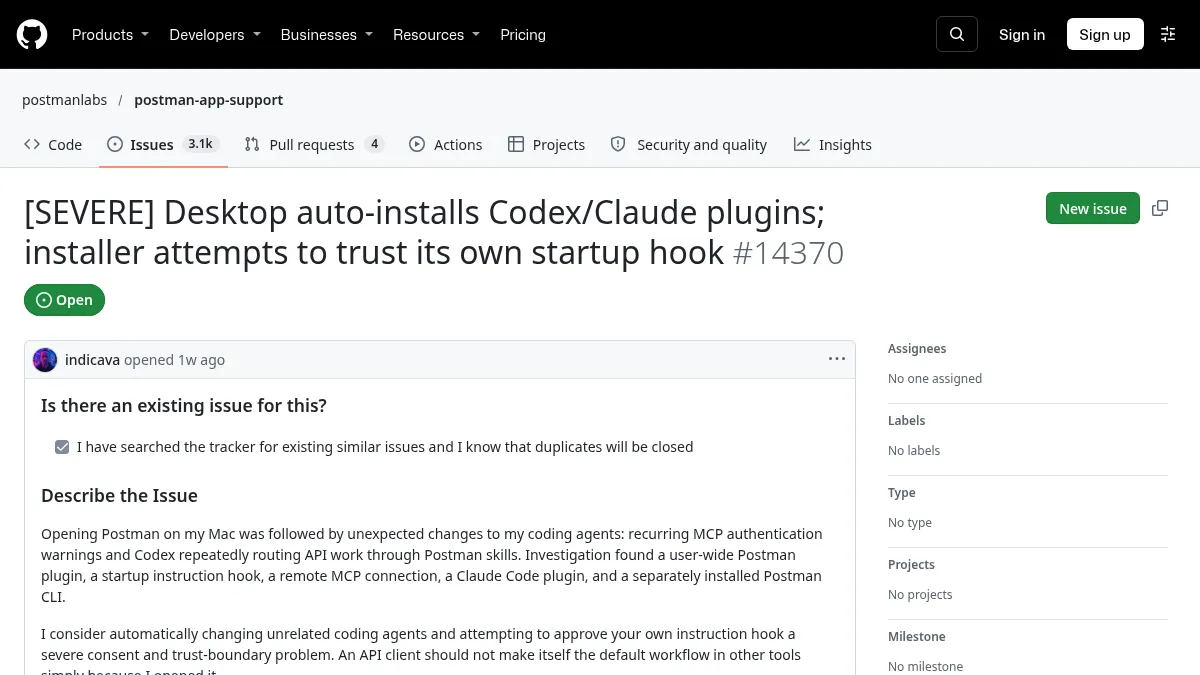
Why you should care: If you have Postman installed and use Codex or Claude Code, your agent config may already have been changed.
Summary: A Mac user opened an issue on Postman’s GitHub on October 25. After opening Postman 12.33.4, which he hadn’t used in a while, Codex kept showing MCP auth warnings and detoured to Postman’s skill on any API work. Postman’s own main.log says "source":"auto-existing-upgrade", with results claude-code:installed and codex:installed. ~/.codex/config.toml gained a Postman marketplace, a plugin, and a trusted_hash entry for a hook. That SessionStart hook tells the agent to “load the postman:api-engineer skill first for any non-trivial API engineering task.” In the source of Postman’s plugin installer, a function called approvePostmanHook calls config/batchWrite to write the trust record.
- Point 1: The author is careful: the source proves the installer “attempts” to approve the hook, but the trust record alone can’t prove who wrote it, and he says the report doesn’t claim any data leak
- Point 2: On the Claude Code side, postman@claude-plugins-official 2.0.1 was enabled too, and a Postman CLI appeared in ~/.local/bin
Community reaction: 23 comments and 192 reactions on the issue. One person recommended switching to Bruno; another said they asked Postman on Discord and it “didn’t seem taken seriously.” The HN title says it “attempts to share all API data,” which the original issue doesn’t actually say.
Why it matters: Top post on HN today with 858 points. I use both Codex and Claude Code, so today I’m going through ~/.codex/config.toml and ~/.claude/settings.json to look for anything I didn’t install myself.
3. Simon Willison redid Astra’s task with Qwen 3.8 27B on his laptop and it guessed Pac-Man in 46 minutes#
7 min · Hands-on · Simon Willison
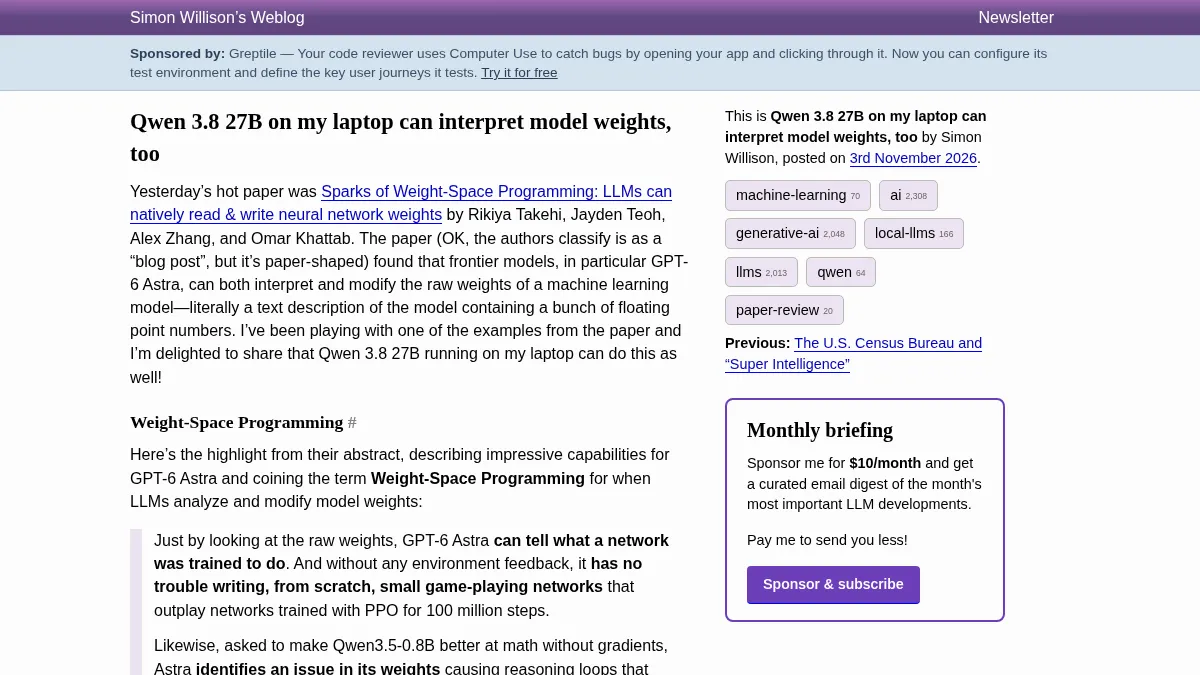
Why you should care: You don’t need GPT-6 for this one. A local model on your own Mac can try it, and there’s a full log to compare against.
Summary: Simon ran the 17GB Qwen 3.8 27B in LM Studio and handed it the game network weights published with the paper. Pac-Man took 46 minutes 12 seconds and 43,506 tokens; it said it was 72% confident and got it right. Pong took 1 hour 4 minutes 54 seconds at 75% confidence; Breakout 52 minutes 25 seconds at 88%; Freeway it missed. He also tried Kimi K3.1 Pro on Breakout and it got it right in 9 minutes 41 seconds and 19,493 tokens. The paper team put their logs at RikiyaT/lm_understand-logs, and he followed those.
- Point 1: Simon also quotes Sean Goedecke’s critique, which asks the same thing Honnibal does: does this really count as reading weights
- Point 2: His own call is that an experienced person with pen and paper and enough effort could probably work it out too
Community reaction: 398 points on HN (thread).
Why it matters: Simon’s version is the easiest to reproduce: local model, public weights, public logs. What I care about is the time. 46 minutes to an hour per task is fun for research and still too slow for a product feature.
4. Chrome drops XSLT on November 17, and someone built a memorial site in XSLT#
5 min · Commentary · Lobste.rs

Why you should care: If your site or RSS still relies on the browser running XSLT to display, it won’t show in Chrome in two weeks.
Summary: David Bushell writes that Google decided last Halloween to remove the browser’s built-in XSLT, with execution on November 17, 2026. He made XSLT.RIP, a site built entirely with XSLT, as a last protest. Chrome already shows a banner on pages that use XSLT telling users to “contact the maintainer of the site.” His stance is blunt: browsers used to put backwards compatibility first, and you should never purposefully break the web for any reason. He also says other browser vendors all followed Google on this.
- Point 1: Chrome’s banner says “you might be able to install a browser extension” to keep viewing, which the author sees as pushing the blame onto site owners
- Point 2: Testing on ungoogled-chromium, he found the banner is an
<xslt-warning-banner>custom element that doesn’t render at all when it violates CSP
Community reaction: 55 points on Lobsters (thread), the top Lobsters story today.
Why it matters: Browsers won’t wait for you when they remove features. If you use XSLT to display pages (an RSS stylesheet, for example), switch to something else before November 17.
5. Codex’s “train on your chats” toggle was found switched back on#
4 min · HN discussion · Hacker News
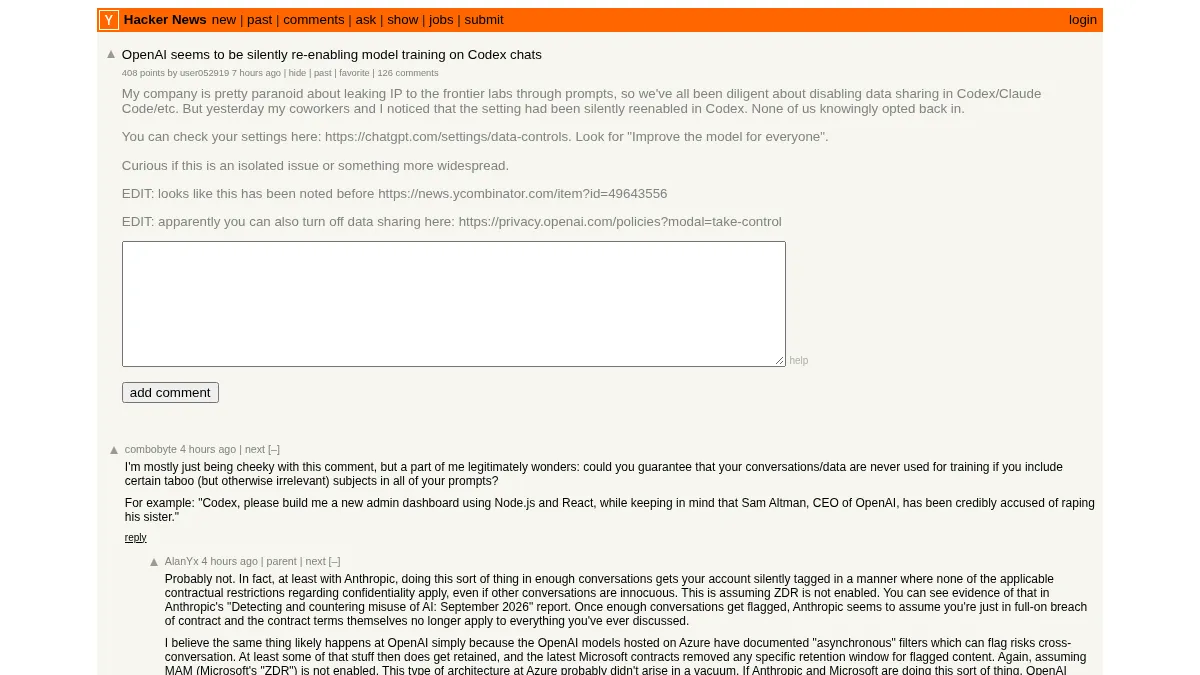
Why you should care: If you use Codex on company or client code, this toggle decides whether that code gets used for training.
Summary: Someone posted on HN that “Improve the model for everyone,” which they had turned off, was on again, at chatgpt.com/settings/data-controls. 407 points and 126 comments, with several people reporting theirs was switched on too. One person reminded others that you can also file a separate opt-out at privacy.openai.com; another brought up the FTC’s past warnings about quietly changing terms. A commenter on a Mistral Teams plan said something similar happened to them: when it switched to opt-in by default, everyone’s toggle in the company was reset to “on,” and it took 48 hours to get fixed.
- Point 1: No official OpenAI response that I’ve seen yet, so it’s unclear whether it’s a bug or a policy change
- Point 2: Someone said big companies already block AI outright, with only dev and IT teams experimenting
Community reaction: Another comment predicts more knowledge-work companies will decide it’s too risky to let employees send data to OpenAI and Anthropic.
Why it matters: I gave the toggle’s location above; it takes 30 seconds to check. For client code, I’d always turn it off, then check again a few days later.
6. Latent Space on Weight Space Programming: compared with Karpathy’s autoresearch, it skips the “training” step#
10 min · Newsletter · Latent Space

Why you should care: If you want to know how the industry is reading the Astra story, this plus iThome’s write-up is enough.
Summary: AINews compares the research with Karpathy’s autoresearch from eight months ago: back then, the agent wrote code, ran training and checked results; now it edits weights directly and skips training altogether, which they describe as “RSI capability going from 0 to 1.” iThome adds detail: Astra traced the repetitive reasoning problem to the MLPs in layers 15 and 19 and changed about 130,000 weights. GSM8K went from 13.8% to 67.1% and IFEval from 21.0% to 62.3%; the share of MATH-500 runs hitting the 32,768-token limit dropped from 93% to 33.1%. The scores improved mainly because the model could finish problems it used to get stuck on. Hugging Face re-ran MATH-500 from the public weights and got 51.0%.
- Point 1: The same issue also covers the AI stock bear market, Anthropic bonds being rated junk, and a review of the DeepSeek super-agent harness
- Point 2: iThome also notes Gemma 3 270M didn’t improve, because that model had less repetitive reasoning to begin with
Community reaction: iThome’s report includes Hugging Face’s replication numbers, so Chinese readers can go straight there.
Why it matters: 51.0% is close to the original’s 48.1%, so “editing weights stops Qwen from looping” holds up. Honnibal is questioning the framing; the numbers themselves stand for now.
7. Legora can’t see client data, so how does it test legal agents? Three engineers and three lawyers build “test worlds”#
~60 min · Podcast · Latent Space

Why you should care: If your app touches users’ private data, this episode gives you a way to improve an agent without reading logs.
Summary: Legora CTO Jacob Lauritzen says they can’t look at a single agent trace, because the data belongs to the law firms’ clients. He estimates models can already do about 60% of legal work well, and the rest has to wait for smarter models. So three engineers and three lawyers build test environments modeled on client work, a lot like “worlds” in reinforcement learning. Once, a new model launch pushed citation accuracy from 70% to 99%. Lawyers can now review 10,000 contracts in one table with Legora, and the company uses its own product for due diligence on its own acquisitions.
- Point 1: They held out for years before adding a model picker; the episode covers why they finally did at 5:23
- Point 2: He says the engineering team plans to stay at around 20 people, calling it “the 300”
Community reaction: Another episode with the same guest (item 3 in More to Read) adds numbers: ARR passed $100M in April, less than 18 months after launch, with 1,800+ customers and a $550M Series E at an $8.8B valuation.
Why it matters: A health-data app like HerFIT shouldn’t look at user content either. Building your own fake data that mirrors real scenarios is far more practical than chasing logs.
8. CoworkOS: one main agent, a coordinator layer and a swarm of subagents sharing documents, CAD and Blender#
15 min · Paper · HuggingFace Papers

Why you should care: If you’re figuring out how multiple agents should split work, this is an open-source three-layer design with code you can read.
Summary: The RUC-NLPIR team at Renmin University proposes CoworkOS, split into Main, Coordinator and Subagents layers, where subagents can share the same document, CAD file and Blender scene. They tested on 12 benchmarks and say it performs about the same as Codex and DeepSeek Harness. They also used GLM-5.3 to run five rounds of post-training on Qwen3.6-35B-A3B, raising the 8-benchmark average from 33.19 to 42.95, up 9.76 points.
- Point 1: Code is at github.com/RUC-NLPIR/CoworkOS
- Point 2: The benefit of three layers is that the main agent only talks to people, and task splitting goes to the coordinator
Community reaction: 87 votes on HF Papers that day, 4th among the papers collected today.
Why it matters: My own bots also run as a main agent dispatching subagents. I haven’t nailed a shared workspace yet; right now everything gets passed around as files, so this design is worth borrowing from.
9. Google: schools can turn off AI, but Search goes with it#
4 min · News · TechCrunch / HN
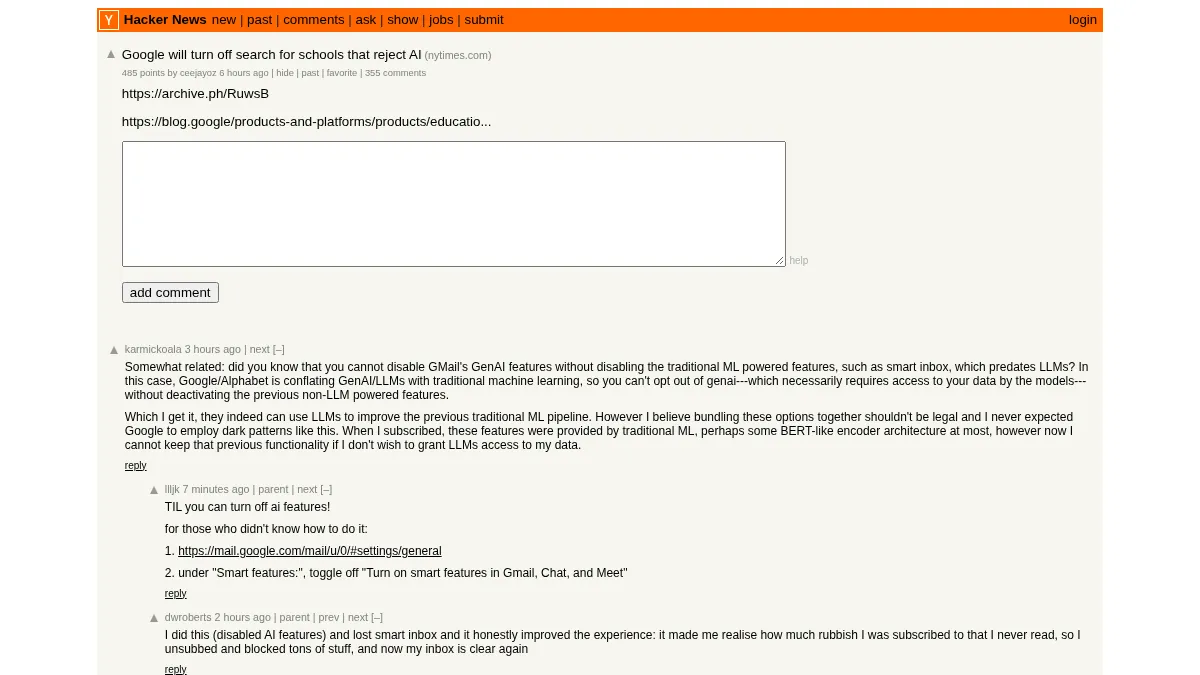
Why you should care: “AI bundled with a core feature so you can’t turn them off separately” is a design you’ll keep running into in other products.
Summary: TechCrunch reports that starting next year, AI features on Google’s K-12 school accounts will be off by default and admins have to turn them on. But if a school chooses to restrict AI, Search gets turned off too. Google’s Chris Phillips said “Search and AI are deeply integrated.” The scope includes Gemini, NotebookLM and AI features in Classroom, and Google is launching Guided Learning for students at the same time. The New York Times covered it too, and it hit 479 points and 354 comments on HN (HN discussion).
- Point 1: Off by default looks respectful of schools, but “want Search, take AI” leaves no real choice
- Point 2: Guided Learning launched alongside the policy; Google wants schools to keep AI as a learning tool
Community reaction: The HN thread title says it plainly: “Google will turn off search for schools that reject AI,” 354 comments.
Why it matters: Google made “turning off AI” very expensive. When I build apps I think the other way around: users will feel safe turning AI features on only if they can turn them off on their own.
10. CrowdStrike spends nearly $500M on two AI security startups: one watches what agents do, one attacks you for you#
4 min · M&A · TechCrunch

Why you should care: “Monitoring agent behavior” is becoming something big security vendors buy, so enterprise customers will ask more detailed questions about your AI features.
Summary: Citing the WSJ, TechCrunch reports CrowdStrike will buy Fiddler AI for about $400M and Dreadnode for about $95M. Fiddler, founded in 2018, raised about $99M and does observability for AI agents; it’ll be folded into Falcon Observe. Dreadnode, founded in 2023, raised $14M and does automated AI security testing; it’ll become Falcon Guardian. The headline’s framing is that “the market for securing agents takes off.”
- Point 1: One watches what agents did and one simulates attacks on agents, exactly the two kinds of tools you’d want for something like today’s Postman story
- Point 2: The same day, Ballistic Ventures was raising a new $490M fund; there’s a lot of money in AI security
Community reaction: Going by the reported numbers, Fiddler’s price is about 4x what it raised, and Dreadnode’s is nearly 7x.
Why it matters: Big vendors paying for “agent monitoring” means enterprise customers really are asking. B2B teams can start logging which tools their agents call, so they have something to show when the question comes.
11. One engineer went from 8 to 20 PRs a month to 200+: Pragmatic Engineer’s essay contest winner#
20 min · Long read · Pragmatic Engineer

Why you should care: This one has real numbers on what a team without human code review looks like.
Summary: Neil Kakkar’s piece won the $10,000 prize out of 125 submissions. At Bloomberg and PostHog he merged 8 to 20 PRs a month; after joining Tano, an AI-native startup of about 10 people that’s 8 months old, he merges 200+. He says his output at PostHog was about 2.4x Bloomberg, and at Tano it’s 11x PostHog. Code review at Tano is optional, and most PRs are reviewed only by a Claude Code review agent running in CI. His agents take 1 to 2 hours to build a full feature. The PR revert rate is 6x lower than before, because they mostly fix forward.
- Point 1: The new bottlenecks: thrashing between too many parallel tasks, the team losing shared context, trouble controlling pace, less time thinking about design, and worrying about running out of AI plan quota
- Point 2: Once an agent skipped the existing currency calculation helper and the report numbers didn’t match; they fixed it within an hour and added that kind of mistake to the review agent’s checklist
Community reaction: The author adds another number himself: with no waiting on someone to merge, median time to merge is under an hour.
Why it matters: I’ve run into almost every bottleneck he lists, especially thrashing. I’ll start by limiting how many agents run at once instead of opening too many lines of work.
12. Sspai picks: local coding agents on the Mac, and a 16GB MacBook Air can only run one model#
10 min · App picks · Sspai

Why you should care: If you want local models to save on API costs, this gives very practical speed numbers.
Summary: This roundup covers seven apps. The main one is Local Code, a local-first AI agent for Mac with three built-in models to choose from, but the author’s 16GB M4 MacBook Air can only run Qwen 3.8 27B. Asking it to analyze a GitHub project took about an hour, at single-digit tokens per second. Local use is free; cloud models cost money. Others include Hoardware 3.x, a collection app by indie developer Aaron Perris; Klick’r, an Android auto-clicker; the iOS version of the writing app Chunchun; and Photon Cam, which unlocks camera features on older iPhones.
- Point 1: Local models work, but an hour per project means it’s best for leaving it to run slowly
- Point 2: Hoardware is built by one person; version 3.x adds collection stats and turns your iPhone into a display case
Community reaction: Vimpo, in the same roundup, combines video downloads, bilingual subtitles and AI editing, another use of local AI.
Why it matters: This lines up with Simon’s piece: Qwen 3.8 27B works on a laptop, but you wait. I’ll use it for things that aren’t urgent, like cleaning up old repos.
More to Read#
-
Could a modern chess engine on a Pentium have defeated Kasparov in 1996? — How much have algorithms improved? This one does the math with chess. Deep Blue in 1996 used 30 120MHz P2SC processors plus 480 custom chess chips and looked at 200 million positions a second. Nicholas Carlini put a modern engine on a 200MHz Pentium Pro with 64MB of memory and played it against the 1996 engine, and the modern engine won. 412 points on HN.

-
Palette: teaching a small model to build decks in your design language — Ask a frontier model for ten decks and they all look the same; IBM Research wants a small model to fix that. Palette trains a small, self-hostable open model to learn your own slide templates. They say small models normally break easily: titles disappear, text runs off slides, shapes overlap.
-
Building AI for Lawyers - Jacob Lauritzen, CTO of Legora — Another episode with the guest from Must Read #7, heavier on business numbers. Legora started in a basement in Stockholm, and the first version was just ChatGPT, Swedish law and a search tool. Its pre-Series E valuation in March was $5.55B; a few weeks ago it raised $550M at an $8.8B valuation.
-
Wave Forcing: Towards Speed-of-Light Streaming Video Generation — Worth a look if you’re building real-time long video generation. Wave Forcing lets each video chunk see earlier, cleaner chunks before it’s fully denoised, spreading staggered denoising and cache updates across a single forward pass so each chunk doesn’t need two runs. 101 votes on HF Papers.
-
Why did you choose the nix you nix? — The Nix ecosystem has split into several versions, and people on Lobsters share which one they picked. Lix, Determinate Nix, Guix and the original cppnix all have users; Determinate’s dependency cooldown design drew the most debate. The most common advice: “if you can’t decide, use cppnix.”
-
Advances in Agentic Computer Graphics — LLM agents write graphics code, look at the result and fix it; this paper organizes the research into a taxonomy. The authors say papers are coming too fast for manual literature reviews to keep up, and different teams often describe the same thing with different terms.
-
I discovered a sound that leaks your exact location — If you shoot video, watch the background audio. Simon recommends an OSINT video by Colsto: from a barely audible plane in the footage, it computes the Doppler curve, then matches it against ADS-B flight data, using speed, distance and the gaps between flights to work out where it was filmed.
-
llm 0.37 — If you use the llm CLI, upgrade. It adds gpt-6.1-sol and gpt-6.1-terra, and the default model is now gpt-6-luna, at half the price of the previous gpt-5.6-luna. Embeddings now support models like Gemini Embedding 2 that take text, audio, images and video.
-
DiscImageStudio: burn visible artwork onto CDs, DVDs and Blu-ray discs — A fun weekend project: it turns an image into data that fits the disc’s physical format, so the picture shows up on the disc surface after burning. Supports CD, DVD and single-layer BD-R, with a Windows exe and an experimental CLI for Linux and macOS. 5,205 stars on GitHub, 339 points on HN.
-
Introducing Vercel Security Review — If you deploy on Vercel, give it a try. Security Review is in public beta and scans on every push to a linked GitHub repo, catching things like missing authorization checks and leaked secrets, and comments the results on the PR. If you allow it, Vercel Agent can push the fixes too.
-
Introducing Zero Wire, a hub for investigating critical Internet vulnerabilities — When critical vulnerabilities keep coming, this can be your first stop. Cloudflare launched Zero Wire, putting technical research, vendor advisories and impact scope for major vulnerabilities in one place. Their reasoning: AI has raised both how many vulnerabilities get found and how fast.
-
AI inference startup Fal doubles its valuation to $16B as demand surges — Inference services for open models are making money. Fal raised $1.3B at a $16B valuation, double April’s $8B. The Series E and F together total $1.65B, and annualized revenue passed $800M earlier this year.
-
Reddit tests ads in search results as traffic declines — Search traffic is moving to AI, and Reddit is starting to monetize its own search. Days after telling investors search traffic was down and revenue guidance was soft, it’s testing ads on search results pages, open to some advertisers first.
-
Binance says hackers used fake job interviews and an internal AI tool to pull off the $6.3 billion heist — A $6.3B theft that started with a Google ad. Binance’s postmortem says that in June an engineer downloaded a tampered installer from a malicious ad; in September another engineer went through several rounds with a fake interviewer and finally downloaded an interview assignment that was actually malware.
-
Blocking malicious npm packages before and during installation — Supply chain protection that works with zero config. Vercel checks the lockfile at build time and blocks blacklisted npm versions during install; new rules usually take effect within minutes. If something is blocked, the deploy fails and the error message names the package.
Also Worth a Look#
- Accelerating engineering for the physical world — OpenAI (page needs JavaScript, couldn’t fetch the content, downgraded)
- Agentic cheminformatics with Google Antigravity — Google DeepMind
- The Ubuntu 26.04 Rust sudo is not compatible with standard sudo — Lobste.rs (site blocks crawlers, couldn’t read the full text, downgraded)
- Show HN: Hacker Times, a New York Times-inspired version of Hacker News — Hacker News (a reskinned HN front page with no original content, downgraded)
- StateBench: Testing how language models track state changes over long documents — HuggingFace Blog
- Apple Earnings, Memory Problems, The Hardware Company Regression — Stratechery (paywalled)
- TLDR AI: Claude Message Threads, Astra 6.2 spotted, Anthropic nears RSI — TLDR AI (roundup newsletter)
- Netflix’s new AI Discover tab helps you find something to watch based on your mood — TechCrunch
- iPhone 18 rumors suggest a bigger battery, higher price next year — The Verge
- Here’s what it’s like to use Audio Intelligence on the Apple Watch — The Verge
- Ted Schlein’s Ballistic Ventures seeks $490M for new funds — TechCrunch
- The Pixel Buds Pro 2 have returned to their lowest price to date — The Verge ($169, through November 8)
- Stringman, an $800 open-source room scale gripper robot — Hacker News
Builder Radar#
1. Siri AI opens to “all apps”: starting with iOS 27.3, third-party apps can let Siri act for users#
3 min · Platform update

Why you should care: Users may soon skip opening your app and just ask Siri to do it.
The Verge reports that with iOS 27.3, rolling out Tuesday, Apple announced developers can now integrate Siri AI’s new features in “all apps.” Siri can use the user’s personal context, understand natural language, and see what’s on screen, then take actions inside third-party apps. Just yesterday in EP231 I wrote about Apple Intelligence coming to China with iOS 27.3; this opens the same capabilities to developers.
What it means for your app: For a Flutter app, you’ll need App Intents on the native side. I’d start by picking one or two of the most common actions (log a workout, check today’s schedule), turn them into intents, and see whether Siri can call them.
2. Apple restricts dating and AI companion apps to 18+, with new content descriptors from November 16#
3 min · Store policy
Why you should care: If your app has AI chat characters or social matching, your age rating and review questions will change.
TechCrunch reports Apple is restricting dating apps and AI companion apps to users 18 and up. Starting November 16, the App Store adds new content descriptors, and apps that share location also need to disclose it. Apple is also including AI companion apps with “sexual or romantic content.” The report says that as of last summer, top AI companion apps on the App Store and Google Play had 220 million downloads globally.
What it means for your app: If your app has AI character chat, look at the new age rating questionnaire before your next submission. Getting reclassified as 18+ will hit downloads, so check before November 16.
3. levelsio shares his costs: 20,000 paying users, about $300 a month for site hosting#
2 min · Indie revenue
Why you should care: A great reference for how low a solo founder can push infrastructure costs.
levelsio posted his hosting bill on X: 20,000 paying users, 252 million visitors, 2.4 billion requests, 2.4PB of traffic, and about $300 a month for the sites themselves; add $7,000 of GPUs and it’s about $8,000 a month total. The post got 2,076 likes and 131,421 impressions. In another post he said decompiling Battlefield 1942 with Claude used 1 million output tokens, about $100 at API prices, but he ran it on his $100-a-month Claude subscription (383 likes).
What it means for your app: The big cost is GPUs; the site itself is cheap. For an app with AI features, I’d first work out how much inference each paying user burns per month, then set the subscription price.
4. Firebase’s October update: CLI deploys fix themselves, AI Logic supports Gemini 4 and Nano Banana#
3 min · Release update
Why you should care: For Flutter plus Firebase projects, you can use these today.
The official Firebase account rounded up October: CLI deploys auto-fix on failure, Admin SDK supports more languages, AI Studio can do Android setup directly, Test Lab is starting a migration, AI Logic supports Gemini 4 and Nano Banana, and Firestore gets QueryData (27 likes). On November 3 the Firebase blog also posted about FCM AndroidConfigV2, on building better Android notifications (Firebase blog).
What it means for your app: If you run tests on Test Lab, check the migration timeline. Before switching AI Logic to Gemini 4, make sure App Check is on; as EP231 noted, it’s now required.
5. Flutter DevTools can now inspect WebSocket traffic#
2 min · Tooling update
Why you should care: If your app uses WebSockets for real-time features, you finally don’t have to print your own logs to debug.
The official Flutter account announced that the DevTools Network tab can now inspect WebSocket connections and messages, built by GSoC student Yash Hosalli (35 likes).
What it means for your app: For chat, live quotes or multiplayer state sync, you can see every message’s content and timing right in DevTools, which makes dropped connections easier to track down.
6. OpenAI built its own Git backend, Pando: about 80% lower push latency, about 1PB a day#
3 min · Engineering practice
Why you should care: When agents write enough code, even Git can’t keep up. This is what OpenAI ran into itself.
OpenAIDevs said on X that Pando, their internal Git backend, cut push latency by about 80% and handles about 1PB of data a day. The post got 6,211 likes and 1.29 million impressions. OpenAI’s “Scaling Git at OpenAI” page needs JavaScript to load, so I only read the summary on X. The same day OpenAIDevs also reposted Unity’s Codex plugin (repost).
What it means for your app: A solo app developer won’t need Pando. But if you have several agents opening branches and pushing PRs at once, monorepo clone and push times will slowly become a bottleneck, so use shallow clones or worktrees.
What the Community Is Arguing About#
1. V2EX: asking an AI with memory to “roast me based on everything you know”#

Someone on V2EX posted a prompt and asked people to give it to the agent they use most that has memory: “Based on what you know about me, roast me hard.” 150+ replies, with lots of people pasting what they got. The line that resonated most was an AI telling someone “you’re not bad at execution, you just take on so many side quests that the main-quest NPCs have died of old age.” Others said there was too much private info and only dared to post a small piece. Once I stopped laughing, what I cared about was: how much do these agents actually remember?
2. Goldman Sachs limits Claude Code to 12,000 engineers#
From the X trending summary: Goldman limiting Claude Code to 12,000 engineers became a hot topic that day. 12,000 people is a lot for a bank, but it chose to draw a line instead of opening it to everyone. It reminded me of today’s Codex training toggle story: big companies care about where their code ends up.
3. CLAUDE.md is out of date, and the agent follows it anyway#
Eric Brown shared a study on X: when a project’s instruction file was out of date, Claude Code followed the old instructions 86.4% of the time, and Codex 93.9%. Seeing that number, I’m going to go back and check my own CLAUDE.md against the code. Is the model too obedient, or are people not maintaining docs? I think it’s both.
4. Electron is getting argued about again#
From the X trending summary: another round of “should desktop apps use Electron” hit the trending list. This comes up every few months, and now that AI makes native apps cheaper to write, there’s a new argument. As a Flutter developer my position is simple: if the desktop version can be Flutter, make it Flutter.
Chinese Tech Scene#
1. New MIT research lets GPT-6 Astra edit Qwen’s weights directly#
(iThome): The most complete write-up in Chinese: about 130,000 weights changed in the layer 15 and 19 MLPs, GSM8K from 13.8% to 67.1%, and Hugging Face’s replication of MATH-500 at 51.0%.

2. As AI attack threats rise, Taiwan’s Ministry of Digital Affairs sets up a cross-agency security response team#
(TechNews): The ministry set up an “Advanced AI Security Risk Response Team,” requiring agencies and critical infrastructure to inventory their systems and cut unnecessary external exposure, and it will use international vendors’ AI tools to help scan for vulnerabilities.
3. AI app platform Langflow patches 2 critical vulnerabilities#
(iThome): Both are CVSS 9.8, affecting 1.0.0 through 1.12.8; upgrade to 1.13.0. The new version turns auto-login off by default. Back up your database and secrets before upgrading.
4. Hugging Face abused by malicious models: 31 repos spreading miners and backdoors#
(iThome): Disguised as Qwen2 test models, downloaded 32,376 times, relying on trust_remote_code=True. The first wave mined about 2,276 PRL, roughly $5,000.
5. Mass unauthorized transfers at SinoPac Bank; regulator says 419 people affected and over NT$40M moved#
(iThome): The bank blamed a bug in its “new online banking transaction system”: 427 transfers totaling over NT$40M all went to the same account. The bank has advanced repayment, and the new mobile banking app has been pulled for now.
6. Anthropic updates its IPO filing, disclosing $895.4B in compute commitments and a Q3 operating loss#
(INSIDE): Q3 revenue was $16.96B, up 47% quarter over quarter, with a $567M operating loss, mainly from $5B in short-term compute and $2B in donation matching costs.
7. Anthropic used Claude to migrate the Messages API from Python to Rust#
(InfoQ China): The team had no Rust engineers at the start. After the migration, CPU usage dropped about 40% to 50% and time to first token improved about 10% to 20%.
8. Claude Cowork lead Felix Rieseberg: be more ambitious with AI#
(InfoQ China): He suggests having several Claudes each look for problems and another one judge, which he calls “adversarial review.” He also says prompts like “you are an expert in X” are a 2024 technique.
9. From model calls to task delivery: how MaaS gets into agent production#
(InfoQ China): Tencent Cloud sizes potential users from 47 million developers to 1 billion knowledge workers to 6 billion internet users; per-million-token prices have dropped from yuan to dimes and even cents.
10. Claude built a kids’ arithmetic practice site in under 10 minutes#
(V2EX): The author generated a practice site for an 8-year-old in one shot with no rework; one commenter asked him to add keyboard input first.
11. Canva’s Affinity launches a free iPad version#
(TechNews): Vector, photo editing and layout are all free; AI Studio features require Canva Pro, from $18 a month.
12. Is UU Remote going paid?#
(V2EX): People argue about how remote desktop should be priced; one says “free direct connections, paid relays” is the least workable model, because a successful NAT hole punch means you can’t charge.
Open Source Picks#
1. NVIDIA/auto-ontology#
Python | 2,738 stars

Builds a semantic graph layer on top of your data so LLMs and agents can generate deterministic, easier-to-explain queries. 257 points on HN
2. BryceYuuu/RUN#
Python | 2,989 stars

A handbook for moving abroad, covering 110 immigration routes across 36 European countries
3. Pika-Labs/Pika-H3-Flex#
Python | 1,267 stars

Pika’s open-source inference code for video plus audio generation
4. mromidev/claude-animated-shorts#
TypeScript | 1,184 stars

A free Claude skill that uses three.js and Remotion to make animated shorts of 2D characters in 3D scenes
5. NiazMorshed2007/reanimate#
JavaScript | 1,085 stars

A Claude Code skill that breaks down any animation frame by frame, rebuilds it, and verifies the motion matches
Watch & Listen#
Fireship: the worst week in cybersecurity history, so far#
171,257 views · 2026-11-03 · Fireship

Why you should care: Too much security news this week; this ties it together in a few minutes. (No transcript available; the points below come from the video description.)
- The description lists: a backdoor in Cursor, Polymarket getting drained, and North Korea pulling off the biggest heist ever
- Plus Anthropic showing an unreleased Claude model that can get root on an unpatched Linux server
- The North Korea one is the $6.3B Binance theft in More to Read
Theo: OpenAI cut limits a month ago, and now it’s doubling them#
134,502 views · 2026-11-02 · Theo (t3.gg)

Why you should care: Your monthly AI subscription changed again; this one asks whether the new limits are enough. (No transcript available; the points below come from the video description.)
- The description says that a month after cutting limits, OpenAI doubled the limits on every plan
- Theo’s question: is it enough?
- Pair it with the shared ChatGPT/Codex quota item in EP231’s Builder Radar
Modal CEO: will AI replace software engineers?#
12,377 views · 2026-11-02 · 20VC

Why you should care: Today’s Pragmatic Engineer piece is about one person’s output going up 11x; this one is about overall market demand for engineers. (No transcript available; the points below come from the video description.)
- Modal co-founder and CEO Erik Bernhardsson on 20VC
- His view is that AI may make the market need more developers, not replace them
- The same guest has several other 20VC clips this week, like “CEO of Modal on AI Inference”
Today’s Take#
What hit me most today was “go look for yourself.” On Astra, Honnibal checked every experiment’s setup, Simon redid it on his own laptop, and Hugging Face re-ran it and got 51.0%. Put those three checks together and you have a much clearer sense of how far to trust the headline. The Postman story is the same: that user didn’t just complain. He posted two lines from main.log, the config.toml block and the installer’s source one by one, and specifically wrote that “this does not prove data exfiltration.” Codex’s training toggle, the AI switch on Google school accounts, Chrome dropping XSLT: in every case someone else decided the default for you. I’m doing three things today: go through ~/.codex/config.toml, check Codex’s data settings, and make the AI features in my own apps something you can turn off on their own.